

The German newspaper Berliner Zeitung reported Saturday that an amendment to German law has come into force with little public attention. According to the report, millions of German men of service age — from their late teens to midlife — will be required to obtain official approval before leaving the country for more than three months.
The move goes far beyond a technical change and is part of a broader shift signaling a deeper transformation in Germany and across Europe. Viewed as a sequence rather than isolated developments, recent months point to an accelerated transition from pacifist policies to a framework preparing for potential conflict. The decision to track the departure of service-age citizens is part of a wider effort to strengthen state control over manpower in emergencies, even if framed in softened bureaucratic language.
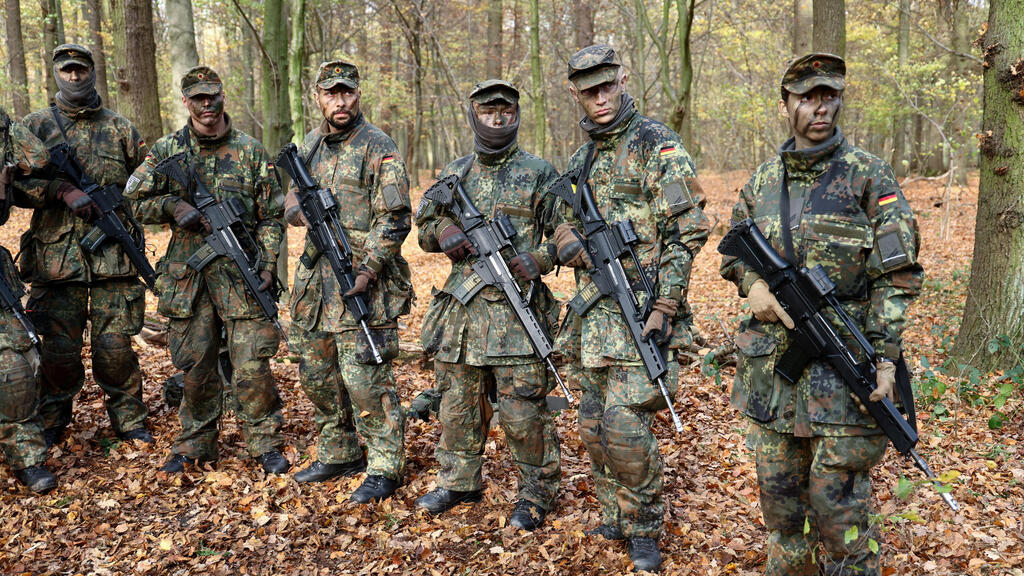
German soldiers
(Photo: REUTERS/Leon Kuegeler)
At the same time, German society presents a sharply different picture. In December, protests were held in 90 cities across Germany against the return of compulsory military service, drawing hundreds of thousands of young participants. In some cases, extreme statements were heard, including expressions of preference to live under Russian President Vladimir Putin rather than serve in the army.
The protests reflect a deep gap between leadership, which perceives a changing strategic environment, and a public shaped by 80 years of the assumption that large-scale wars are no longer part of European reality. Within this gap, Germany is rearming at an unprecedented pace, including the purchase of advanced systems from Israel. The procurement budget has recently been doubled to more than 20 billion shekels, with initial Iron Dome systems delivered in December.
The shift is particularly striking given that only a few years ago, German soldiers trained with broomsticks simulating machine guns — a symbol of longstanding neglect rooted in the assumption that war would not return.
The broader European picture reveals additional challenges, particularly regarding manpower quality. In recent decades, military service has ceased to be a path for social elites in many countries, becoming the choice of narrower segments of society. This shift is now evident as armies are required to expand rapidly. Reports last week revealed that 175 sailors in Britain’s nuclear submarine fleet failed drug tests over time, including for cocaine and heroin, with some serving in highly sensitive deterrence roles. Analysts say this is not an isolated incident but a symptom of deeper erosion.
Against this backdrop, France’s military chief recently warned that Europe may have to sacrifice its sons and daughters in a potential conflict with Russia — a statement that sparked media backlash rather than substantive debate.
A parallel political shift is also underway. Germany’s far-right AfD party, which has grown to represent nearly a quarter of the public and includes elements accused of antisemitism, continues to gain strength. Its influence extends beyond Germany, contributing to European Parliament decisions such as advancing measures to deport undocumented migrants and establish detention facilities.
At the same time, German Chancellor Friedrich Merz hosted Syria’s new president, Ahmed al-Sharaa, in Berlin this week, where discussions included the possible return of refugees under the premise that Syria has become “safer” — another sign of Europe’s changing direction.
Externally, NATO Secretary-General Mark Rutte warned as early as 2025 that Russia could invade Europe by 2030. In light of recent developments in the Middle East and tensions involving Iran, as well as frictions between NATO and US President Donald Trump, those timelines may be shortening. Trump has also suggested the United States could withdraw from NATO. While US law requires congressional approval, as commander in chief the president has significant authority to reduce troop deployments.
 Dr. Kobby Barda Photo: Tal Givony
With roughly 45,000 US troops stationed in Germany, any reduction would directly affect one of the pillars of European security since World War II. Taken together, these developments suggest Europe is entering an accelerated phase of rearmament, border tightening and shifting security doctrines, while its civilian society still operates under assumptions from an era when war was not seen as a realistic possibility.
In a short period, Europe appears to be transforming from a continent that believed war was behind it into one that is once again preparing for it.
Dr. Kobby Barda, HIT Holon Institute of Technology and senior researcher at the Jewish People Policy Institute (JPPI)