


The issue of Iran’s remaining enriched uranium — about 440 kilograms enriched to 60% — is a major concern for both the United States and Israel. Enriching this material to the 90% level required for a nuclear weapon is relatively quick, and within weeks, Iran could produce enough fissile cores for up to 11 nuclear bombs. With additional effort, it could potentially assemble an actual weapon, not just the core. This stockpile, along with the potential closure of the Strait of Hormuz, is among the top concerns in Washington and Jerusalem.
According to the International Atomic Energy Agency, the uranium is stored deep underground in tunnels at two nuclear sites targeted by the United States during last year’s 12-day war: Isfahan and Natanz. It may also be present at Fordo, though that remains uncertain.
The video Trump posted overnight, which a US official said shows a series of explosions in Isfahan


Gallery
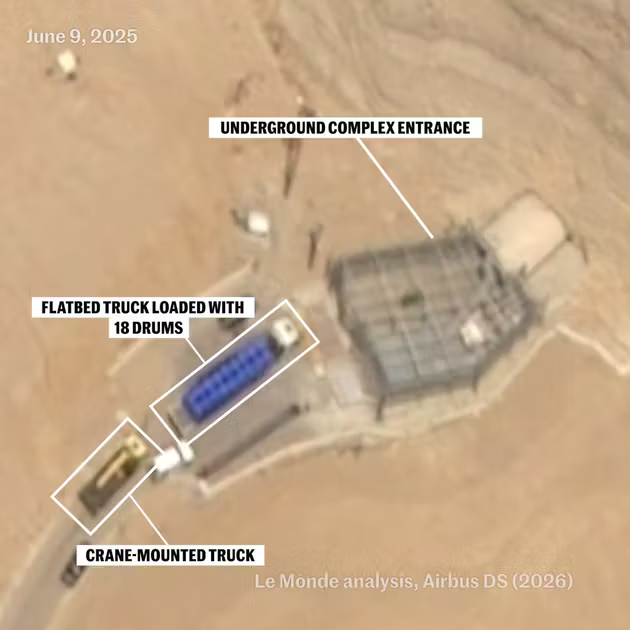
The truck carrying 18 blue containers entering the Isfahan facility, days before the June 2025 Operation Rising Lion
(Photo: AIRBUS DS (2026))
Over the weekend, the French newspaper Le Monde published a satellite image taken on June 9, 2025 — days before the opening strike of Operation Rising Lion on June 13 — showing a truck carrying 18 blue containers entering a tunnel at the Isfahan nuclear facility. Experts cited by the newspaper said that while it cannot be confirmed the containers held 60% enriched uranium, it is likely evidence that Iran moved a significant portion — possibly all — of the material deep underground at the site in preparation for Israeli and U.S. strikes. The IAEA has recently assessed that roughly half of the enriched uranium is stored in Isfahan.
In recent days, there has been discussion of a possible ground operation to extract the material from Iran, or alternatively, a negotiated agreement under which Iran would transfer it abroad. U.S. President Donald Trump said Monday that Iran should “give us the nuclear dust.” However, Iran has so far refused such terms, and a ground operation would be highly complex and dangerous. It would require more than 1,000 troops on the ground, the construction of airstrips at sites like Natanz and Isfahan to supply forces, and the use of heavy engineering equipment to access sealed tunnels. Such an operation would likely involve casualties and take considerable time.
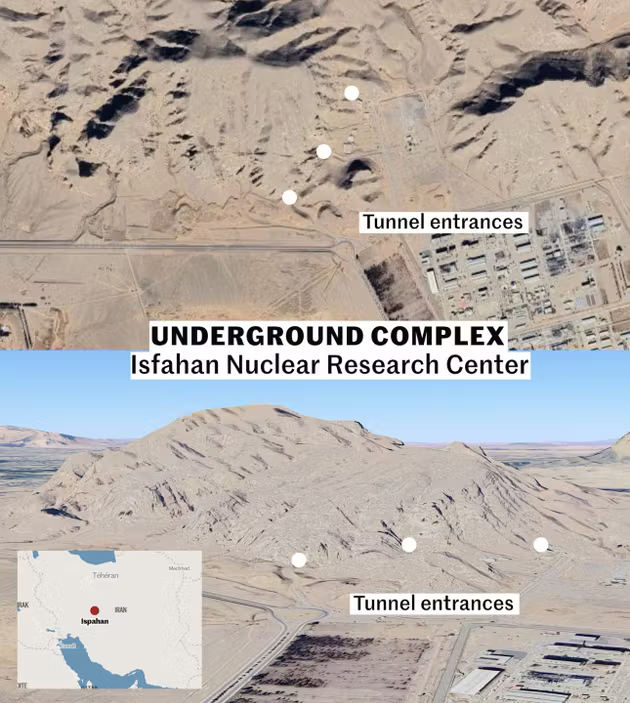
Entrance tunnels to the underground facility in Isfahan
(Photo: AIRBUS DS (2026))
An alternative approach is to neutralize the material by effectively burying it — making it inaccessible and requiring at least a year for Iran to locate and retrieve it, giving the United States and Israel time to detect and disrupt such efforts. The enriched uranium, stored in lead containers holding 10 to 20 kilograms each, can be rendered inaccessible by bombing the surrounding area, blocking all access points and tunnels.
It can be assessed with reasonable confidence that the United States has chosen this approach — burying the material rather than attempting a ground extraction or relying on Iranian cooperation. At Natanz, U.S. forces struck the area surrounding the uranium storage site earlier this month, and similar strikes were likely carried out overnight in Isfahan.
In Isfahan, what was described as a large ammunition depot was targeted. A U.S. official told The Wall Street Journal that a “large number” of 2,000-pound bunker-busting bombs were used. Trump posted a video on his Truth Social platform showing a series of explosions but did not provide details; the official said the footage captured the strike in Isfahan.
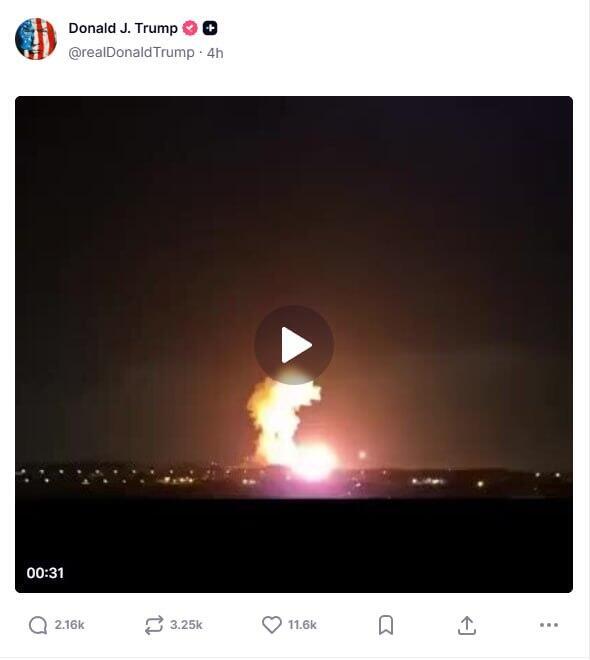
Trump posted the video without any explanation
It appears the United States took care not to disperse or directly hit the enriched uranium itself, in part to avoid creating radioactive contamination in nearby areas. Instead, the strikes targeted surrounding infrastructure, sealing off tunnels and access routes, leaving the uranium buried beneath more than 100 meters of rock.
As with the earlier strike on Natanz, Iran’s claim at the time that there was no radioactive contamination suggested that the goal was not to destroy the uranium, but to entomb it under layers of rock, soil and concrete.
Trump on the enriched uranium
Most importantly, U.S. operational activity indicates a decision to bury the enriched material rather than attempt a prolonged and risky ground operation that would require a sustained American military presence inside Iran.
It is likely no coincidence that Trump chose to publish footage showing explosions around the facility — highlighting this strategy.