

The French have grown used to it: No respectable demonstration seems to end without bus stops, garbage bins and cars being set on fire. Even so, the scenes from the riots in France have shocked even veterans of the barricades of 1968.
A French business owners' organization reported that 1,500 businesses had been attacked, with damage currently estimated at several hundred million euros. That damage will add to France's enormous deficit, which helped fuel protests over the cost of living. Those demonstrations merged with high school students' protests over the deteriorating state of the French education system. A chain reaction, French style. And we are only at the end of the first weekend.
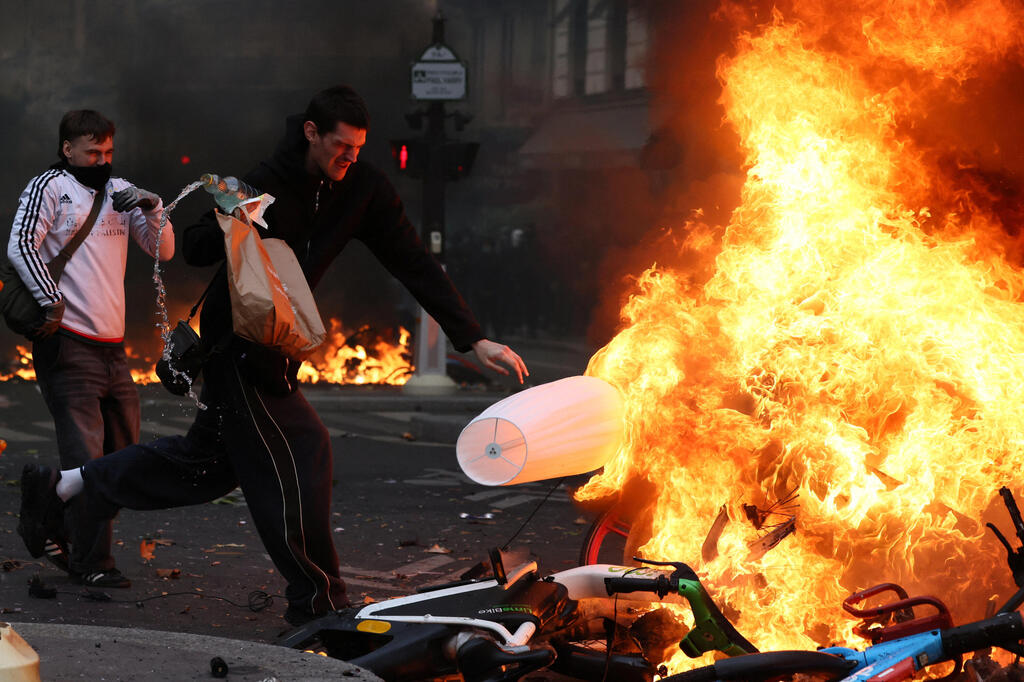
Protest in Paris
(Photo: REUTERS/Jack Taylor)
More than 500 members of the security forces were injured, 2,400 people were arrested, and buildings damaged included schools, a tourist office and the historic City Hall in Limoges. Only 250 cars were burned this time, compared with the usual 800 to 1,200 vehicles set ablaze on New Year's Eve. And this is only the beginning.
That is precisely the French government's greatest fear. The high school students' demonstrations and street blockades earlier this month were the first warning sign, suppressed, in the view of many French people, with excessive force. But the transformation of those demonstrations into protests against the cost of living, and the arrival of the Yellow Vests, brought back historical images of the storming of the Bastille and the barricades depicted in Les Misérables.
This was exactly the impression the organizers wanted to create: well-fed, spoiled students from elite universities joining the high school students in solidarity while seeking to relive the excitement of the 1960s. At the same time, far-left activists from the France Unbowed party (LFI) are pushing for chaos, hoping that thousands of people disillusioned with the Macron government's economic policies will move into their camp.
They want to portray themselves as people who will fight to the bitter end, supposedly for the good of the people, while in practice ignoring France's dire economic situation, with the largest deficit in Europe, and putting the entire European Union's economic system at risk.
The demonstrations appear likely to continue, threatening the economy, tourism, the luxury industry, one of France's most important engines of growth, and democracy across the European Union, which is increasingly leaning toward the nationalist right.
‘A threat to democracy’
If the National Rally wins the next presidential election, scheduled for late April and early May 2027, Marine Le Pen could become the leader of one of Europe's most powerful countries, alongside Germany, and dramatically influence European politics. Le Pen herself has already declared that the demonstrations are "a threat to democracy." She is unlikely to support Ukraine.
French President Emmanuel Macron addressed the public, saying: "We have elections in six months. France is a great democratic power. Don't let anyone undermine the debate ahead of the elections or steal it from you. The debates should not take place in the streets, but at campaign rallies, party discussions and television studios. We deserve a beautiful election."
This may not be the main reason for the unrest, but the theory of Russian-generated agitation on social media, aimed at appealing to disillusioned Europeans, cannot be entirely dismissed. Macron convened party leaders at the end of September and warned them of physical and online attacks by the Russians. He repeated the warning three days ago at a meeting of European Union leaders in Brussels.
A weakened France benefits Vladimir Putin because France is at the forefront of support for Ukraine. The more French citizens protest their economic situation and question why money is being directed toward Ukraine, the easier it will be for Putin to threaten the rest of the continent.
Jean-Luc Mélenchon, the far-left leader who has fanned the flames, declared: "You cannot call for an end to violence while at the same time making excuses for those who cause it." On Sunday evening, he accused Macron of "playing for time until the atmosphere in France rots," which is precisely the outcome he himself is pursuing.
Mélenchon is no knight in shining armor. He is an agent of chaos whose hubris will ultimately bring the nationalist right to power.
Who are the rioters, and what do they want?
The issue is more complicated than it initially appears. The student protest began online and was apparently spontaneous. It may well have received support from France Unbowed (LFI).
The students are genuinely concerned about the poor condition of their schools and a teacher shortage estimated at no fewer than 300 professionals, even by the most optimistic assessment. Police suppressed the demonstrations with violent measures, as though the young protesters were veteran Yellow Vests. Hundreds of minors were arrested, two lost their hands after picking up smoke grenades, and another protester lost an eye on Saturday.
The anger of their families, along with a partial apology from Interior Minister Laurent Nuñez, gave the Yellow Vests legitimacy to join the protest against the cost of living. It is fair to say they stole the demonstrations from the young people. The protest has grown, but it is no longer focused on supporting the education system.
The interior minister has already submitted his resignation to the president, but Macron refused to accept it.
Whenever riots spread and spiral out of control, as happened in 2019 and 2023, the question arises: Why are the security forces unable to prevent the situation from deteriorating?
The easy answer is that security forces have been on maximum alert for many months and that the unrest is spreading with considerable force even to smaller cities, where insufficient personnel have been deployed.
The second answer is that Macron's government is nearing the end of its time in office, and nobody is making much of an effort on any issue. The long summer vacation is just around the corner.
The third answer can be drawn from past experience: France has a strong democratic tradition, and an excessively heavy-handed response to demonstrators is considered a betrayal of democracy. Suppressing riots is legitimate, but what happens when the situation deteriorates from the very beginning? Does restoring order, by almost any means necessary, then become legitimate?
That is exactly what Marine Le Pen and the National Rally promise, as does Bruno Retailleau, the hard-right candidate of the Republicans. This is no coincidence, but a cynical exploitation of public anger over the cost of living.
The rioters came prepared. They wore masks and gloves and had decided in advance which shops to loot. In Paris, it has become customary to protect shop windows around the Champs-Élysées with heavy wooden boards, but other cities were not expecting a wave of violence on this scale.
Stealing computers, armchairs and luxury clothing is a business in itself. Many of the looters are people who profit from chaos. They had identified in advance the items they wanted to steal. Witnesses describe young people shouting, "Let's go to Sephora for perfumes," or "Come on, let's grab some coats."
This is where the road to meaningless chaos begins, branching into social unrest that will be decided in what promises to be a dramatic election.
These are not only immigrants or second-generation residents of the suburbs expressing their frustration. They also include otherwise ordinary citizens who refuse to be taken for fools. They want revenge against those they see as symbols of France's wealthy elite, whom they accuse of not paying enough taxes: Louis Vuitton, Dior and Chanel, as well as Apple and Samsung.
And what about the Palestinian flags?
Those waving Palestinian flags are not only Muslim immigrants to France. They also include young French people who are fed up with the images coming out of Gaza and the Palestinian territories. Some do not understand the complexities of the situation in the Middle East, but want to be on the right side of history.
This is not merely the result of failed Israeli public diplomacy. It reflects genuine disagreement with Israeli policy, and that sentiment is spreading across Europe. The Palestinian flag has become a permanent feature of demonstrations because, in the protesters' eyes, it symbolizes opposition to injustice, including injustice in France.
The boundaries between antisemitism and legitimate criticism of Israel have long been blurred. A synagogue in Paris's 19th arrondissement was found ransacked on Sunday.
Paul Amar, a journalist with the right-wing CNews channel, claims that rioters in Marseille had lists of Jewish-owned businesses, which they targeted while leaving other businesses untouched. There is no evidence to support that theory. Nevertheless, given the temporary breakdown of law and order, there is little doubt that racism and antisemitism could find fertile ground.
Weather forecast: The storm is still ahead
The next demonstration will be more violent and will be suppressed with harsher measures. Afterward, ordinary protesters will be afraid to take to the streets. And so it will continue until the next round and the dramatic presidential election.
This is a preview of what could happen across Europe, unless the French come down from the barricades and understand that life is not a musical version of Les Misérables.