

During Operation Roaring Lion, Israel, in unprecedented cooperation with the United States, demonstrated impressive intelligence, operational and technological capabilities that enabled it to achieve significant gains. These included decapitating the senior Iranian leadership, attaining aerial and intelligence superiority, damaging missile arrays, partially disrupting command-and-control systems and inflicting heavy damage on defense industries.
Nevertheless, the war ended with a sense of missed opportunity, stemming primarily from the fact that the campaign’s three central objectives—regime change, destruction of the nuclear program and severe damage to the missile array—were either not achieved or only partially realized.
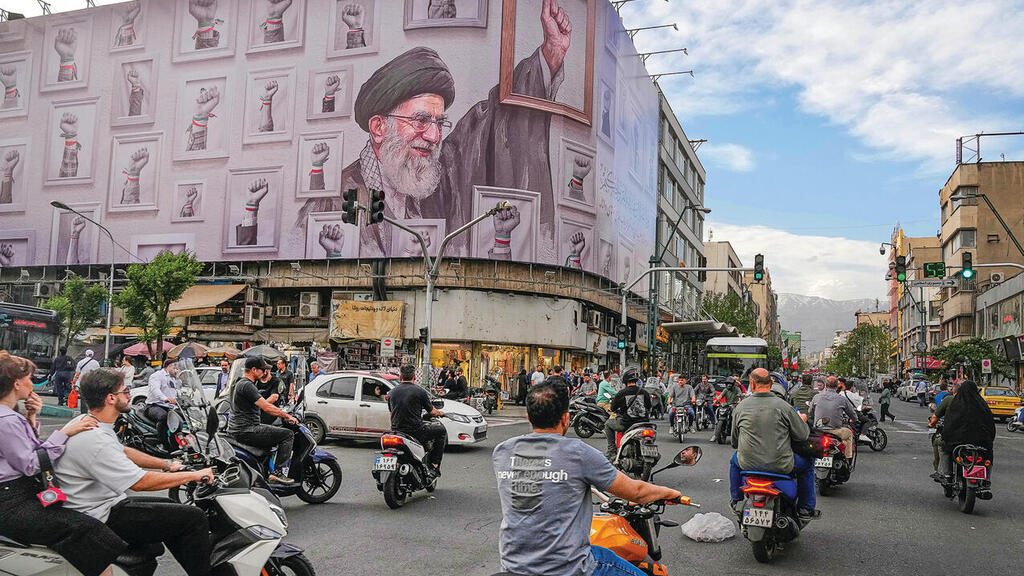
Khamenei Is gone, but his legacy still looms over Iran
(Photo: Vahid Salemi, AP)
What went wrong? The first failure lies in the dynamics of entering the war. Shortly after it broke out, Defense Minister Israel Katz declared that Israel had originally planned to initiate a campaign against Iran in the summer of 2026. This was intended to counter Iran's efforts to rebuild its missile array following Operation Rising Lion. However, the outbreak of widespread public protests in Iran in December 2025 and their brutal suppression in January 2026, together with President Trump’s declaration of his intention to assist the Iranian people, created a window of opportunity that Israel seized in order to join forces with the United States in pursuit of objectives far more ambitious than those originally planned. The result was a transition from a carefully planned war to a campaign unfolding under severe time constraints, conditions of uncertainty and gaps between the political and military echelons in both countries.
One of the central failures was the underestimation of the Iranian regime’s resilience. According to sources cited by The New York Times in late March 2026, Prime Minister Benjamin Netanyahu adopted the Mossad's assessments regarding the possibility of a regime collapse by encouraging the opposition and igniting riots. The President of the United States, influenced by the success of the military operation to abduct Venezuelan President Nicolás Maduro in a covert January 2026 raid carried out by American special forces, was likewise convinced that toppling the regime was possible.
However, it appears that both Israel and the United States overestimated their ability to execute these operational plans, which included an invasion by Kurdish separatist groups from northern Iraq and positioning former president Mahmoud Ahmadinejad as leader, while underestimating the durability of the Iranian system itself. Once again, the regime proved to be an institutionalized, multilayered and resilient system, capable of maintaining functional continuity even under severe damage to its senior leadership and chains of command and control.
The regime adapted quickly and consolidated a new collective leadership under the direction of Mojtaba Khamenei. At the same time, damage to national infrastructure, the encouragement of separatist tendencies among minority groups which heightened fears of the fragmentation of the Iranian state, and President Trump’s inflammatory statements regarding his intention to “destroy Iranian civilization” all helped the regime rally broad segments of the public, including many of its critics, around feelings of nationalism and patriotism.
A gap between political objectives and military objectives
The war exposed a significant gap between the objectives defined by the political echelon and the capabilities and operational logic of the military leadership. While the political echelon entered the war with highly ambitious goals, chief among them regime change, the military focused on degrading capabilities and creating conditions for future political change. This disconnect created a lack of coherence between the political vision and the military plans.
The core assumption that economic pressure would lead to the collapse of the regime, or at the very least compel it to surrender to American dictates, proved to be limited. It failed to account for the regime’s ideological dimensions and for the fact that it viewed the campaign as an existential struggle. Even under severe pressure, including the ongoing naval blockade, the leadership in Tehran assessed that relinquishing strategic assets—such as nuclear capabilities and control over the Strait of Hormuz—would not only deprive it of the ability to achieve economic and security guarantees at the end of the campaign, but would also weaken it to such an extent that the United States and Israel could exploit its vulnerability to strike again in the future.
While economic considerations were factored in by the regime, it is evident that it is willing to bear incredibly heavy costs—particularly when it assesses that the price of strategic concessions could be far more severe than the economic toll.
While economic considerations were factored in by the regime, it is evident that it is willing to bear incredibly heavy costs—particularly when it assesses that the price of strategic concessions could be far more severe than the economic toll. In addition, the regime estimated that the international system’s threshold for enduring the economic consequences of closing the Strait of Hormuz was lower than Iran’s own threshold, and that ultimately President Trump would be forced to “blink” first.
The possibility of renewed protests was likewise not perceived as a decisive threat, given the regime’s assessment that it would retain the ability to suppress them yet again. Although it is difficult to assess what the long-term impact of a continued naval blockade might have been on Tehran's decision-making processes, it is highly doubtful that even a further deterioration of the economic situation would have convinced the regime to agree to concessions it viewed as total surrender to the United States—even at the cost of its citizens' suffering.
The maritime surprise
Even if the actual closure of the Strait of Hormuz was not an intelligence surprise—given that Iran had repeatedly threatened to take this step in a military conflict scenario with the United States—the timing of the closure in the opening stages of the war, and its execution via the deployment of moored mines along shipping lanes rather than just firing missiles and drones at tankers, provided Iran with global leverage independent of its military capabilities. As a result, the United States—and consequently Israel—was forced to alter its wartime priorities. Instead of continuing military pressure to achieve more significant operational gains against the missile and nuclear programs, a large portion of the American effort (including within negotiations with Iran) was redirected toward reopening the Strait to stabilize the global energy market and trade.
Realizing some of the war's objectives, primarily inflicting significant damage on nuclear capabilities, required a substantial ground operation to deeply penetrate fortified nuclear facilities and extract enriched uranium. However, the operational plan to destroy the nuclear project was ultimately not implemented, likely due to concerns within the political echelon regarding heavy casualties and soldiers being taken captive. The result was a relatively "clean" but limited campaign in terms of its ability to achieve certain goals. Operational plans that could have helped resolve the crisis in the Strait of Hormuz were also shelved due to the risks involved.
At this stage, the Iranian regime does not appear likely to collapse in the short term. Even if the leadership lacks the capability to resolve the country’s economic crises and water and electricity shortages, there is currently no indication of an immediate threat to the regime’s stability or to its capacity to cope with future protests.
What has changed, and what has not? At this stage, the Iranian regime does not appear likely to collapse in the short term. Even if the leadership lacks the capability to resolve the country’s economic crises and water and electricity shortages, there is currently no indication of an immediate threat to the regime’s stability or to its capacity to cope with future protests. The regime maintains internal cohesion and significant control capabilities. Although the decline of the Islamic Republic may ultimately lead to the desired political change—the timing of which cannot be predicted—the strategy toward Iran cannot assume such a change in the foreseeable future.
The new leadership, headed by Mojtaba Khamenei and the Islamic Revolutionary Guard Corps, is expected to maintain a rigid and defiant ideological line, at least on par with the one that characterized the era of Ali Khamenei. Statements by senior Iranian officials on core issues—including relations with the United States and Israel, support for the pro-Iranian regional axis (“the Axis of Resistance”), and the preservation of strategic nuclear and missile capabilities—leave little room for doubt regarding the leadership’s refusal to retreat from its foundational principles.
Rebuilding capabilities at home and abroad
Efforts to rehabilitate the missile array, which began during the ceasefire, clearly indicate Tehran’s intention to continue developing its strategic military capabilities despite the blows it sustained and its resource constraints. The same is true with regard to the rehabilitation of its regional proxies, foremost among them Hezbollah. From the perspective of the Iranian regime, Operation Roaring Lion once again demonstrated the importance of the “unification of the fronts” doctrine, despite the weakening of the pro-Iranian axis in recent years. It can be assumed that despite the limitations facing Iran, Hezbollah and the other components of the axis, the Islamic Republic will continue its efforts to rebuild the regional network it spent years constructing.
The war also strengthened voices within Iran arguing that it is no longer sufficient to maintain the status of a nuclear threshold state and that Iran should instead strive to achieve ultimate deterrence through nuclear weapons. This does not necessarily mean that Iran will rush to develop nuclear weapons, particularly given the risks involved. Nevertheless, it is clear that the motivation to do so has increased. At the same time, although the nuclear program sustained severe damage during Operation Rising Lion, which delayed breakout time for fissile material, Iran's remaining nuclear capabilities continue to provide it with the ability to develop a nuclear bomb.
The damage to the nuclear infrastructure may lead to changes in the characteristics of the nuclear program: from a broad industrial model to a more limited yet advanced one; from a relatively overt project based primarily on extensive civilian enrichment capabilities to a covert campaign; from an emphasis on enrichment activities toward progress in weaponization (the development of nuclear weapons); and from slow and cautious advancement to rapid progress, even at the cost of assuming certain risks.
At this stage, there is considerable doubt regarding the ability to block Iran’s path to nuclear weapons through a diplomatic agreement between Iran and the United States.
At this stage, there is considerable doubt regarding the ability to block Iran’s path to nuclear weapons through a diplomatic agreement between Iran and the United States. Even if an agreement is reached that provides some response in the areas of long-term suspension of uranium enrichment, the handling of uranium enriched to high levels (20% and 60%) through its removal from Iran or dilution to lower levels, and the restoration of monitoring by the International Atomic Energy Agency (IAEA) to Iran, such steps would not completely block Iran’s path to nuclear weapons. This is due to the capabilities that would remain in its hands, including stockpiles of uranium enriched to lower levels, a broad array of advanced centrifuges, and underground infrastructure—including facilities damaged during Operation Rising Lion and those that remained untouched or were rehabilitated after the campaign, such as “Pickaxe Mountain.”
Israel must also consider that the erosion of its diplomatic standing in the United States, stemming from the perception that it dragged the American administration into war on the basis of flawed assumptions, as well as from its complete identification with the Trump administration, could limit its future freedom of action vis-à-vis Iran. Possible political changes in the United States in the coming years, or shifts in American priorities in the international arena, may further intensify this trend.
What comes next?
The failure of efforts to bring about political change despite ambitious operational plans, decapitation operations targeting the Iranian leadership, and campaigns aimed at eroding the regime’s internal security forces demands a reassessment of the feasibility of promoting change in Iran through foreign intervention, and all the more so through a military campaign. This does not mean that there is no need to continue efforts to weaken the regime along two primary tracks.
First, diplomatic, economic and cognitive efforts, including the international arena, aimed at weakening the regime over time. Second, the development of tools that could assist forces of change inside Iran in the event of a resurgence of anti-regime protests—for example, means of bypassing internet restrictions, aid funds and support for protesters, strengthening civil society institutions and developing cyber and influence capabilities that could, “on judgment day,” disrupt the ability of Iranian security forces to suppress demonstrators effectively.
However, it must be recognized that the ability to drive internal processes of change in Iran from the outside is highly limited and will not necessarily mature into a change of governance. Furthermore, it is time to abandon the notion that one can rely on secular, pro-Western and pro-Israeli diaspora groups and organizations seeking revolutionary change in Iran to actually bring about such a transition. Regime change depends primarily on the ability of the Iranians themselves to produce an effective alternative government—despite the significant hurdles they face—by forging a broad, nationwide coalition of sectors holding diverse and even conflicting views.
Israel cannot afford to conduct repeated rounds of warfare against Iran at high frequency. Such campaigns significantly disrupt its economy and demand aerial and intelligence superiority, as well as American assistance, neither of which are guaranteed to remain at its disposal in the future.
Israel will find it difficult to reconcile itself to a reality in which the Islamic Republic, committed to its destruction, possesses an arsenal of thousands of ballistic missiles capable of striking it. At the same time, Israel cannot afford to conduct repeated rounds of warfare against Iran at high frequency. Such campaigns significantly disrupt its economy and demand aerial and intelligence superiority, as well as American assistance, neither of which are guaranteed to remain at its disposal in the future.
Consequently, Israel must re-evaluate its red lines. Crossing these lines would trigger military action based on the severity of the threat—both quantitatively (the number of missiles and launchers, and the rate of production) and qualitatively (missile types and precision capabilities). This calculus must align with the IDF's interception capabilities and factor in the wider implications of such operations on Israel’s economy, society and foreign relations. Concurrently, Israel must develop alternative tools, including covert capabilities, to disrupt or delay Iran's ability to rebuild its missile array, while continuing to develop enhanced capabilities to counter the missile threat, particularly in the fields of air defense and underground warfare operations.
Israel cannot reconcile itself with the development of nuclear weapons by Iran. Regime change cannot be relied upon to solve the nuclear issue, and it is highly doubtful that Iran's path to nuclear weapons can be blocked over the long term solely through a diplomatic arrangement—especially given the significant advancements Iran has achieved in the fields of nuclear knowledge and technology. Consequently, it can be assessed that for the foreseeable future, a way must be found to ensure that Iran does not renew its efforts in either uranium enrichment or weaponization. This must be accomplished through a combination of diplomatic arrangements that minimize Iran's nuclear capabilities as much as possible and restore IAEA monitoring in Iran—and perhaps even expand it to additional sites; close and continuous intelligence surveillance; and the preparation of military capabilities to intervene should any evidence of renewed nuclear activity emerge.
The need for diplomatic arrangements is highlighted by the fear that it will not be possible to guarantee airtight intelligence capabilities over the long term that would provide a deterrent against renewed Iranian nuclear efforts.
The need for diplomatic arrangements—similar to arms control models from the Cold War era, including those promoted by President Ronald Reagan during the final decade of the Soviet Union's existence—is highlighted by the fear that it will not be possible to guarantee airtight intelligence capabilities over the long term that would provide a deterrent against renewed Iranian nuclear efforts, as well as by potential constraints on exercising military options in the future. Therefore, efforts toward a diplomatic arrangement—even a partial one—should be supported, even if this means certain economic concessions to the regime. Since a collapse of the regime cannot be guaranteed to occur before it can acquire nuclear weapons, the correct balance must be struck between diplomatic agreements and the continued application of pressure on Iran, alongside ongoing preparation against Iranian attempts to break out to a nuclear weapon.
Ultimately, the lessons of Operation Rising Lion and Operation Roaring Lion demonstrate that, despite the impressive operational successes of two of the strongest militaries in the world, no satisfactory permanent solution to the Iranian challenge has been found Consequently, a reassessment is required in the face of the Iranian threat—one that factors in the need to combine military, diplomatic, economic and covert tools in an ongoing campaign; to define realistic goals regarding Iran; and to recognize the limits of power, alongside the inability to reconcile with the Islamic Republic’s acquisition of military capabilities that pose a strategic threat to Israel’s security.
- Dr. Raz Zimmt is Director of the Iran and the Shi'ite Axis Program at the Institute for National Security Studies (INSS).