

The 38th anniversary of the adoption of UN Security Council Resolution 598, which ended the Iran-Iraq War, has sparked a lively public debate in Iran. Many see similarities between the circumstances in which the leader of the revolution, Ayatollah Ruhollah Khomeini, decided to accept a ceasefire with Iraq on July 18, 1988, and the current confrontation with the United States.
This debate also reflects the internal dispute in Iran between pragmatists and radicals amid the renewed escalation between Iran and the United States.
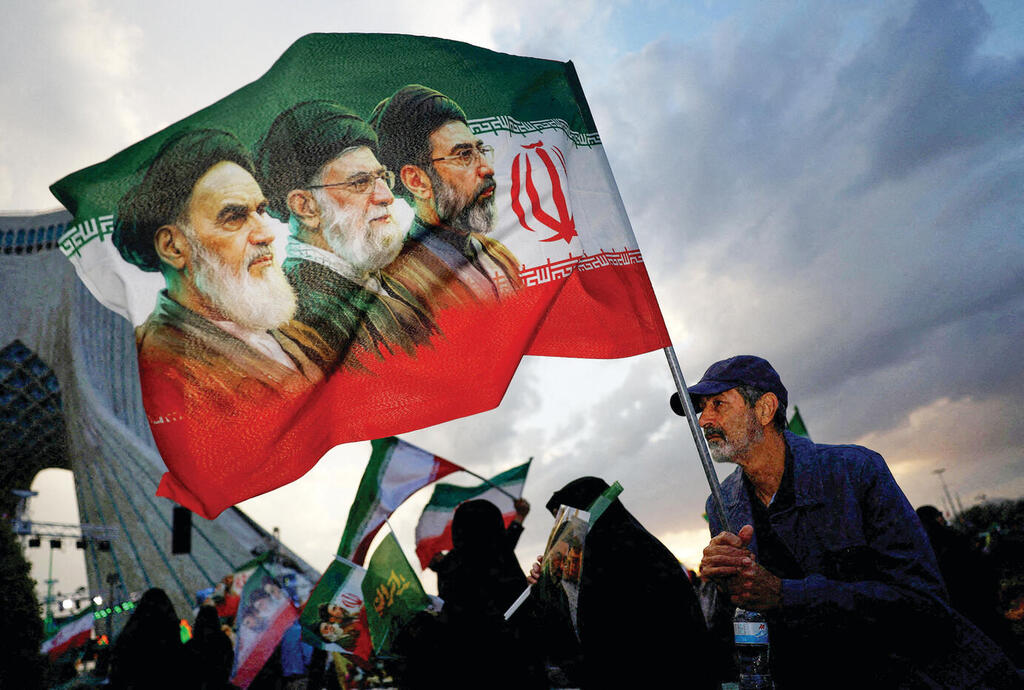
Not just missiles: Iran’s supreme leaders through the years
(Photo: Majid-Asgaripour, via REUTERS)
A battle over the future of the region
The pragmatic camp views the acceptance of the resolution as an expression of responsible leadership that placed long-term national interests above adherence to ideals and slogans. According to this view, Khomeini understood that continuing the war would lead to military, economic and social deterioration, given the international support for Iraq, the weakening of the Iranian home front and the risk of direct American intervention.
This is also the lesson for the present: Diplomacy should be used as an instrument of power, it must be understood that not all objectives can be achieved, and it is sometimes better to settle for partial gains than to be dragged into a war of attrition.
Reformist journalist and political activist Ahmad Zeidabadi argued that when Khomeini concluded that continuing the eight-year war no longer served the country’s interests, he took sole responsibility and agreed to “drink the poisoned chalice,” as he put it, despite his previous insistence that the war continue until Saddam Hussein was overthrown.
The radical camp, by contrast, rejects any analogy between 1988 and the present. Its members argue that Resolution 598 was accepted because Iran was incapable of confronting the United States after the war expanded into the Persian Gulf, while today the reality is the opposite: Iran has the ability to fight across the region, strike American forces and challenge freedom of navigation in the Strait of Hormuz.
Therefore, they argue, there is no place for “drinking the poisoned chalice” again, and calls for political compromise even serve the enemy.
Political activist and media figure Vahid Yaminpour, for example, maintained that the Islamic Republic agreed to the ceasefire in 1988 because it was unable to confront the United States in the Persian Gulf. Today, the United States possesses far more advanced military technology than it did at the time, but it is incapable of opening a 30-kilometer-wide strait and moving even a single ship through it, while Iran has its hand around its throat in the strait in a battle over its own future and that of the region.
In any event, in light of the intensified American strikes in Iran and the disappointment over the collapse of the memorandum of understanding between Tehran and Washington, the Iranian leadership, despite internal disagreements, currently appears unwilling to make difficult and painful decisions similar to the one Khomeini made 38 years ago.
This approach reflects not only a sense of confidence and complete distrust of the American administration, but also recognition of the vital need to translate the gains Iran accumulated during the war, foremost among them its takeover of the Strait of Hormuz, into long-term security and economic guarantees. This is the case even at the cost of the risks involved in continuing the current escalation.
Military power alongside negotiations
Moreover, in the Iranian leadership’s view, there is not necessarily a contradiction between a fundamental willingness to negotiate an end to the war and firmly defending Iran’s essential rights and interests.
This perception was expressed in an article published by an Iranian news agency associated with figures in the Supreme National Security Council. The article stated that the anniversary of the adoption of Resolution 598 serves as a reminder of the birth of a strategic approach combining a willingness to use military power with diplomacy.
According to the site, the gravest strategic mistake is to view “war” and “peace” as two opposing and contradictory concepts, as though anyone who speaks of negotiations has distanced himself from resistance, and anyone who emphasizes military power has closed the door to dialogue.
A political system is measured not only by its ability to fight, but also by its ability to identify the right time to shift the arena of struggle. The decision to accept the ceasefire with Iraq was not the end of resistance, but its transfer from the military arena to the political and legal arenas. In the Iranian leadership’s view, there is not necessarily a contradiction between a fundamental willingness to negotiate an end to the war and firmly defending Iran’s essential rights and interests.
This historical experience is more relevant today than ever. In recent months, Iran has gone through a difficult war against the United States and the “Zionist regime,” which proved that the Islamic Republic does not hesitate to defend its sovereignty, security and independence, and that if war is imposed upon it, it will respond appropriately and decisively.
However, that same war also demonstrated that even the most successful military operations do not end the competition. After the weapons fall silent, the battle begins in other arenas: diplomacy, international law, economics, the media and public opinion.
Therefore, if during the war Iran’s missile power, defensive capabilities and national cohesion were its main assets, then in the postwar era, wise diplomacy, focused negotiations and political management will complement that power.
 Raz Zimmt
The most important message of the anniversary of the adoption of Resolution 598 for Iran today, the article concluded, is that courage is expressed not only in launching missiles or maintaining a presence on the battlefield, but also in a nation’s ability to know when it must fight and when it must negotiate, while in both situations refusing to retreat from one principle: preserving Iran, defending its independence and securing its national interests.
Dr. Raz Zimmt is director of the Iran and Shiite Axis Program at the Institute for National Security Studies