

The situation in northern Israel is unbearable. It is unbearable because a million Israeli civilians are living under a real threat to their lives, livelihoods and well-being. It is unbearable because the state placed them in this situation through an initiated military move without first ensuring their security.

In 1982, too, Israel crossed the Litani and captured Beaufort. The capture of Beaufort entered Israeli memory as a tragedy because of the death of Maj. Goni Hernik, commander of the Golani reconnaissance unit. It later settled into memory as farce after Prime Minister Menachem Begin visited the site.
“Did they have machine guns?” Begin asked, with an air of expertise. Machine guns? The soldiers around him struggled not to laugh, and the camera kept rolling.
Netanyahu and Katz will probably visit Beaufort as well and have their pictures taken there, protected on all sides by anti-drone nets. “We will expand and deepen our hold inside Lebanon,” Netanyahu will promise. We have been here too.
One of the sharper scenes in the Israeli comedy “Givat Halfon Eina Ona” brings together Victor Hasson, played by Shaike Levi, and the brigade commander.
“If the Egyptians come, what do you do?” the commander asks.
“What we did in ’56,” Hasson replies.
“What did you do in ’56?” the commander asks.
“What we did in ’48,” Hasson answers.
“What did you do in ’48?” the commander presses.
“Thirty years, who remembers?” Hasson says, ending the debrief.
In Lebanon, we are now doing what we did in ’82. If force does not work, use more force. That is the doctrine. Sometimes it works. Sometimes it does not. Sometimes it takes 18 bloody and futile years to understand that it does not.
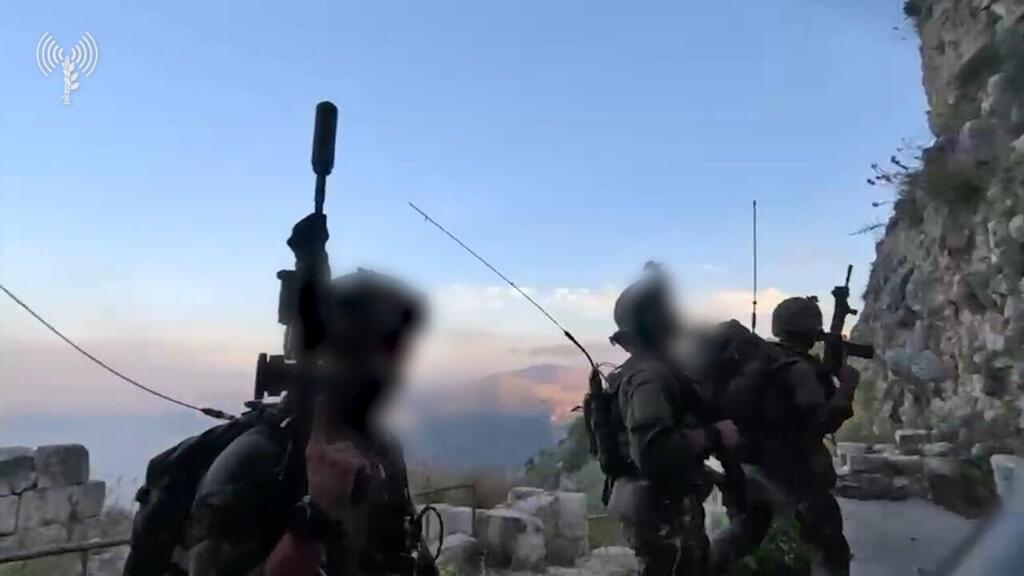
IDF forces capture Beaufort fortress
(Photo: IDF)
The offensive in Lebanon enjoys almost wall-to-wall support. It is not only the government and the top military brass that stand behind it, but also Naftali Bennett and Gadi Eisenkot, two potential candidates for prime minister from the opposition camp. In the posts they publish every day, they attack the government for not doing more. In their eyes, the government is too restrained, too considerate of American dictates. Give the IDF a free hand, they say. Advance north. Advance even into Beirut.
They are not alone. Channel 12, Israel’s tribal bonfire, demands to see Beirut burning. A day when smoke rises over Kiryat Shmona but not over Beirut is treated as an insult to national honor, a day of defeat.
I am not sure this patriotic fervor stems only from a deep analysis of strategic options. It is possible that Bennett and Eisenkot are pushing to expand the war because they think that is what a certain group of voters wants to hear. It is possible they are afraid that if they say one word of criticism about the offensive in Lebanon, they will be denounced as traitors, cowards or, worse, leftists. A similar message comes from television broadcasts. We have one tribal bonfire, and everyone wants to warm themselves by it.
Beaufort is the parable. The Crusader fortress on the Ali Taher ridge is not Masada. It is not Iwo Jima. The ridge has some military significance because it overlooks communities in the Galilee Panhandle. That was true in 1982. It is less true in 2026.
UAVs and drones can reach their targets without being guided by an observer standing on a mountaintop. What remains is the name, the symbol. It belongs more to the world of marketing than to the world of combat.
It is hard to see how taking control of more territory in Lebanon advances a solution to the drone and UAV problem. It is easier to see how it could sink into a prolonged deployment with many casualties.
The original plan for the offensive in Lebanon did not include Beaufort and did not include the Litani. The army was dragged there because of the difficulty of dealing with the drone problem and because of public pressure. Bennett, who views the territory captured in Lebanon as a temporary and useful bargaining chip for negotiations, forgets how hard it is for Israeli prime ministers to give up territory.
In other times, the army might have placed the expansion of the fighting opposite the unreasonable burden on reservists, opposite the erosion of the fighting army’s capabilities. But today, any such statement would put the chief of staff before a social media firing squad.
Wars are serious matters. They must not be handed over to the poison machine.