

Ever since I was a child, I have heard the same lines again and again. Whenever Arab leaders take the stage before an audience of men and women, they tell us: You are our partners, you are more than half of society, you are life itself. These are beautiful words, and sometimes sincere ones, but they have no real expression in practice.
We, Arab women, wage constant battles over our lives, our careers and our presence in the personal, public and political spheres — spaces we carry on our shoulders while paying a very heavy price — yet we remain almost entirely absent from centers of power.
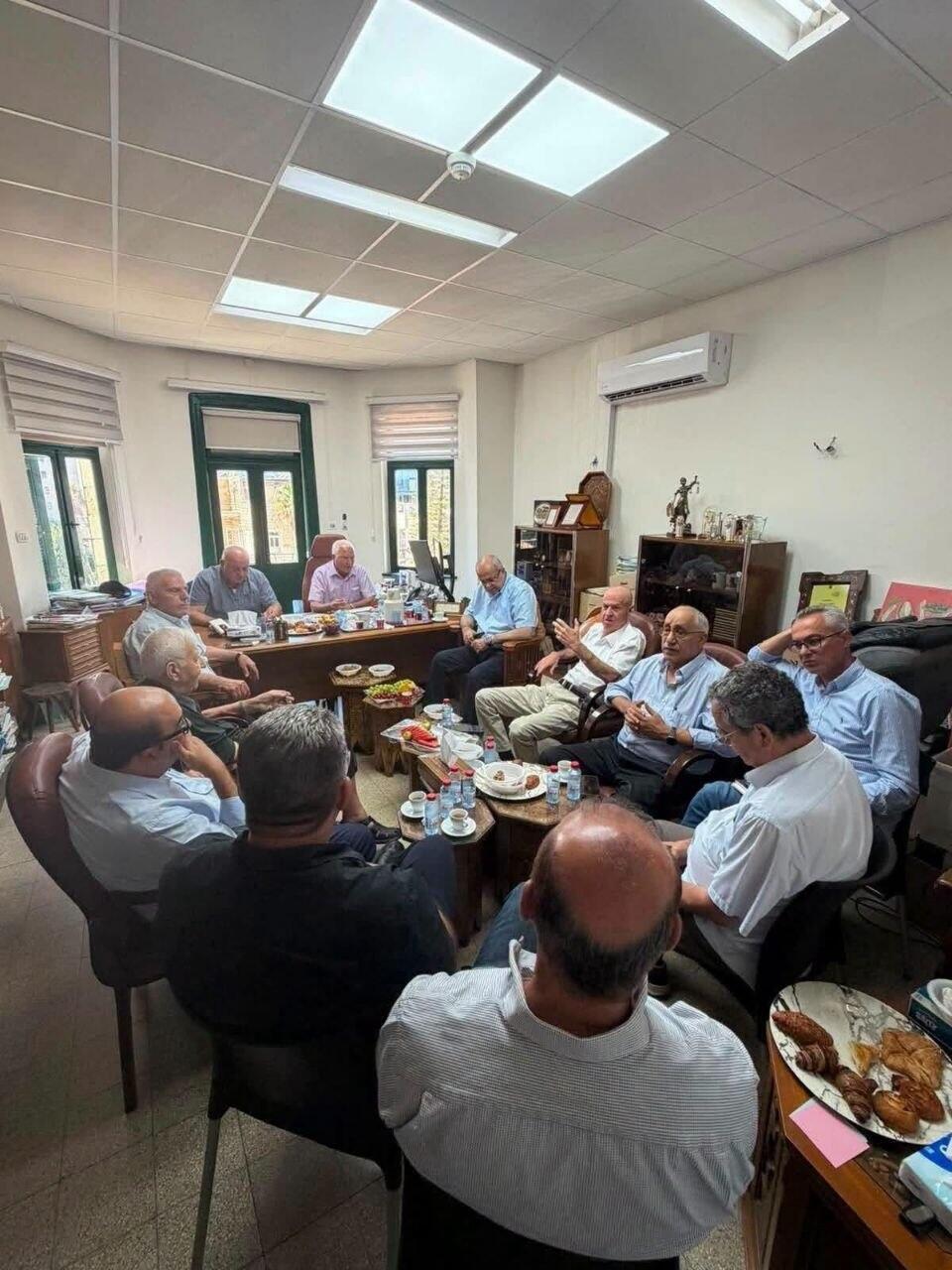
Joint List meeting
One image that illustrates this well is the current makeup of the Arab party slates in general and the Joint List in particular, where the first seven spots are held by men. The first woman, Dr. Maha Karkabi-Sabbah, appears only in eighth place. In Ra’am, the first three spots are held by men, while Knesset member Iman Khatib-Yassin is fourth, a realistic position according to the polls, unlike on the Joint List.
The Joint List did not create this exclusion from scratch. The parties came into negotiations with internal selection mechanisms that had already placed women behind men. When they merged the slates, they also merged their male hierarchies. The alliance solved the equation of how to divide seats among the parties, but it did not correct the inequality.
To be clear, the problem is not a shortage of worthy women. There is simply no correlation between their human capital, education and capabilities and their political representation. How is it possible that as a child I saw so few women in positions of influence, and that a girl today, at the age I was then, sees almost exactly the same picture?
Political parties are comfortable talking about women as an “electoral force.” During election campaigns, they turn to us and treat us as a bank of votes that needs to be mobilized — much as Jewish liberal parties do with Arab citizens as a whole. But once the votes are counted, the negotiating tables, appointments and distribution of power become male-dominated again. We are asked to share responsibility for the outcome without being genuine partners in shaping the path.
Arab women are also trapped in a unique political bind. In the current reality, many do not find a place in Jewish parties, which do not speak to their narrative, identity or pain. At the same time, the Arab parties, which are supposed to be their natural political home, do not give them an equal place in the leadership.
This is an example of what academic literature calls “intersectional exclusion”: exclusion as a minority in the broader public sphere and exclusion as women within the minority group itself.
I fully understand the political low point Arab society finds itself in and the importance of the coming election. I also understand the need for unity and for increasing Arab representation. But none of that can silence the discussion about equality.
The constant argument is that this is “not the time”: There is a war, a hostile government, rampant crime and a threat to Arab society’s very existence. Any woman who insists on talking about equality is portrayed as weakening unity or harming the national struggle. It is a mechanism of silencing and blame. In a society that has lived for decades in a state of emergency, “not now” effectively means “never.”
We, Arab women, are well aware of these mechanisms and of the gravity of this moment. We will do everything in our power to encourage voting, increase Arab representation and stop fascism and incitement.
There is no convenient time to address the absence of women from centers of power. A society cannot move forward unless its women are at the forefront of that progress, as full partners with equal opportunities and real power in decision-making.
As long as women are expected to save the Joint List at the ballot box but are not partners in its leadership, the Joint List is not truly joint.