

For now, it is unclear whether the Arab League, made up of 22 Arab states and the Palestinian Authority, which holds full membership status, will convene for its scheduled session on May 17 in Baghdad.
Alongside discussions on the “state of the Arab nation” following the war with Iran, the gathering is expected to include a farewell event for the current secretary-general, Ahmed Aboul Gheit, who will step down in June after a decade in office.
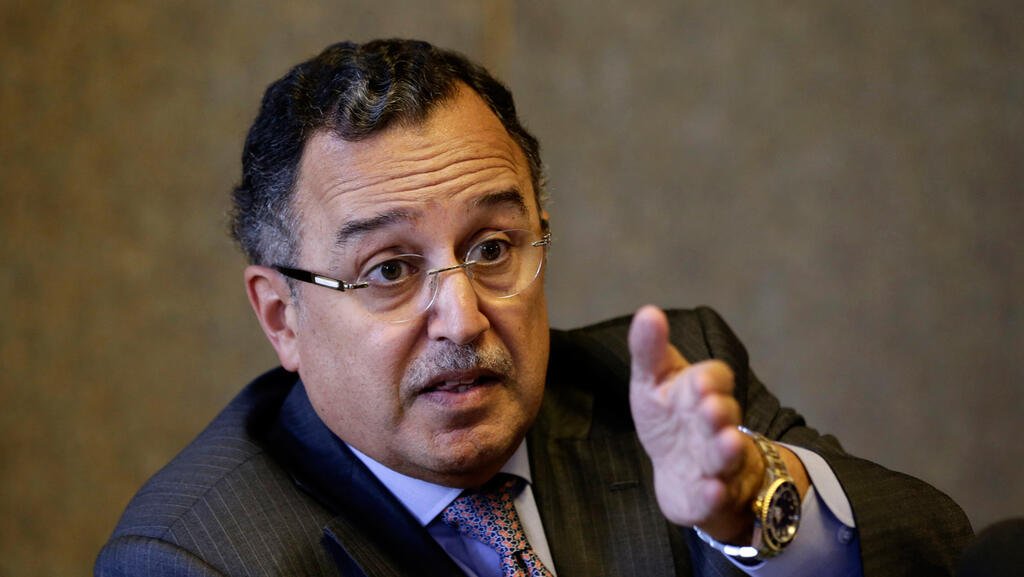
Nabil Fahmy
(Photo: AP)
His successor, with an impressive diplomatic career, has already been appointed: Egyptian diplomat Nabil Fahmy, who served as ambassador to Washington and Japan, as well as foreign minister, and now heads the School of Global Affairs and Public Policy he founded at the American University in Cairo.
Few in the upper ranks of the Arab world are unfamiliar with Fahmy, including in Israel. In less than two months, he will assume the role of the ninth secretary-general of the Arab League. His term is expected to last five years, with the option to extend it to 10, after which he would receive a bonus of $1 million per year.
Only a few in Israel may recall that the Arab League was established in Cairo in March 1945 as a barrier to the creation of a Jewish state “in the heart of the Arab world.” The United Nations was founded six months later.
Most secretaries-general, including the outgoing and incoming figures, have served as Egypt’s foreign ministers. Only once, following Egypt’s peace agreement with Israel, was the League’s headquarters moved to Tunis, where Tunisian diplomat Chedli Klibi was appointed secretary-general. He resigned in 1990 after the Iraq-Kuwait war, and the League returned to Cairo.
Two aspects of Fahmy’s biography point in different directions.
He is the son of Ismail Fahmy, Egypt’s foreign minister under President Anwar Sadat, who resigned in protest over Sadat’s planned visit to Jerusalem. Ismail Fahmy left in anger, and Ibrahim Kamel replaced him during the historic visit.
The second point relates to Fahmy’s ties with Saudi Arabia. Throughout his career, particularly in Washington, he was involved in coordinating strategic relations between Cairo and Riyadh. His name has also been mentioned in discussions about advancing a joint Egyptian-Saudi naval force in the Red Sea.
For now, Saudi Arabia remains firmly aligned with the Palestinian position. Fahmy, who has been deeply engaged in Palestinian affairs since participating in the Egyptian delegation to the 1991 Madrid Conference, has not expressed a different stance.
Based on my meetings with him, I can say he is an educated, pleasant and open individual. But Israel will not have an easy time with him, unless there is a shift in the position of Crown Prince Mohammed bin Salman toward Israel.
It is difficult to separate the position of the Arab League secretary-general from that of Egypt. That has been the case until now, and it is likely to remain so.
 Smadar PerryPhoto: Yariv Katz
Egypt relies on Israeli gas, yet resists broader economic cooperation. It does not welcome Israeli tourists for security reasons, but continues to sell entry permits to Sinai at high prices for Israelis traveling abroad via Taba. For years, Egyptian citizens have been barred from visiting Israel, a policy supported by the Arab League.
Last June, an interesting photograph was published: three former Egyptian foreign ministers, Amr Moussa, Mohamed El-Orabi and Fahmy, hosted Iranian Foreign Minister Abbas Araghchi at the historic Naguib Mahfouz restaurant in Cairo’s bustling Khan el-Khalili market. The meeting took place over dinner, with the public kept at a distance.
Egypt is trying to maintain distance from the confrontation with Iran, but recently expelled diplomats linked to the Revolutionary Guards and the Quds Force.
How the new secretary-general will shape the League’s policy toward Israel remains uncertain. According to an associate, much will depend on Israel’s leadership and its willingness to show flexibility on the Palestinian issue.
Do not expect dramatic shifts. In their view, meaningful change must come from the Israeli side.