

Rabbi Isaac Arama, author of Akeidat Yitzhak, places us squarely within this profound debate. Following Socrates, he advances a bold claim: sin is not the result of conscious evil but of misunderstanding. If a person truly grasped the full meaning of their actions, he would not sin. This is why the sages taught: “A person does not sin unless a spirit of folly enters him.” Not a battle in which desire overpowers intellect, but a momentary blindness that clouds the mind.
The prophet Isaiah framed the problem sharply: the issue is not that people want evil, but that they begin to call evil good and good evil. The distortion begins in definition—in corrupted judgment.
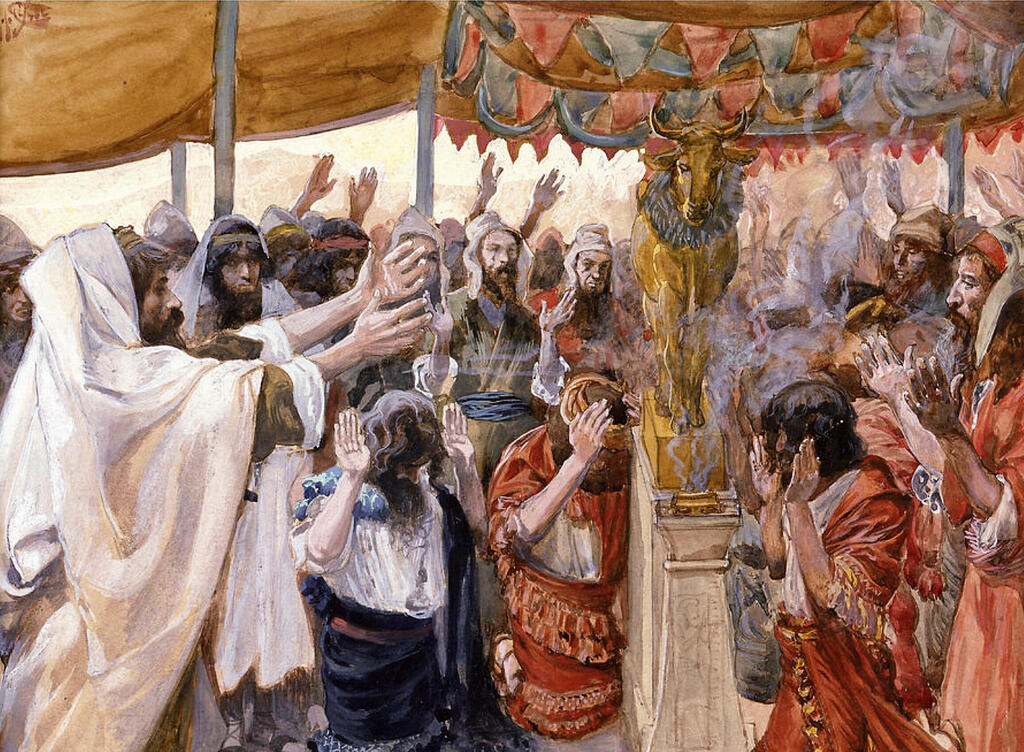
Golden Calf
(Painting: James Tissot)
Yet another voice stands in opposition. In the dialogue between Protagoras and Socrates, it is argued that human beings often know exactly what is right—and still fail because of weakness of will. This line of thought appears later in the writings of the Maharal of Prague, who describes a person drawn after desire even when the intellect clearly shows the path.
This ancient disagreement is not merely theological. It lies at the very heart of modern leadership.
When a manager confronts an organizational failure—whether a strategic delay, a failed investment, or a cultural crisis—they must ask a precise question: did the team fail to understand the implications? Or did they understand them—and surrender to pressure, ego, or fear?
If the problem is knowledge, the solution is clarity: better data, deeper analysis, critical thinking.
But if the problem is weakness of will, the solution is not another presentation. It is the building of organizational character.
Rabbi Isaac Arama describes the “defeated” person as one who is persuaded by an argument that should not even be heard “at that moment.” Notice the precision: not every argument is false—but some are simply inappropriate for the time. The failure lies in context. In the judgment of timing.
How often do successful organizations fail not because they lack information, but because they fall for a comfortable narrative?
“Everyone is entering this market.”
“We can’t afford to be left behind.”
“It will work itself out.”
In such moments, the sweet becomes bitter and the bitter becomes sweet—not because reality changed, but because discernment became blurred.
As a manager, I have often experienced prolonged hesitation even when there was still more information to gather. On one hand, deeper analysis allows for a more mature process. On the other hand, it can paralyze decision-making and legitimize postponing a decision that is already clearly required. People sense hesitation, and that hesitation ripples through the entire organization.
At the beginning of my tenure as CEO of Fyber, I learned that it is sometimes better to decide quickly on the basis of sufficient information—even at the cost of mistakes—than to drift into indecision that erodes trust and clarity. In retrospect, the fast decisions proved far more effective than prolonged hesitation.
A similar pattern can be seen in the public arena. This week the Minister of Finance announced that a compensation plan for businesses would be published “in the coming days.” The framework was already prepared but was not immediately released, based on the assumption that it might not ultimately be needed. Business leaders argued that the delay harmed cash-flow planning and recovery efforts. The State Comptroller has also criticized the fact that every round of fighting requires special legislation for compensation rather than a permanent mechanism that provides certainty.
The question is not merely economic—it is managerial: do we wait for complete certainty, or do we decide even at the risk of later adjustments? Sometimes indecision carries a higher cost than a mistake that can be corrected.
I found expression for this idea in a new poem I wrote, Hallelu:
You don’t need a stage of gold
Nor grand and lofty words
Just a pure heart in real time
That quietly opens doors.
Do not wait to praise a person
When they are already gone
A kind word in the middle of the day
Can save a small world.
Whether we follow Socrates or his critics, one truth remains clear: an organization that fails again and again is not suffering merely from a lack of information. It is suffering from a crisis of decision.
And so the question a leader must ask is not simply, “Did we make a mistake?” but “Why do we keep going?” Is more essential information truly missing—or are we postponing a decision in the name of comfort, hope, or fear? Are we correcting—or merely justifying?
True leadership is not only the accumulation of knowledge. It is the creation of clarity. It is the courage to call things by their name and to stop in time—even when it is not popular.
Because in the end, a mistake is human.
But repeating it is not bad luck—it is a choice.
And the difference between an organization that errs and one that collapses often comes down to a single moment:
The moment when someone dares to stop.