

In the coming weeks, if no security change in southern Lebanon satisfies the demands of Israel and the United States, the region may slide into another round of fighting. Such a conflict could severely destabilize the Lebanese regime and plunge the country into a bloody civil war.
This scenario would likely push the United States to reduce its involvement in Lebanon, restore Iran’s status as the dominant external power in the country, and undermine the stability of the Syrian regime as well.
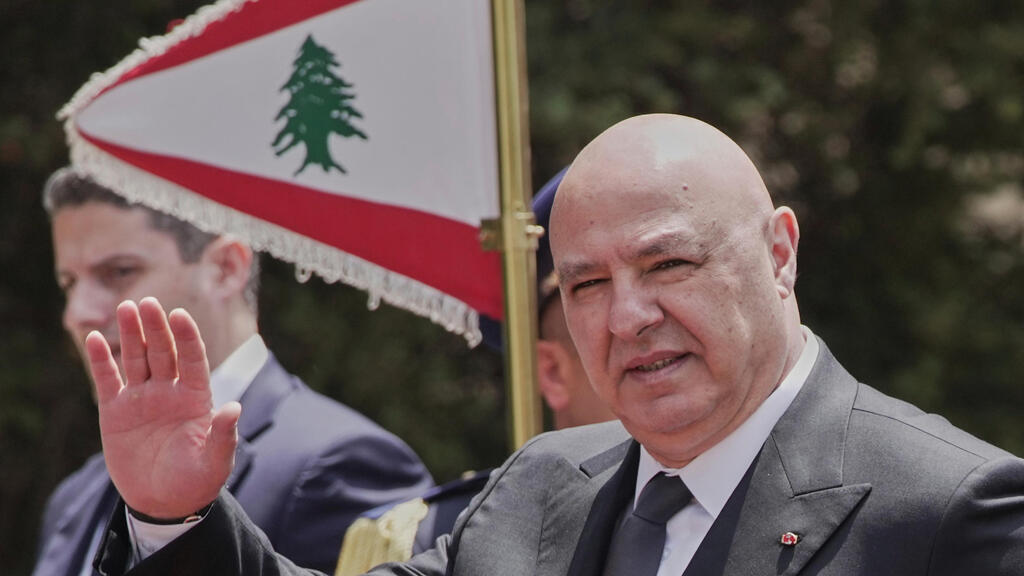
Lebanese President Joseph Aoun
(Photo: Hassan Ammar/ AP)
Israel’s firm policy, backed by the United States, to disarm Hezbollah by the end of 2025 is based on a timetable set by the Lebanese government itself in August. This policy has been expressed through near-daily Israeli airstrikes, including continued attempts to eliminate Hezbollah’s military chief, Tabbatabai, as well as intense diplomatic pressure led by U.S. envoys Ortagus and Barrack, in close coordination with Saudi official Yazid bin Farhan and French envoy Jean-Yves Le Drian.
These developments have created the conditions for restructuring the “mechanism” in Naqoura tasked with overseeing the November 2024 ceasefire agreement between Israel and Lebanon. They also led Lebanese President Joseph Aoun to approve the appointment of pro-American figure Simon Karim as chairman of the mechanism, despite strong objections from the Shiite Amal-Hezbollah alliance.
Against the backdrop of the recent war and a prolonged political crisis that preceded it, Lebanon is facing accelerated emigration of its stronger socioeconomic groups, particularly among Christians. This demographic shift threatens the fragile national consensus established in 1943, which envisioned Lebanon as a state of all its sects, each operating with near-complete autonomy.
At the same time, Lebanon has become almost entirely dependent on external financial aid for its survival and reconstruction. Such aid will not be forthcoming unless Hezbollah is disarmed. Together, these dynamics have brought the country to the edge of the abyss.
Sectarian fragmentation within Lebanon today is far deeper than it was on the eve of the 1975 civil war. The power and cohesion of the Shiite community are also significantly stronger. The Loyalty to the Resistance bloc, representing the Amal-Hezbollah alliance, is the most vocal faction in parliament.
Parliamentary elections scheduled for mid-2026 have already sparked a bitter dispute over proposed changes to the electoral law. The standoff has blocked approval of a $250 million loan intended to rehabilitate abandoned villages in southern Lebanon, fueling public anger in the south. Conditions in Palestinian refugee camps are also dire due to institutional discrimination and the scaling back of UNRWA operations.
Longstanding political figures continue to dominate the Lebanese scene and appear to have learned little. Druze leader Walid Jumblatt persistently undermines the legitimacy of Prime Minister Nawaf Salam’s government and President Aoun. Christian leader Samir Geagea of the Lebanese Forces has mounted an aggressive lobbying campaign in Washington against Aoun, while also adopting an increasingly radical line against Hezbollah.
Since the ceasefire, Hezbollah and Iran have pursued a strategic and cautious approach based on deception and concealment. Despite fiery rhetoric, Hezbollah has largely restrained itself in the face of continuous Israeli strikes, while simultaneously working steadily and effectively to rebuild its capabilities outside southern Lebanon.
Iran, facing severe domestic economic distress, transferred approximately $1 billion to Hezbollah in 2025. It has also supplied missile components and weapons through newly established smuggling routes, successfully bypassing U.S. financial sanctions imposed on the Qard al-Hassan bank and other institutions.
The Lebanese army, which President Aoun claims has dismantled 80 percent of Hezbollah’s weapons in the south, remains entirely dependent on U.S. funding. The recent humiliation of its commander, Rudolph Haykal, whose visit to Washington was abruptly canceled, has further eroded the army’s already limited motivation. At least half of its ranks are Shiite, complicating its ability to meet Israeli and American expectations without appearing to act as a proxy of the United States and Saudi Crown Prince Mohammed bin Salman, despite the genuine intentions of Lebanon’s leadership.
 Dr. Haim Golovenzits
There is a broad consensus that Hezbollah must not be allowed to reestablish itself in southern villages under any circumstances, and that Israel cannot afford a northern infiltration attack reminiscent of October 7. At the same time, Israeli and American policymakers must find a way to apply pressure without tearing the rope apart.
For decades, Lebanon has not had a government genuinely committed to rebuilding the state and severing its dependence on Iran. If no viable path forward is found and the parties slide into a more intense confrontation beyond the current level of targeted strikes, Lebanon could descend into an all-out internal war more severe than that of 1975.
In such a scenario, the Salam-Aoun government would be exposed as powerless in the face of Israel’s freedom of action and would likely collapse quickly. Hezbollah would emerge from internal conflict with military and political supremacy, entrenching Iranian influence in Lebanon for years to come.
Determination is essential, but it must be matched by caution.
Dr. Haim Golovenzits is a Middle East scholar and analyst.