

The data published this week presents in graphic form what for the past year has mostly been said in whispers: Hundreds of thousands of Israelis have left the country during the war. Hundreds of thousands more are thinking about it, some of them already in the midst of the process.
I apologize in advance, but for the purpose of writing the following words, we will dispense with political correctness: At this very moment, there are hundreds of thousands of Israelis for whom leaving the country is either a practical plan of action or a thought at some stage of development in their minds. We will call them “yordim,” those who go down, just as the opposite act is called “aliyah,” going up, and there is no dispute about that.
Unlike immigrants to Israel, the number of those who leave is difficult to measure. After all, a new immigrant receives Israeli citizenship, and it is easy to know how many new citizenships have been granted. The method on which a team of researchers from Tel Aviv University based its measurement of the number of yordim is departure from Israel’s borders for more than three months. In 2025, according to that measure, almost 91,000 Israelis left the country. By comparison, in the previous decade, the average was about 60,000 departures a year.
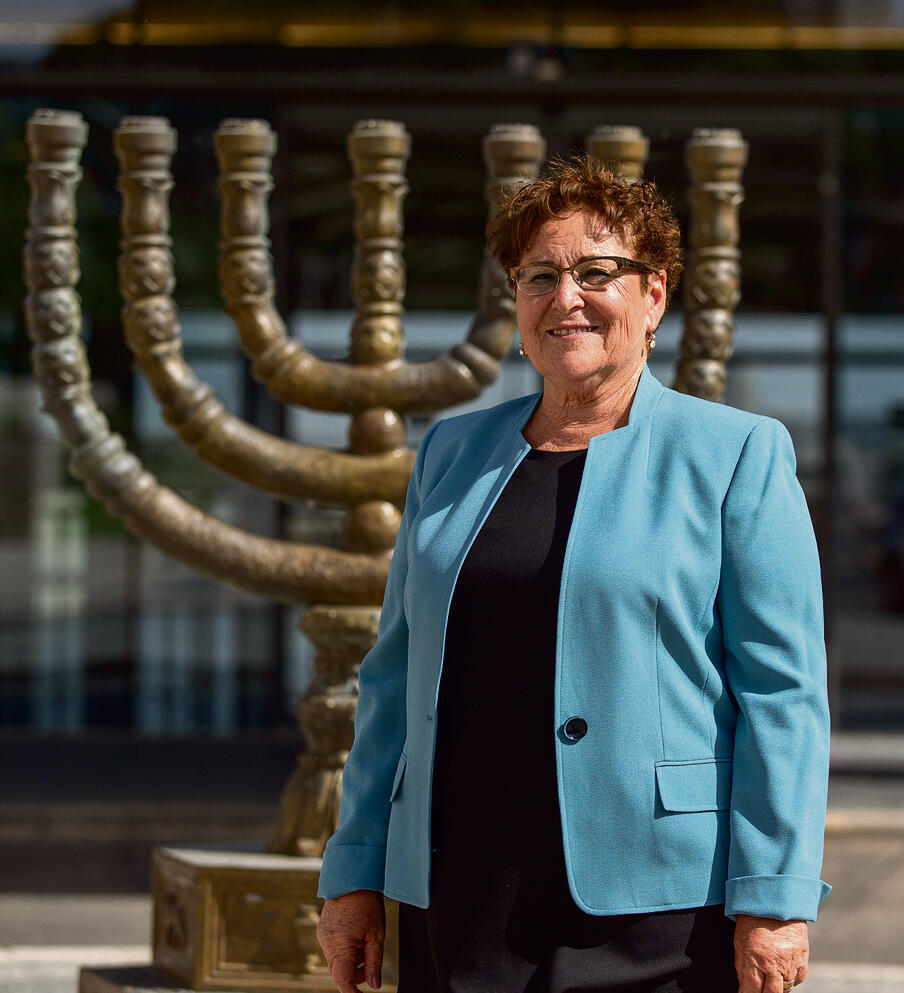
Miriam Peretz has paid the ultimate price, but she is not leaving
(Photo: Alex Kolomoisky)
If the choice is based solely on quality of life, there is no doubt that life in Israel is not simple. On the one hand, let’s keep things in proportion: My grandfather, who was burned in Auschwitz, could not even have dreamed of the standard of living and freedom enjoyed by his hundreds of descendants in the State of Israel. Not only that, as a religious Jew, my grandfather could not have dreamed that my mother, his daughter, would raise her children 300 meters from the Western Wall. I am certain he could not even have imagined that his daughter, from whom he parted forever when she was 2, would take a walk on a Saturday afternoon in a liberated Jerusalem while well-fed and safe. And we grew up there without even noticing how insane it was what had happened to the Jewish people within a few decades.
There is no one like Miriam Peretz, who contains within her all the elements suited to this conversation: She was born in Morocco in 1954 and immigrated to Israel at age 10. She worked in education all her life and became a Zionist symbol after losing her two sons, Uriel and Eliraz. Based on her life story, Peretz could have been highly judgmental toward those who now choose to leave, but the additional and, if I may say, magical element in her personality is the love she has for every person.
“I don’t judge anyone, and I can also see what these people are going through. I travel all over the world on public diplomacy missions and in meetings with Jewish communities, and in recent years this has become a real phenomenon: There are not only Jewish communities, now there are also communities of Israelis everywhere. That is something entirely different. And they have many good reasons. An Israeli woman I met in Canada told me: ‘While I was giving birth to my son, I heard sirens outside and then ambulance sirens when the wounded arrived at the hospital.’ She says to herself, ‘What kind of world am I bringing this child into?’ and decides to leave. One can understand her.
“They also talk about the bureaucracy in Israel, the great tension in the air, the economic pressure. They say it is much easier to live on what they earn abroad, that everyone has Sunday off and they go out on relaxed trips. The modern world is one in which people have high expectations of life.
“I always tell them that I understand, but that as far as I am concerned, the Jewish people have no other home. This is my home. It is a complex home, a difficult home, but because it is my home, my life’s mission is to make it a better home. I love this country, and I paid the highest price for it, and precisely the price I paid is my reason not even to dream of leaving. It makes me want to make this home the best it can be. There is probably a difference between the generation born in exile or at the founding of the state and the generation born here when everything was already ready.”
***
And Peretz is probably right about the intergenerational g. The issue is that there is a process of getting used to things, and there are things that do not satisfy members of the third generation. For this purpose, Generation Zero is the last generation of exile. The generation of the grandfathers and grandmothers who were murdered in the Holocaust or survived it, and came here in the final years of their lives. The generation that did not even dare to dream. When they fought for their lives in the concentration camps or, as in my father’s family, in Algeria, they truly did not imagine that we would get so far, so quickly.
After them came Generation One: the parents who had vision, ability and faith in themselves and in the eternity of Israel, and they did the unbelievable. They built the physical infrastructure: cities, transportation arteries, the IDF, the Israel Electric Corp., the National Water Carrier, academia, the education system and a magnificent security establishment. That generation fought, and it could not believe the scale and speed of the victory in the Six-Day War. It absorbed the trauma of the Yom Kippur War but, despite the terrible surprise, succeeded in repelling the enemy. The first generation dreamed and fulfilled, and was also moved by what existed.
After it came the second generation, which was already born into a state but saw its first stages of development. This generation turned Israel into the start-up nation. Enormous economic successes, tremendous growth in GDP, a dramatic rise in the standard of living, Israel joining the OECD, and the Israeli, especially the secular Israeli, becoming a citizen of the wider world. The second generation took the infrastructure built by the first generation, deepened it and established it
Then comes the third generation, for whom the dreams of Generation One are not understood at all — meaning, they are taken for granted. The deepening and consolidation of all those achievements are also no wonder in its eyes. The fulfillment of the Jewish vision also speaks to it less.
And if that process were not enough, suddenly the war arrived. Suddenly it became clear that there is an insane price to living here. We may feel like global people, flying on vacations around the world, making huge exits and doing business with London and Manhattan, but one morning a few Gazans in flip-flops with Kalashnikovs invade our home and remind us where we really live.
Not only that, but just before that terrible reminder, a yearlong bitter struggle over the judicial overhaul was taking place here. If I may guess, most of the Israelis who are leaving call it a “coup d'état.”
***
I myself am a religious Zionist, live in such a community and send my children to Bnei Akiva. Most of my relatives are from the Haredi-nationalist stream, and my wife’s family is from the liberal stream of religious Zionism. Within all these circles, I do not know a single person for whom leaving the country has crossed their mind. By contrast, among my Zionist friends who are not religious, the thought of leaving is present in alarming proportions.
A few months ago, I was invited to a gathering at the home of a high-tech entrepreneur in north Tel Aviv. About 40 people sat in the living room, many of whom had made major and medium-size exits. Every cliché related to Israel’s old elite would fit the people sitting there. They are much more Ashkenazi, left-wing and secular than the average Israeli, and in very high percentages, they are graduates of elite or technological units in the IDF. Their children also enlist in meaningful service, but I find it hard to imagine what will happen with the generation of grandchildren: Some of them may no longer live here, and some may feel less connected.
The net worth of the people sitting in that living room that evening could be estimated at several billion shekels. But money, I discovered, certainly does not buy calm. The general atmosphere was one of alarm. The host is a person trying to organize his friends to lead change. He is trying to mobilize them to use their abilities and connections as a means of influencing a cross-camp discourse, rather than throwing up their hands and fleeing with their bank accounts. But many others spoke of the next election as the watershed.
Those hundreds of thousands who have left or are currently considering leaving are, for the most part, among the strongest people in Israeli society. They are members of the highest socioeconomic strata, broadly educated, people who performed significant military service and stood at the forefront of public, economic and security activity. And they are members of Generation Two or Three; the Jewish-Israeli story no longer burns within them. They live comfortable lives and are unwilling to compromise on them.
But wealthy people do not leave because it is expensive to live here. The most significant motivation among established populations, and also among the middle class, is the feeling that the country is slipping out of their hands, that Israel is not what it was.
They are largely right, and there are several reasons for that: the demography of the Haredi and religious public, the sharp identity politics of two camps that have become actual enemies, and the algorithm of social media, which gives excessive weight to negative processes and highlights them. This includes both objective and subjective experiences. They are, in general, members of the founding elite, and Israel has taken on a different demographic hue. But that hue does not have to frighten them at all.
They fear a halachic state, but they do not understand that there is no creature in the world capable of forcing a traditional Mizrahi Jew to observe Shabbat, and therefore they also miss the psychological structure of the other camp. They are not fleeing out of physical weakness like the exilic Jew who immigrated to Israel after the Holocaust. They are leaving out of a sense of suffocation, and above all because of a loss of hope.
***
The message that must be directed at them right now cannot be moral preaching, and certainly not contempt. Around this discourse, I often encounter the response: “They want to leave? Let them leave.” There are even those who say the country is vomiting them out. But that thought is sheer stupidity. It is not only that we need them. Our social, human and economic fabric is such that the State of Israel cannot afford to lose this layer: a strong stratum of creative, hardworking people who built and established magnificent institutions here. People who paid billions of shekels in taxes, money from which we all benefit.
Not only that, but according to every Jewish conception, the Jewish people cannot afford to lose one of its limbs. There are hands and there are feet, there are eyes and there are ears, and the books of Kabbalah, the writings of Rabbi Kook on which the worldview of religious Zionism is based, and the Tanya of Chabad Hasidism are also based on the idea that the Jewish people is one body divided into different organs. Each has its own role. We all depend on one another and cannot exist without one another. It is not only the need for hardworking taxpayers. It is also truly a matter of spiritual existence.
Religious Zionism, which stood out greatly in its devotion and also in the price it paid in the current war, has an organizing story. We live here by virtue of the Bible, by virtue of the founders of Zionism who chose to establish our life specifically here and not in Uganda. Zionism is realized specifically in Zion because our ancient forefathers lived here, and they lived here on the basis of the divine command and the promise of inheriting the land. Therefore, our standard of living, which continues to rise, is a great blessing. We are even truly addicted to it by now, but it is not the parameter on which we will decide whether to stay or not.
Secular Zionism, on the other hand, is now at a crossroads. It must establish for itself an understanding of why we live specifically here, because life specifically here has a price. I am convinced that responsible leadership, from any political camp, would devote significant energy to this: how we help the secular Zionist public build for itself a new existential narrative. How we help it remember the old love of previous generations.
And how does one create love anew? Back to Miriam Peretz: “I remember myself at age 10 sitting next to the radio, listening every Wednesday to the program in which Effi Netzer taught songs of the Land of Israel. I sat with a notebook and pencil and wrote down the words so I could learn them:
In the mountains the sun is already blazing,
And in the valley the dew still glistens,
We love you, homeland,
In joy, in song and in toil.
“And that is what I say to all our brothers: We love the homeland in joy and in toil. The best way to create love is through toil, through action, through contribution, through building. That song also has a line: ‘What have we not yet given, and will give.’ Not what I will receive from the state, but what I can give it. The mission of this generation is to love the country. What is the test of love? Not when it is easy, but when it is difficult. Now this is our toil. And you, people with so many abilities and talents, do not go. Harness all your strength to fight for our home, so it will be the best it can be. We want you with us. We cannot manage without you.”
Therefore, regardless of the identity of any party at this moment, after the election, any government formed unilaterally will cause the other side to feel that its country has ended. The order of the day will be cooperation. At least one party from the other camp must enter the coalition to dissolve the fears, the panic, the built-in distrust, on the way to the repair we so badly need. On the way to a new Israeli story.