

"I don't say what I mean, and I don't mean what I say," Simcha Ehrlich, a minister in Menachem Begin's first government, once declared. The remark was absurd, cynical and infuriating, but, like it or not, entirely true. It is especially accurate when it comes to statements made on the eve of elections. At times like these, every promise rests on thin ice, and every threat is hollow, hollow, hollow.
Nevertheless, Benjamin Netanyahu's alarmist speeches in recent days are worth listening to. There is a kernel of truth in his diagnosis. The problem lies in the treatment, and in the doctor.
Benjamin Netanyahu
(Photo: REUTERS/Ronen Zvulun)
Netanyahu has warned Israelis that sanctions will soon be imposed on them in both Europe and the United States. Governments and parliaments across Western Europe have initiated measures that are at various stages of advancement. Legislation harmful to Israel has also been introduced in the Senate and House of Representatives in Washington, and will become law if the midterm elections give Democrats control of both chambers. The threat begins at the grassroots, in the streets and in public opinion. That is true in Western Europe, and it is true in America. Over three years of war, Israel has become a hated country. Only one entity is more despised: the Jewish lobby working on Israel's behalf.
The sanctions pose a threat unlike anything we have ever faced. In their fullest form, like those imposed on Iran, they would destroy our banking system and, through a domino effect, the entire Israeli economy. When I described this danger here, I was branded the panic-monger, the defeatist, the party pooper, the alarmist.
The threat is real, but it is far from inevitable. First, the world's financial center is in New York, not The Hague or Brussels. As long as the Trump administration works with Israel rather than against it, it will be extremely difficult for the rest of the world, even for the U.S. Congress, to cut Israel off from global financial markets.
Second, legislation in democratic countries moves slowly and is subject to judicial review. Symbolic sanctions, like those imposed by the Netherlands on products from the territories, will pass relatively easily, perhaps even bans on arms sales and purchases. But the road to closing markets to Israel is a long one.
Third, elections will be held in several key Western European countries over the coming year. Right-wing parties are expected to gain ground in Spain, France, Britain and elsewhere. Slovenia has already undergone a political upheaval. Some of these parties draw on a deeply troubling fascist and antisemitic legacy, but they have no sympathy for the Palestinian flags waving in the streets or for the attitudes Muslim immigrants bring with them. Israel will be able to get along with Europe's rising right.
Most importantly, the sanctions are conditional. What Netanyahu does not tell his voters is that the dangerous process he is warning about can easily be stopped. All it would take is to elect a responsible government tomorrow, one capable of seeing beyond Ben-Gvir and Smotrich. In both Europe and America, political institutions are closely watching the elections here, stopwatch in hand. If the same government remains in office, sanctions will intensify and accelerate. If a different government takes power, it will be given a temporary grace period, a few months, perhaps a year. We can still climb out of the hole they have dug us into.
Netanyahu is a marked man. I fear, though I may be wrong, that the boycott of Israel will gain momentum regardless of what a government under his leadership does or fails to do. And with him, we too are marked, those who vote for him and those who have had enough of him.
Netanyahu's proposed solution, to shift to a crypto-based economy, is as desperate as it is ridiculous. Young people will flee; money will flee; talent and expertise will flee. I am not even sure Netanyahu, his wife and children will stay here. They pack light.
Calls for a boycott are based on Israel's actions on two fronts: Gaza and the West Bank. What happened and continues to happen in Gaza can be debated. There is no debating, much less justifying, what is happening in the West Bank. The price Israel is paying, and will continue to pay, for its actions there is colossal. There is nothing to be gained from the free-for-all on the hilltops, not for Israel's security, not for the security of the settlements, not even politically. "A horse! A horse! My kingdom for a horse!" cried Shakespeare's Richard III in desperation. "A kingdom for Smotrich," Netanyahu decided.
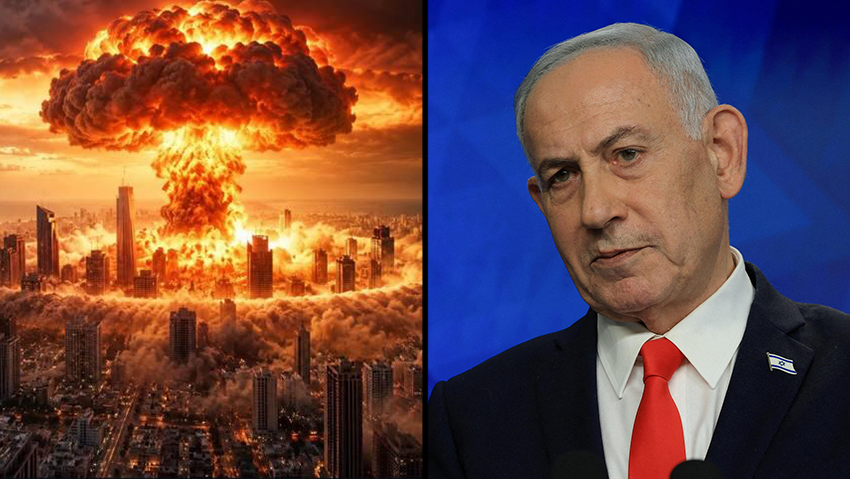
With his back to the wall, Netanyahu is trying to instill existential fear in his voters: The world will destroy us economically; the Iranians will destroy us physically. The narrative that said things had never been better has suddenly given way to one declaring that things have never been worse. Vote for me because I brought you to the pinnacle of happiness; vote for me because I brought you to the brink of annihilation. Netanyahu reminds me of the politician who declared, his voice trembling, "We are on the edge of an abyss!" Then added, on an optimistic note, "And now we will take a giant step forward!"
First published: 02:01, 10.26.26