

Israel is growing increasingly crowded, and this density comes with a heavy price tag - one that directly inflates operational costs for the business sector and threatens its global competitiveness.
The reality on the ground is stark: while the demand for space is skyrocketing, the traditional industrial zones in central Israel have turned into a suffocating bottleneck. Today, tech companies, smart manufacturing firms, defense contractors and other enterprises require substantial, scalable spaces. This ranges from integrated campuses and data centers to advanced laboratories and high-tech production lines.
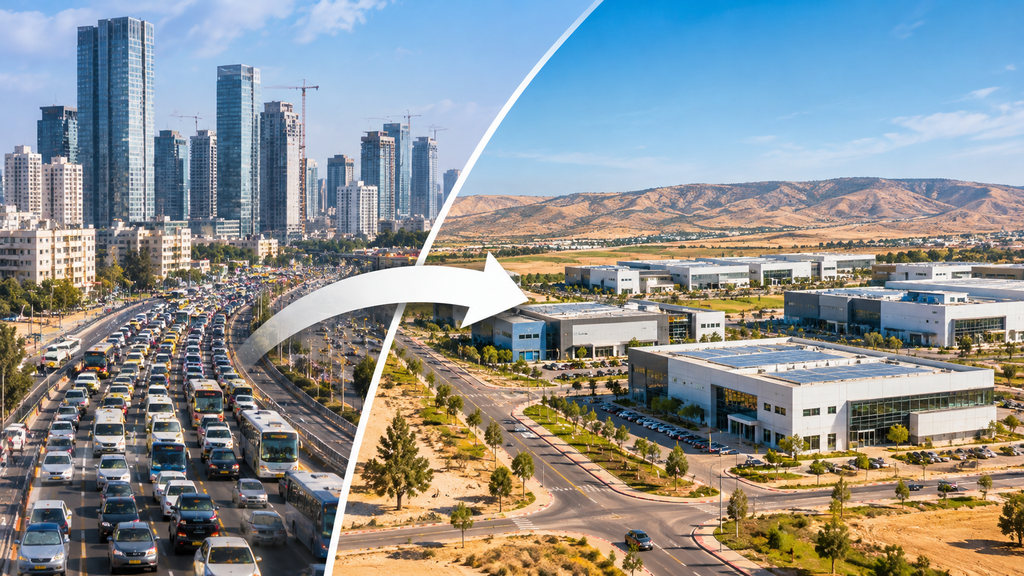
(Illustration: Generated using ChatGPT)
For companies and organizations anchored in central Israel, a clear real estate equation has emerged. As industrial land prices continue to surge across Gush Dan and surrounding central cities, the only viable path for future expansion and land utilization lies just southin the Negev.
The broken model of the center
In the central region, a "bargain" price for industrial land runs at around NIS 5,000 ($1,400+) per square meterand frequently much higher. Meanwhile, plots exceeding 10 or 25 acres (approx. 40–100 dunams) have become scarce and prohibitively expensive. This traditional model is fundamentally broken. Trying to forcefully squeeze manufacturing plants and tech operations into a congested coastal strip stifles productivity, overburdens local infrastructure and chokes long-term growth.
Any attempt to patch up the problem with piecemeal solutions inside congested urban areas is nothing more than a temporary bandage. What’s required is a strategic, gradual shift of our economic growth engines. Advanced development zones - located less than an hour south of Gush Dan—are currently being built out to offer a comprehensive alternative that answers every business need through massive tracts of available land at a fraction of central prices, averaging roughly NIS 1.5 million to NIS 2 million per dunam, paired with smart infrastructure and cutting-edge utilities situated right alongside passenger railway stations and Highway 6.
Furthermore, this dynamic is supercharged by direct proximity to world-class research institutions and academia, such as Ben-Gurion University of the Negev and Soroka Medical Center. These advantages are amplified by massive government investments in infrastructure, alongside the relocation of major IDF technology units to the nearby Cyber and Intelligence hubs in the south. Together, these elements are creating an unprecedented ecosystem in the Northern Negev for advanced, smart and technological industries.
A comprehensive solution: certainty, coordination and connectivity
Executing a move of this scale successfully requires a multi-year master plan that provides developers with a critical asset: certainty. A company opening a secondary headquarters or scaling up its operations needs to know precisely when it can break ground, what the bureaucratic licensing timeline looks like and when construction will wrap up.
 Idan HaNegev Park CEO Yagel Deutsch Photo: Eldad Markus
Achieving this demands seamless coordination between government ministries, local authorities and planning committees, alongside a drastic streamlining of national transit and rail corridors to slash travel times from the heart of the country.
In fact, this infrastructure is already a reality in the Northern Negev, which boasts active industrial zones and hundreds of dunams specifically earmarked for advanced industries, anchor enterprises and defense manufacturing.
Putting people first: human capital and community
However, building state-of-the-art tech and industrial parks won’t move the needle unless we take care of the end user: the employee. A true revolution in our region must include deep, ongoing investment in human capital and the daily work-life ecosystem. Today, commuting through Gush Dan to an office in the center often takes longer than traveling from Gush Dan straight to the development zones of the Northern Negev, especially with Highway 6 and the Lehavim rail station providing direct access to these burgeoning employment hubs.
Engineers, researchers and entrepreneurs who currently commute north from the south - as well as those who will choose to live and work in the south rather than congested Gush Dan-will significantly relieve pressure on Israel's central arteries. At the same time, they will dramatically upgrade their quality of life: spending less time stuck in traffic, and more time enjoying open green spaces, robust cultural scenes, top-tier education, healthcare and leisure. All of these sectors are currently experiencing massive momentum and development around us.
In the coming years, the Israeli economy will require unprecedented spatial flexibility to safeguard its economic and global resilience. Developing accessible southern hubs that combine advanced industry, tech companies and a high-quality employee lifestyle is a critical step in decentralizing the national load.
Unclogging Israel's traffic and real estate gridlocks through a smart migration to the Negev will empower the Israeli economy to build a stable, innovative foundation for decades to come. This is not a fantasy-it is a proven reality on the ground, demonstrated by leading companies that have already relocated from the center to the Negev and watched their business metrics soar as a result.
- The author is the CEO of the Idan HaNegev Park