

In the latest round between Israel and Iran, both sides found themselves in a contest over who would have the last word, or fire the last missile.
The reason is a false motivation rooted in a sense of superiority and control. Although this kind of conduct is often described in terms of deterrence, balance-of-terror strategy or “breaking the equation,” it is usually driven by ego and image. The goal is to avoid looking weak, to avoid appearing to lose the symbolic battle of perception, especially before domestic audiences.
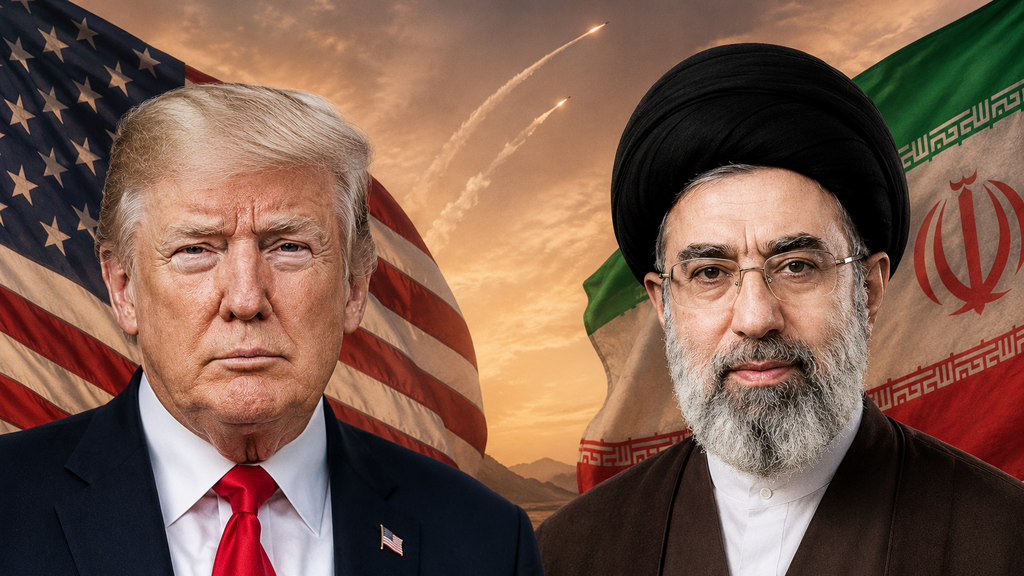
In the current Israel-Iran confrontation, both sides know neither can land a knockout blow. Trump and Mojtaba Khamenei
In the past, Israel knew how to say it would respond in the appropriate way, at the appropriate time and place. That approach created prolonged uncertainty for the enemy, a sense of being hunted and a constant alertness that disrupted daily life.
In recent years of confrontation with Iran, the Iranians learned to say the same: that they would respond according to their own timing. They have done so more than once, especially after the killing in Lebanon of Brig. Gen. Mohammad Reza Zahedi, the Quds Force commander in Syria and Lebanon and a senior figure in Iran’s Islamic Revolutionary Guard Corps.
Zahedi was killed on April 1, and for two full weeks Israel was on high alert for an Iranian response, living through a period of prolonged tension that disrupted routine life.
The response came with great force. On April 14, 2024, Iran fired about 130 ballistic missiles, 36 cruise missiles and some 185 drones. Israel, with the help of foreign militaries that joined the defensive effort, managed to neutralize most of the threats launched at its territory.
In the current confrontation between Israel and Iran, it is clear to both sides that neither has the ability to deliver a knockout blow. It is also clear that neither side has the legitimacy or space to conduct a long and substantial campaign. As a result, the visibility of each response takes on excessive weight in decision-making.
President Donald Trump also understood that the two sides had entered an endless loop of attack, response, attack and response again. Therefore, the question of which side would say the last word or carry out the final strike was not the right question.
The real question was who could force both sides to end the exchange of blows.
Trump succeeded this time as well in forcing both sides to end the current round. But for those reading between the lines, there is a considerable chance that Iran’s agreement to end the round will be carried directly into the framework agreement between the United States and Iran.
That could give Tehran leverage to improve its position in the deal Trump wants so badly, for a range of reasons and because of events rapidly approaching: the World Cup, America’s 250th anniversary and the November midterm elections.
The price of oil, which jumped at the start of the round, and the resulting negative effects on markets, only strengthen Trump’s need to ensure there is no spillover from this confrontation. To do that, he will need Iranian cooperation. The Iranians, in turn, will demand compensation for that cooperation in the agreement.
 Doron Hadar
The Middle East is a maze of players, calculations, constraints and risks. Every move must therefore be examined strategically, with attention to all variables and the possible domino effect.
This is a chess game the Iranians know well and like to play. Israel and the United States need forward-looking thinking, the kind that tries to identify the missing variable in the equation.
In practice, Hezbollah’s fire on northern Israeli communities created a chain reaction. It led to an Israeli strike in Beirut’s Dahieh district, which led to Iranian missile fire at Israel, which led to Israeli Air Force retaliatory strikes on targets in Iran, which led to American pressure to end the round.
The price may now be paid in American willingness to make concessions in an agreement dealing with the issues most important to Israel: Iran’s missile program, funding for proxy groups, the nuclear program and 450 kilograms of enriched uranium.
All of this sharpens one question: Was the decision to carry out the pinpoint strike in Dahieh in Beirut the right one?
Col. (res.) Doron Hadar is a former commander of the IDF’s crisis management and negotiation unit.