

In recent weeks, we have once again seen a stream of reports and commentary on Iran’s worsening internal situation. Some are published under a familiar headline, repeated many times over the past decade: “The Iranian regime is on the brink of collapse.”
There is no doubt that the Islamic Republic’s condition is more severe than ever. It is not only in Israel that the situation in Iran is assessed as dire — Iranians themselves share that view. The reformist newspaper Hammihan published particularly alarming data this week on the state of Iran’s economy. Inflation has crossed the 50% threshold, with food prices rising by more than 60%, and about a third of Iran’s citizens are defined as living in absolute poverty, earning less than $2 a day. Official unemployment remains relatively low, but largely because many jobless people have given up looking for work in despair.
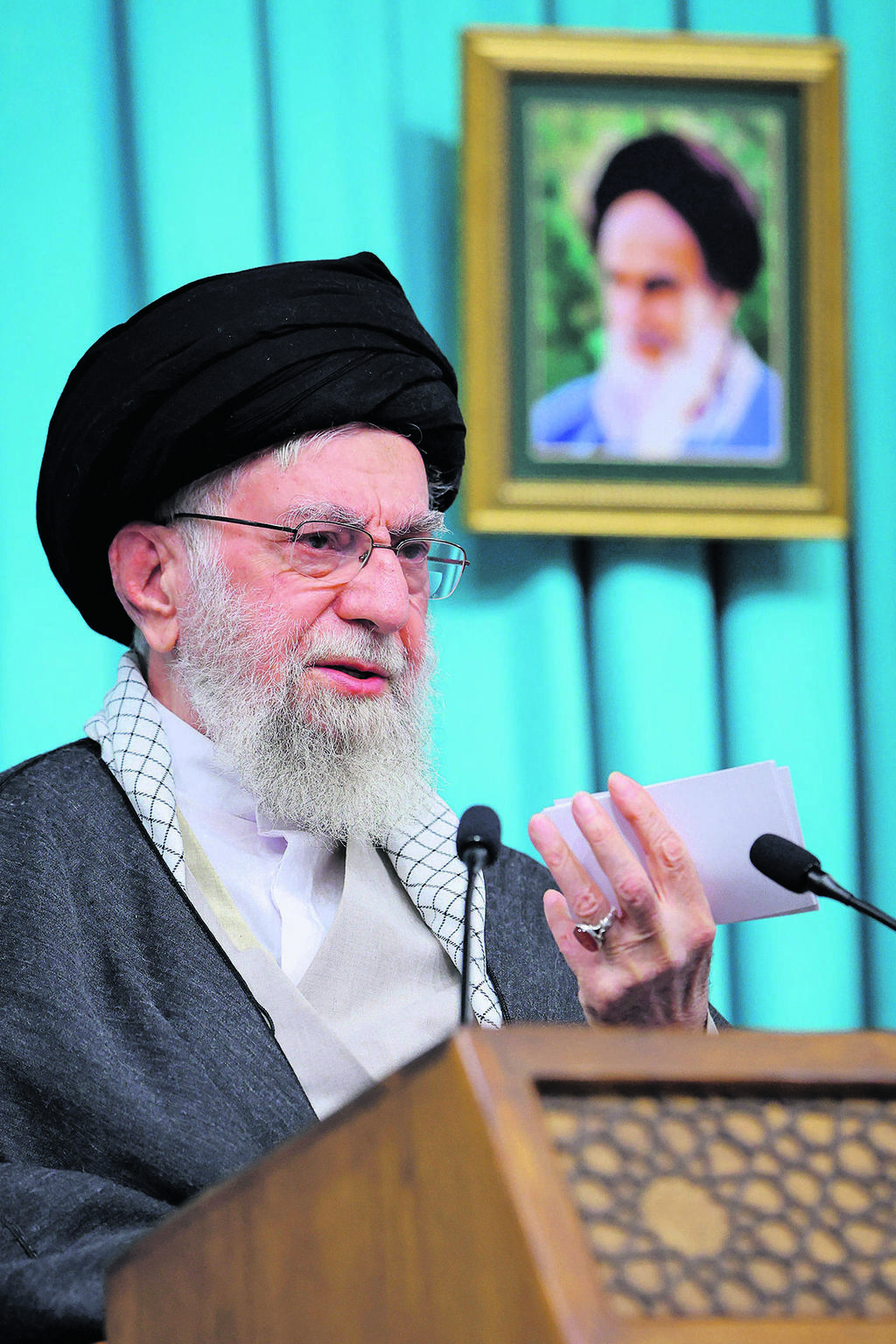
Iranian President Ali Khamenei
(Photo: AFP)
In addition, Iran is facing an unprecedented budget deficit, which this week forced the government — for the first time since 2019 — to significantly raise fuel prices based on consumption levels. The Iranian rial has plunged to a record low of more than 1.3 million rials to the dollar. This is before factoring in the electricity shortage and the near-total collapse of the water sector, problems that recent rain and snow are unlikely to resolve.
Any one of these factors could reignite popular protests at any moment. Many now point to similarities between Iran’s current situation and that of the Soviet Union in the years leading up to its collapse. Several months ago, Iranian journalist and regime critic Abbas Abdi described the Islamic Republic as a state undergoing a process of “silent death.”
And yet, it is important to stress that even if there is no dispute over the Islamic Republic’s severe condition — marked by a prolonged legitimacy crisis, a deepening economic crisis and a widening gap between the regime and the public, especially among the second and third generations of the Islamic Revolution — this does not necessarily herald imminent political change.
In an article I published at the Institute for National Security Studies in January 2025, I argued that regime change in Iran is possible only through a shift in the balance of power between those seeking revolutionary change to the political status quo and those determined to preserve it at all costs. Such a shift depends, among other things, on millions of Iranians taking to the streets, the ability to form a broad, nationwide social coalition and cracks within the political elite — particularly within the regime’s repression apparatus, led by the Revolutionary Guards.
Those forces remain dependent on and committed to the regime. Even several videos circulated recently on social media — at least some of them created using artificial intelligence — that purport to show senior Iranian military officers declaring opposition to the regime do not, at least for now, indicate that the security forces are aligning with regime opponents or intend to refuse to suppress protests if they resume in the near future.
Regime change?
Even if it can be assumed that a trigger for renewed protests — impossible to predict in advance — is only a matter of time, there is no guarantee their outcome would differ from past protest movements in Iran: the 2009 Green Movement following alleged election fraud, the late-2017 protests sparked by a worsening economic crisis, the 2019 protests over fuel price hikes and the 2022 protests following the death of young Iranian woman Mahsa Amini.
Regime change in Iran is one possible — and perhaps preferable — solution given the threats posed by the Islamic regime. Until such change occurs, steps can be taken to weaken the regime and reduce, as much as possible, its ability to pose a range of threats to Israel’s national security. Ultimately, however, such change depends primarily on factors beyond Israel’s control, foremost among them the Iranian people themselves.
 Dr. Raz Zimmt
In any case, since it is impossible to know if or when regime change will occur — or perhaps a change within the regime, such as in a scenario involving the death of the current leader, 86-year-old Ayatollah Ali Khamenei — it cannot be relied upon as a working assumption for shaping strategy. One may hope that the regime in Tehran will fall soon, but those who build strategy on hope may find that those hopes were misplaced.
Dr. Raz Zimmt is head of the Iran and Shiite Axis Program at the Institute for National Security Studies (INSS) and a researcher at the Alliance Center for Iranian Studies at Tel Aviv University.