


In 2009, the U.S. Army published an unusual document titled The Commander’s Guide to Money as a Weapons System. It was not written by economists, nor intended for classrooms. It was a practical field manual for military commanders. Its core message was stark: money is not neutral. Properly deployed, it can shape behavior, secure legitimacy, stabilize societies, and weaken adversaries—often more effectively than force.
At the time, this framing may have seemed confined to counterinsurgency and post-conflict environments. Today, it reads like a blueprint for global economic reality.
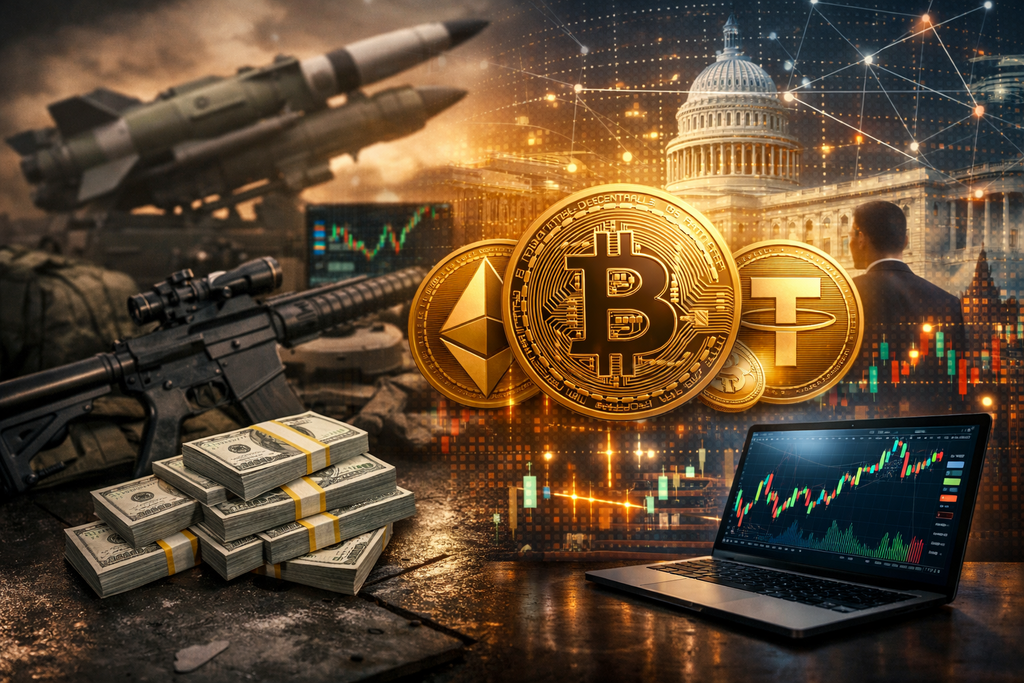
Crypto is part of the weaponization of money
(Photo: Generated)
Modern power is increasingly exercised through financial means. Sanctions, access to payment systems, control over liquidity, interest rates, inflation, and regulatory pressure have become primary instruments of geopolitical competition. Entire economies can be constrained—or enabled—without a single shot being fired. Money has become one of the most effective non-kinetic tools of state power.
This is the context in which cryptocurrencies must be understood.
Too often, crypto is treated narrowly: as a speculative asset, a technological curiosity, or a regulatory nuisance. That framing misses the larger point. If money is a weapon system, then monetary architecture itself is strategic terrain—and crypto represents a structural shift in that terrain.
Decentralized networks introduce monetary systems that operate without central permission, with transparent rules, predictable issuance, and global accessibility. They do not replace states, but they challenge the assumption that states are the sole credible issuers and controllers of money. In doing so, they introduce something fundamentally new: an exit option.
 Prof. Ilan Alon Photo: Courtesy
Exit options matter. They discipline institutions. They alter bargaining power. They change incentives. In international political economy, the ability to exit dominant systems has always been a source of strategic leverage. Crypto lowers the cost of that exit—for individuals, firms, and, increasingly, for states operating at the margins of the global financial system.
This has direct policy implications. Ignoring crypto does not preserve monetary sovereignty; it weakens strategic awareness. Over-regulating it does not eliminate risk; it often pushes innovation—and influence—elsewhere. The relevant question is not whether crypto is “good” or “bad,” but whether policymakers understand that monetary competition has entered a new phase.
The U.S. military understood, years ago, that money must be aligned with strategic objectives. Civilian policymakers should draw the same lesson today. Crypto is not merely about finance or technology. It is about power, governance, and credibility in a world where economic instruments increasingly define geopolitical outcomes.
History is consistent on one point: those who grasp changes in monetary power early tend to shape the rules later. Those who dismiss them tend to live under rules written by others.
In that sense, crypto is no longer optional for policy debate.
It is part of the weaponization of money—and therefore part of modern statecraft.
- By Prof. Ilan Alon, Professor of Economics and Business at Ariel University (Israel) and the University of Agder (Norway)