

On Nov. 13, 2023, my mother, Yaffa Peer-Tadelis, died at the age of 97, about a month after the Oct. 7 massacre. Despite being a Holocaust survivor who experienced that inferno firsthand, she struggled to withstand the scenes of horror unfolding in her own country. Oct. 7 took her back 80 years.
I always felt the memory of the Holocaust that shook her life, even without words. For decades she did not speak about it or tell her story. Everything was locked away, yet it was evident in how she lived. For example, she would ask us to avoid going into the pool because the water was cold and we might catch a chill. She never threw away a crust of bread. When you grow up in such a family, you are not aware of it. You simply live that way.
My father, Yaakov, of blessed memory, a carpenter, came from Riga, Latvia. He immigrated to pre-state Israel in 1935 at age 14. He experienced, together with us, the lasting marks carried by a family of Holocaust survivors.
We did know some details: that she lost her parents, Cherna and Zvi Stauber, her two older brothers, Menachem-Mendel and Avraham-Yaakov, her sister-in-law Tzipora, and two nephews. We knew she remained an orphaned teenager with two siblings we knew — Yisrael (Shrol), who has since died, and Esther, now 99, may she live a long life. Yisrael was drafted into the Soviet army and, fortunately, was not in Birkenau. Esther was there with my mother, and both had numbers tattooed on their arms, numbers whose stories we were always afraid to ask about.
The change began in 1999, when Steven Spielberg launched his documentation project among Holocaust survivors and came to my mother. In front of the cameras, we heard her story for the first time.
We heard how, before her eyes, her father was taken from her during a selection. We heard how she slept with five other girls on the same narrow wooden bunk in the barracks of the extermination camp, how they shared stale bread, how they marched kilometers each day wearing only a filthy sack, barefoot on the freezing snow. Anyone who stepped out of line or collapsed was immediately set upon by SS dogs. From then on, her feet remained frozen and hard as stone. She was terrified of dogs for the rest of her life.
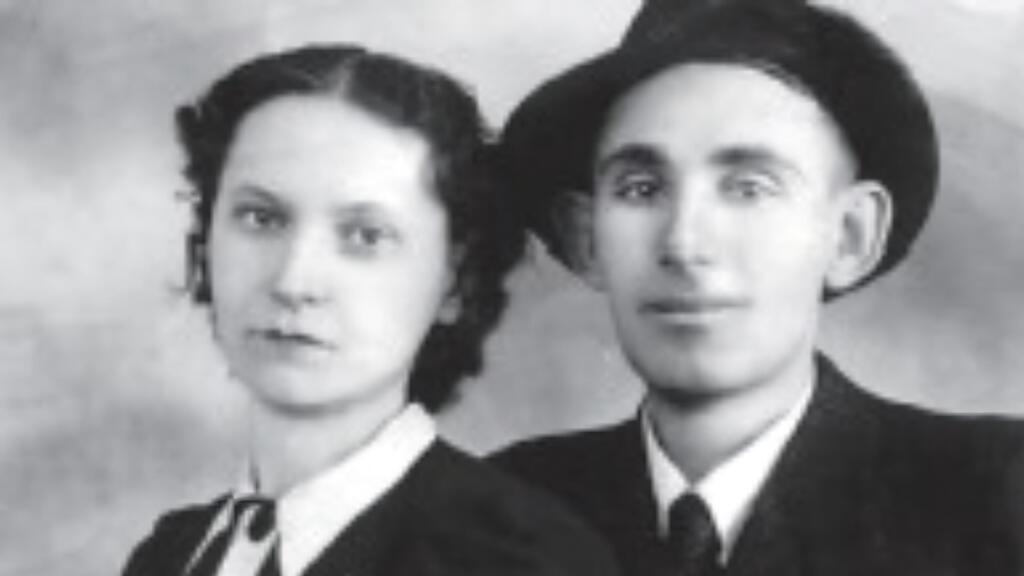
Single photo that remains: her brother Menachem-Mendel and his wife Tzipora, who were killed in the Holocaust
We struggled to grasp how the Nazis took her and her family from their home in the small village of Stramtura, near the city of Sighet — then in Hungary, today in Romania. They gathered all the Jews in the synagogue, and after several days loaded them onto cattle cars. Hundreds were crammed into each car, pressed together, unable to move or even shift a tired leg. Near the end of the long journey, a rumor spread that they were arriving and would soon be freed. Joy began to break out — only for a different reality to emerge.
Birkenau: SS guards, executions, overcrowding, stench, bitter cold, crematoria, fear, the separation of young girls from their parents, a brutal struggle for survival. She saw Adolf Eichmann and Dr. Josef Mengele up close and never forgot their faces.
In early 2006, she decided it was time for another step. “I want to go there, to close the circle,” she said — and she did.
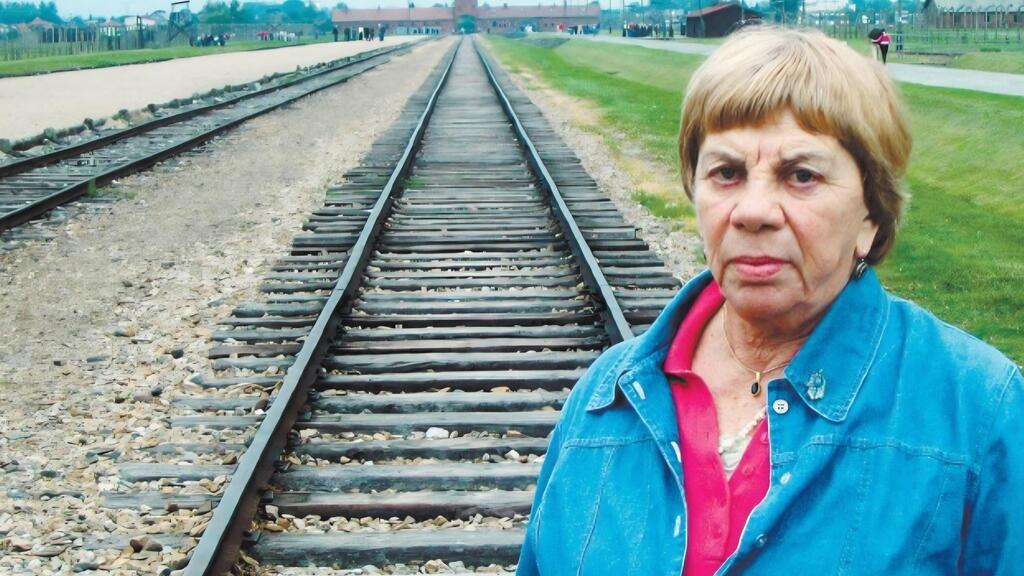
May 24, 2006. A rainy spring morning in Poland, at Auschwitz-Birkenau. Sixty-three years had passed since a Nazi officer hooked his curved cane around the neck of the Jewish teacher Zvi Stauber and dragged him away, in front of the terrified eyes of his 17-year-old daughter, Yaffa-Shindel, sealing his fate — death.
At that exact place, Yaffa-Shindel returned, now Yaffa Peer-Tadelis, walking into Birkenau. We thought she would hesitate, cry, falter. Instead, with determined steps and a gaze that combined revulsion and pride, she walked into the killing field, stood on the very railway track where she had been separated from her parents and two older brothers, and said out loud for the world to hear: “I am here. I won.” A true heroine.
There we understood how the Nazi killing machine operated — its planning, its scale, its straight lines, its order, its cruel coldness. To the right were the women’s barracks. “I was here,” she said, and walked inside without hesitation. It is hard to comprehend how they lived there, like animals crammed into foul cages.
From the barracks we walked along the long railway line and the ramps where the selections took place. Suddenly she stopped and, almost without noticing, began explaining in Yiddish, though it is not a language we speak.
“Here, at this point, they took my father from me. Right here on the track,” she said. It was shattering.
We continued to the end of the line. On both sides stood the gas chambers and crematoria. “We smelled the burning flesh throughout the camp, and we understood,” she said. “We saw the smoke from afar.” The crematoria buildings remain, though completely destroyed. Between them stands a memorial with plaques in many languages of the victims. Beside the Hebrew inscription, we held a quiet ceremony of our own.
Two days later, we traveled from Birkenau in Poland to her childhood village of Stramtura in Romania, where she had lived a peaceful and happy life with her family until 1943, when the Nazis deported them to Auschwitz-Birkenau. After a two-hour drive — about 100 kilometers — in a Romanian taxi that seemed never to have seen a garage, we reached Sighet and from there Stramtura, accompanied by a warm and gracious woman named Ildi, a native of Sighet in her 30s at the time, married to an Israeli and fluent in Hebrew.
With Ildi’s help, we immediately began searching for my mother’s childhood home, from which she had been deported 63 years earlier. In pouring rain we barely noticed, we walked through a small Romanian village that seemed frozen in time: open sewage in the streets, dilapidated wooden huts, donkey- and horse-drawn carts, muddy narrow paths.
Soon, nearly half the village was walking with us, trying to help. First, they led us to the house of my mother’s uncle, where she had spent much of her childhood and adolescence. It had been the only stone house in the village. “Today,” one of the locals told us nervously, “my daughter lives here. She bought it a few years ago.” “Don’t worry,” my mother replied in fluent Romanian, “I didn’t come to take anything, only to see and remember.” He relaxed, and from there everything flowed.
We entered the house. When my mother saw the veranda, she was overcome with emotion and burst into tears. Suddenly she recognized every corner. The memories flooded back all at once. She became so emotional that she began speaking to us in Romanian. She told the family living there what each room had been when her uncle owned the house. Before we left, they insisted on giving her the only item that remained from that time — a mortar and pestle.
From there, they helped us search for her home, the shack of her childhood. She recognized it with certainty, even though its windows and doors had been boarded up. She remembered that the house stood slightly above street level, and it did. The wooden door was closed. When we opened it, we startled two cows sleeping peacefully inside.
We stepped outside. Across the way, about six meters away, a wooden gate opened and an elderly woman beckoned to us. We approached. My mother and the woman looked at each other for a long moment — and then, without warning, fell into each other’s arms.
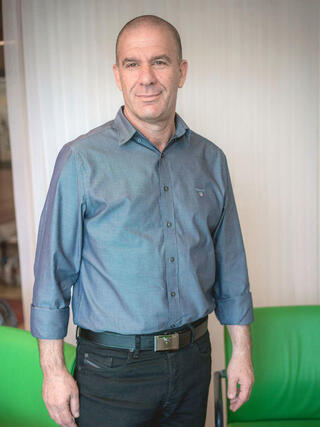 Memi Peer Photo: Ilan Spira
“Felga!” my mother cried.
“Shindele!” Felga answered.
Our throats tightened with tears.
For a moment, I saw two young girls again — one 17, the other 19 — chatting about the ordinary things that interest girls their age. It took me several blinks to return to the present.
I cannot explain why, but this moment of the journey — the roots trip — was the most moving of all. Perhaps because it embodied the force of life, my mother’s victory over the Nazis.