

For two decades, Israel focused primarily on Iran’s nuclear ambitions. The assumption was that the greatest threat lay in the possibility of Tehran one day acquiring a nuclear weapon.
In reality, the more immediate danger was always the network of armed groups Iran already supports across the Middle East. The nuclear program was meant to serve as a shield, giving those groups protection under the threat of a future nuclear umbrella. That calculation is now being upended.
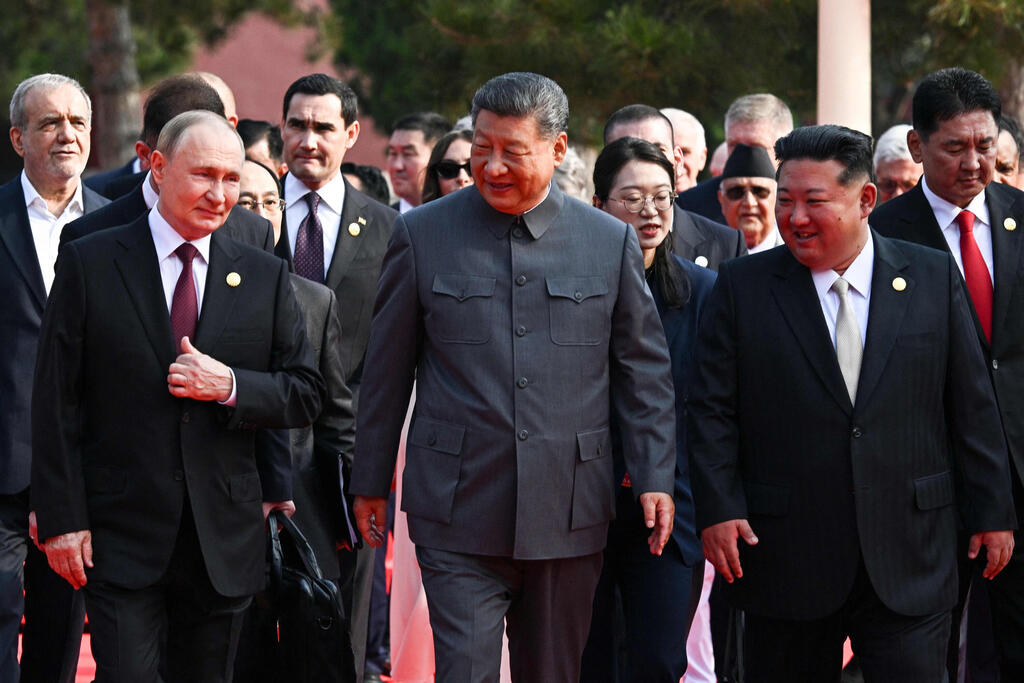
(Photo: Sergey Bobylev / POOL / AFP)
A shifting global alignment
A new geopolitical reality is emerging in the form of a cooperative bloc between Russia, China, and North Korea. This loose partnership, which could be called an “axis of immunity,” is united by a common goal of challenging the U.S.-led world order. North Korea, once an isolated state, is becoming a critical supplier of advanced weaponry to countries and non-state groups hostile to Israel.
In this arrangement, Russia provides military protection and technology in exchange for munitions, while China offers an economic cushion that helps North Korea weather international sanctions. This alignment transforms Pyongyang into a major arsenal for conflicts far beyond the Korean Peninsula.
New threats to Israel’s military edge
The direct consequence for Israel is the erosion of its traditional military advantage. Instead of waiting years for adversaries to slowly develop their own missile systems, groups like Hezbollah could gain access to advanced, ready-made weapons from North Korea.
One example is the KN-23 short-range ballistic missile. These missiles fly on unpredictable, low trajectories that make them difficult to intercept. If such weapons reached Hezbollah, they would significantly challenge Israel’s air defenses and restrict the freedom of action of the Israeli Air Force in a future conflict.
International safeguards breaking down
Israel’s long-standing security strategy relied on international cooperation, especially within the UN Security Council, to monitor and contain weapons proliferation. But with Russia now vetoing sanctions enforcement and shielding North Korea, that mechanism has been dismantled. Diplomatic tools that once slowed the spread of advanced weapons are no longer reliable.
At the same time, traditional military solutions are far less viable. A preventative strike against North Korea is unrealistic when the regime enjoys explicit protection from a nuclear power like Russia. This creates a new model for rogue states: trade weapons for a great power’s protection and gain immunity from conventional military responses.
The way forward
In this new reality, Israel must rethink its security doctrine. Intelligence agencies need to prioritize the arms pipeline linking Pyongyang and Tehran just as much as Iran’s nuclear program. Diplomacy must pivot toward building a broader coalition of countries directly threatened by this alignment, from South Korea and Japan to Gulf Arab states.
Such a coalition would need to focus on intelligence sharing, coordinated sanctions outside the UN framework, and joint operations to intercept shipments before they reach their destination. The strategy must shift from passive containment to active prevention.
The sense of distance that once insulated Israel from events on the Korean Peninsula has disappeared. Weapons from Pyongyang can now find their way to Israel’s northern border. Addressing this new threat will require nothing less than a fundamental shift in Israel’s national security doctrine.