

At a political conference held last week in Tamra, an Arab city in northern Israel, familiar warnings resurfaced against Arab parties joining a governing coalition, along with calls to reject in advance any support for any future government. To me, that debate reflects a much larger story about Arab politics in Israel.
For years, the debate centered on participation: Should Arab parties seek a place inside the centers of power, or remain outside them? But in 2026, that is no longer the real question. The question now is whether Arab citizens want politics of protest alone, or politics that can also deliver influence.
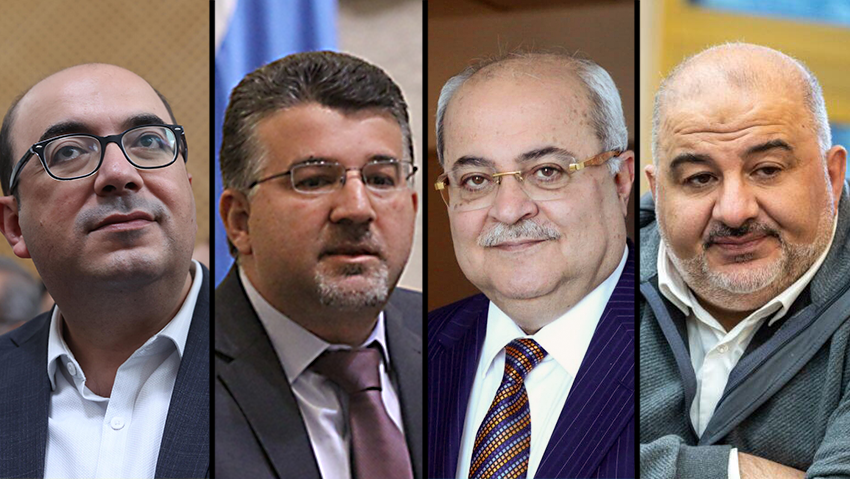
From right: Mansour Abbas, Ahmad Tibi, Yousef Jabareen and Sami Abu Shehadeh
(Photo: Shalev Shalom, Ryan Frois, Knesset Spokesperson’s Office)
More and more Arab citizens are no longer satisfied with slogans. They want to know who will address soaring crime, who will bring budgets to local authorities, who will advance housing, education and infrastructure. They want to see results.
That is why I find it hard to understand those who declare in advance that every future government will be equally bad, or that Arab parties must not participate in any coalition. Not because there is no criticism of Israeli governments, but because politics is supposed to change reality, not only describe it.
Protest is an important tool. At times, it is necessary. But protest alone does not transfer budgets, establish government programs or set national priorities.
This is where the major shift in Arab society can be found. Today’s Arab public is more aware, more involved and less willing to settle for declarations. It understands that the question is not only who is right, but who is capable of exerting influence.
A governing alternative
After the past several years, it seems that more and more citizens, Arabs and Jews alike, are looking for a governing alternative that can offer a different direction.
That is the nature of democracy: When a government fails to provide a sufficient response to the central challenges occupying the public, citizens look for alternatives. But no less important than the question of who will lead the country in the coming years is the question of what kind of leadership will be able to offer better answers to the challenges that have accumulated over time.
Any such alternative, however, will struggle to emerge without a genuine Arab-Jewish partnership. Anyone seeking to build a different political majority here must see the Arab public as a full partner, not as a blocking bloc, not as a spectator on the sidelines and not as a temporary addition.
 Muhammad Osman
The demand that an Arab party be part of the next government is not a concession of principles. It is a simple expression of the fact that one-fifth of the country’s citizens are Arab.
The Arab public is no longer looking for a seat in the gallery. It wants a seat at the decision-making table.
The writer is a political and social activist and independent journalist.