

When Israel was founded, it was not clear what its political orientation would be: whether it would align with the Western bloc led by the United States or the Eastern bloc led by the Soviet Union. Another option raised in the 1950s was to join the Non-Aligned Movement led by India. Each of these options, in the eyes of Israel’s leaders across the spectrum, had advantages and disadvantages. Only in 1950, following David Ben-Gurion’s decision to support the United States in the Korean War, did it become clear that Israel would align with the West.
The need to rely on a superpower was one of the cornerstones of Ben-Gurion’s security doctrine, and all subsequent prime ministers maintained this strategy. Until the 1960s, France supplied Israel with weapons and helped initiate the nuclear reactor in Dimona. Only after the Six-Day War, when Israel proved itself a regional power whose stability and strength the United States could rely on, did the special relationship begin to flourish — though its roots, of course, run deeper.
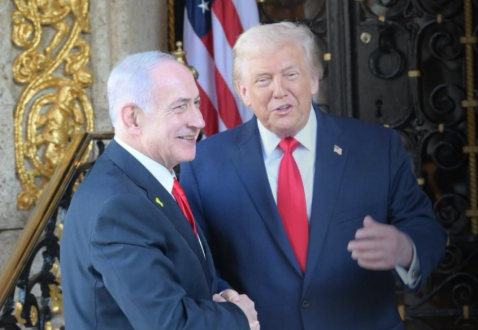
Trump receives gift from Netanyahu
(Photo: Holy Gems Website)
Over the years, the relationship of the two major American parties toward Israel has shifted. Although Republicans are now perceived as more supportive, there were periods — such as during the presidency of George H.W. Bush — when the Democratic Party was considered closer to Israel. The Jewish community, which during the Holocaust and the early years of the state still feared accusations of “dual loyalty,” gradually gained influence and integrated into American society in a way that allows it to support Israel openly and confidently.
Thus, at the risk of oversimplification, and to make a long story short, while Europe has distanced itself from Israel, we have reached a point — approaching Israel’s 80th year — where the alliance with the United States appears to be at its peak. The two countries have never fought together as they have against Iran. It has even been reported recently that the Americans are considering establishing bases here in Israel instead of in Gulf states. The U.S. president, whose daughter converted to Judaism and whose Jewish son-in-law serves as his envoy on international crises, displays both warmth and support — and at times even intervenes in the legal proceedings against Benjamin Netanyahu. We have become almost like one country.
The closer Israel draws to the United States, the more dependent it becomes on American decisions
The advantages of an alliance with the world’s strongest superpower are clear, as Israel’s enemies have learned. The United States is also an economic powerhouse, grounded in democratic values, and closeness to it offers benefits beyond the security sphere. Yet precisely when the alliance is at its peak, its limitations must be recognized: the closer Israel draws to the United States, the more dependent it becomes on American decisions. Fortunately, so far, President Donald Trump has known both how to support wars and how to help us end them. In many respects, his decisions have been better than those of our own government. But what if the United States chooses differently?
Moreover, under Netanyahu, Israel is no longer content with seeking assistance from the United States but defines itself as “a defender of Western civilization.” This is a new development. In the past, Israel’s leaders aspired to be “a light unto the nations” without taking sides in global blocs, and historically saw themselves as belonging both to the West and, in some ways, to the East.
Today, as Israel positions itself — somewhat presumptuously — at the forefront of defending Western civilization, it also exposes itself to greater danger if the world enters bloc-based conflicts. The fact that Israel is so closely identified with Trump and the Republican Party also strains relations with the Democratic Party, which may well return to power one day. And whereas in the past Israel was careful to maintain a clear distinction between its policies and the citizenship of American Jews, those same Jews may now find themselves facing accusations of irresponsible support for Israel, potentially fueling antisemitic trends.
The alliance with the United States is one of the foundations of Israel’s strength. Precisely for that reason — and especially when it is at its peak — Israel must preserve its independence and moderation, so that this honeymoon with Washington does not become a double-edged sword.