


In early April 2025, Israeli Air Force jets struck the runways and facilities of Syria’s T4 military air base. It was hardly the first time the base had reportedly been targeted by Israel. During the Syrian civil war, T4 served not only the Syrian Air Force but also Iranian forces, which sought to use it to transfer advanced air defense systems to Hezbollah and Syria. For that reason, according to foreign reports, the Israeli Air Force attacked the base several times.
But the April 2025 strike appeared to be different. Arab and international media reported at the time that Israel targeted T4’s runways because Turkey, following the collapse of Bashar Assad’s regime, was seeking to take control of the base and deploy air defense systems and detection radars there.
Gallery
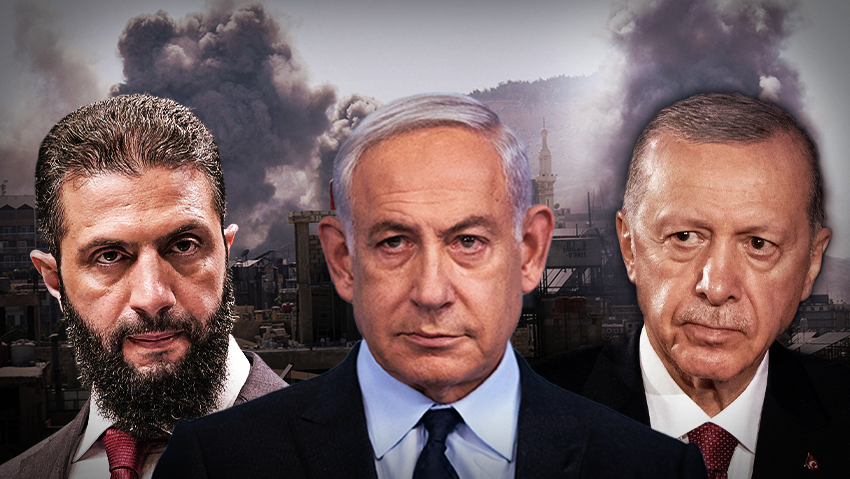
(צילום: אלכס קולומויסקי , MEHMET ALI OZCAN Anadolu via AFP, Andrew Harnik GETTY IMAGES NORTH AMERICA AFP, REUTERS/Khalil Ashawi)
Israel appeared to be drawing a red line. As Turkish troops, engineers and contractors made their way toward the base, Israeli aircraft struck its runways and surrounding areas, signaling that Jerusalem would not accept a Turkish military presence at such a strategically important site. From Israel’s perspective, sophisticated Turkish radar and interception systems there could severely restrict the Israeli Air Force’s freedom of action over Syria. As later became clear, that freedom of movement was also relevant to the aerial route used for strikes against western Iran.
Those details were never officially confirmed by Israel, but neither were they denied. It is therefore reasonable to assume that the overnight strike attributed to Israel against the runways and facilities of Abu al-Duhur military airfield in northeastern Syria was carried out for similar strategic reasons.
Abu al-Duhur was used by the Syrian Air Force under Assad and changed hands several times during the civil war between rebel groups and government forces. After Assad’s regime collapsed and was replaced by Ahmad al-Sharaa, the rebel leader who took power in Damascus, the Israeli Air Force struck and destroyed Assad’s remaining combat aircraft as well as other strategic military facilities and stockpiles.
Abu al-Duhur, a large base that includes 22 runways and covers an extensive area, was therefore left largely unused in the absence of a functioning Syrian air force. Recently, however, Qatari media reported that Turkey was seeking to establish a presence at the base and install detection radars as well as missile and aircraft interception systems.
A glance at the map helps explain why that could alarm Israel. A Turkish military presence equipped with such systems at Abu al-Duhur could pose a serious threat not only to Israel’s freedom of action throughout Syria but also to its ability to operate if fighting with Iran resumes.
The base’s location means that Turkish detection and air defense systems there could affect the broader strategic airspace stretching across northeastern Syria, northern Iraq, including the Kurdish region, and toward western Iran. The latest strike may therefore represent another instance in which Israel is using air power to draw a line against Turkish military entrenchment that could restrict its operational freedom across that entire theater.
Israel’s warning to al-Sharaa, who owes Erdoğan
At the same time, Israel appears determined to avoid a direct confrontation with Turkey. That may explain why the overnight strike was carried out against areas where no people were present, and certainly no Turkish troops or civilians, while Israel has officially remained silent about responsibility for the attack.
Despite that silence, a senior Israeli official told Fox News that Jerusalem had shared “sensitive intelligence” with Washington ahead of the strike. According to the official, the intelligence was passed “at the highest levels of the various agencies and bodies” of the two countries. “Al-Sharaa understands that he cannot operate like the previous Syrian regime,” the official said.
Following that logic, the strike also appears intended as a message to Syria’s new ruler, Ahmad al-Sharaa. Israel is signaling, it can reasonably be assumed, that it will not accept Turkey taking control of strategic positions in Syria in ways that threaten not only Israeli freedom of action in the air but other Israeli security interests as well.
The warning is therefore directed at Ankara, but also at Damascus: Syria should not go too far in allowing Turkey to use its territory. Turkey already controls a significant area of northern Syria along its border and has effectively created a Turkish security belt there against Kurdish forces. It is now seeking to expand its strategic presence farther south, bringing it closer to Israel.
Al-Sharaa has reasons to allow that. Turkey was one of his principal patrons when he was still leading jihadist forces in the Idlib region southeast of Aleppo, before his forces advanced on Damascus. Ankara provided weapons, training and protection. Al-Sharaa is indebted to Turkey, and Israel is warning him not to take that relationship too far.

Tom Barrack
(Photo: REUTERS/Emilie Madi)
Syrian official media condemned the overnight attack and effectively identified Israeli aircraft as responsible for striking Abu al-Duhur. Turkey also strongly condemned the strike and attributed it to Israel, as did U.S. Ambassador to Turkey Tom Barrack, who also serves as President Donald Trump’s special envoy for Syria.
His criticism caused little surprise in Israel. Barrack, who is of Lebanese descent, is viewed in Jerusalem as a strong supporter of Turkish President Recep Tayyip Erdoğan and a patron of Syria’s current president, al-Sharaa.
From Washington’s perspective, Israeli military action in Syria complicates the Trump administration’s effort to accommodate Erdoğan and draw Syria into the pro-American regional camp Trump is seeking to build in the Middle East. Under Erdoğan’s influence, Trump decided to embrace al-Sharaa, until recently a jihadist leader also known as Mohammed al-Jolani.
For Barrack, who represents Trump in both Turkey and Syria, Israeli strikes inside Syria are therefore seen as interfering with U.S. interests and with Washington’s broader effort to stabilize Syria under its new leadership.