

What haven’t we done there, and what haven’t we said? Maybe not for 78 years, but for at least 50. Quiet infiltrations and stormy incursions. Operations more brilliant and less successful. A sea of hopes and a string of frustrations.
From Operation Spring of Youth in 1973 — wow, how spectacular it was, with Ehud Barak in a dress and a bullet between the eyes of senior PLO officials in their bedrooms, through Operation Litani in 1978, a ground incursion and “we pushed the threat away,” on to the First Lebanon War in 1982, all the way to Beirut.
“There will be no more Terroristan on our northern border,” Menachem Begin promised, though I don’t remember whether that was before or after the promise that the land would be quiet for 40 years.
We established the security zone. We were told we would leave a few dozen soldiers there to advise Saad Haddad’s army, which over time became the South Lebanon Army, and the dozens grew into thousands. We stayed there for 18 years and withdrew over the objections of IDF Chief of Staff Shaul Mofaz and Northern Command chief Gabi Ashkenazi. We believed Barak, the man from Spring of Youth who became prime minister, when he promised a strategic change and said that “we are leaving Lebanon from a position of strength, not weakness.”
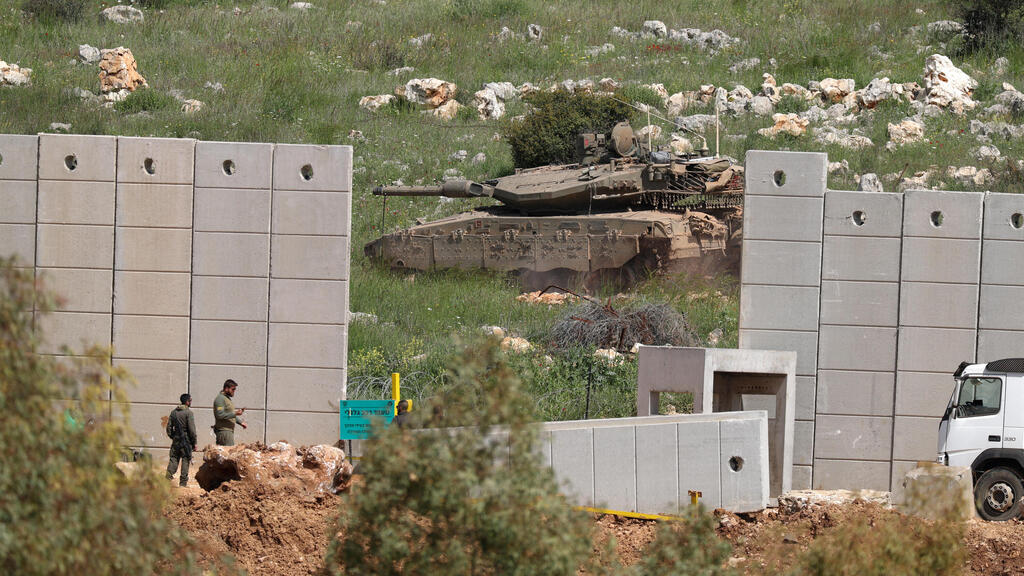
An IDF tank near the Lebanese border
(Photo: Florion Goga /Reuters)
That was in 2000, after the Four Mothers movement, but before that came Operation Accountability in 1993 and Operation Grapes of Wrath in 1996, with Shimon Peres in a battle jacket on the northern border. Six years later came the Second Lebanon War, led unsuccessfully by Ehud Olmert — “the reality in the north has changed fundamentally” — and DanHalutz — “we returned Lebanon to the Stone Age.” Or we will return it. Whichever comes first.
Then came the campaign between the wars, until the Third Lebanon War within Swords of Iron, with Rising Lion, Roaring Lion and, on the way, other lion-themed names that have yet to make the list. And in the meantime came a return to past promises: Yoav Gallant’s “Stone Age” and Benjamin Netanyahu’s “they will miss the Second Lebanon War.”
In between, the PLO was replaced by Amal, and Amal was replaced by Hezbollah, which is here to stay. And in between, according to unofficial figures, until the current war Israel lost about 1,500 soldiers and members of the security forces, and killed between 6,000 and 10,000 terrorists on the other side, depending on whom you ask.
In other words: a clean and decisive operation that led to escalation, which led to war, which led to withdrawal or a ceasefire, which led to the other side’s buildup and to clashes, which led to an operation that was no longer quite so clean and decisive, which led to more escalation, more war and another agreement that led to an endless loop.
One that brought our soldiers, for the umpteenth time, to take up positions on a rocky hilltop in an outpost that looks like the twin sister of one built a decade, two decades or three decades earlier. The same gaze northward, the same endless nervous alertness, the same built-in frustration. Only the weapons change.
No longer ambushes, no longer roadside bombs, no longer anti-tank fire — or not only those. Now there are drones, too. Small, cheap, sometimes improvised, sometimes more sophisticated, forcing them to raise their heads to the sky again and again. Those who believe will look there for the source of their help. Those who do not will scan for those aircraft. A stubborn reality, an endless loop that repeats itself. Generation after generation. Each generation and its Lebanon.
 Ariela Ringel Hoffman
Not a war that ends, but a condition that refuses to end. Not an enemy that disappears, but an enemy that changes. Not a border line or separation, but a hostile space. Not a swift victory, but prolonged attrition.
“Hit them hard,” a Republican man, a supporter of Israel, told me about a week and a half ago after I met him by chance at an art exhibition in Houston. “Don’t stop until you finish them off,” he said. “However long it takes.” An important message, I told him. I’ll pass it on to my grandchildren, who will pass it on to theirs.
“This is not a 100-meter sprint,” Moshe Ya’alon once said of the Second Intifada. “It is a marathon.” A marathon in place, and hit them until it is over. And in the meantime, we are there again. So is Hezbollah, which is not going anywhere, does not give up and only changes form and style. And the total victory is still delayed. Until the next pause.