

One of the newer and less-discussed phenomena exposed by the war against Iran is betting on political and military decisions on sites such as Polymarket. Recently, several Israeli air force soldiers were reportedly investigated for betting on the timing of strikes against Iran, based on prior information. In the United States, a White House employee was arrested for allegedly betting on military action based on advance information.
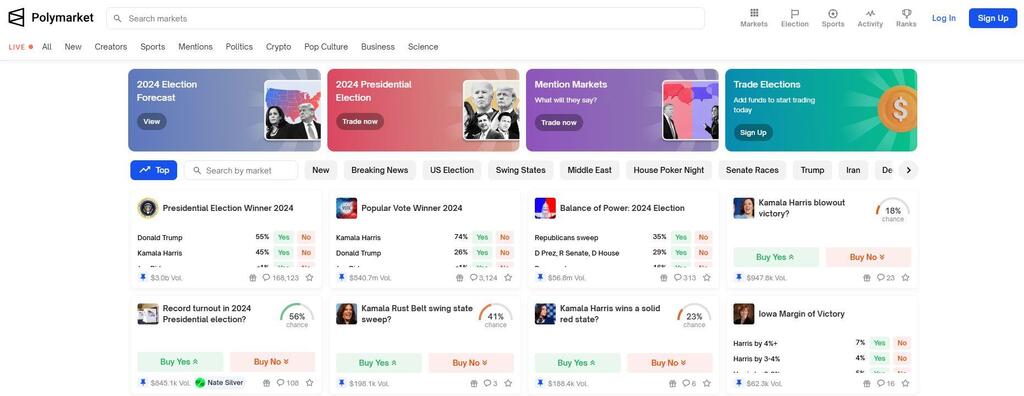
Polymarket platform
(Photo: printscreen)
The issues debated on such sites include almost anything imaginable: when a war will begin, whether a ceasefire will be reached by the date announced by the president and, during the 2024 presidential election, how many times Trump would refer in a speech to “Sleepy Joe.”
On the surface, there is no difference between these questions and sports betting, a common phenomenon worldwide. But in practice, sites that offer betting on political and military decisions involving human lives represent something entirely new. So much so that even Trump, for whom almost everything is measured in money, has expressed discomfort with turning political and military matters into a casino.
The popularity of Polymarket and similar sites has led their founders, some of whom recently appeared on John Oliver’s show in the U.S., to argue that it is not gambling at all, but a comparison of differing assessments by individuals regarding major events. They claim the phenomenon could even help create a better society, because people will become accustomed to thinking carefully and deeply about decisions that shape the future.
Another argument centers on the concept of the “wisdom of the crowd,” since in many cases reality has shown that the outcome, for example, when Iran would be attacked, aligned with the view of most bettors. One of the site’s founders even said that people in Beirut decided whether to go down to shelters or stay home based on bombing forecasts for Lebanon on such sites, because the odds were usually accurate.
But the truth is that this is another troubling development in the adoption of neoliberal logic in Western society, in which everything, even life and death, is measured in terms of profit and loss. The phenomenon, still in its infancy in Israel and developing in the United States, has not yet received much attention in public discourse. But the fact that soldiers and people with access to classified information have been arrested during the war, both here and overseas, requires a response.
If people can bet on when a war will begin or when a ceasefire will take effect, why wouldn’t they also bet on the number of dead? If people can bet on how many times a leader will use a certain phrase in a speech, who can assure us that the speechwriter, or even the politician himself, will not pass information to bettors? And if betting on political and military decisions becomes as accepted as sports betting, who will ensure that criminal elements do not interfere behind the scenes in politicians’ decisions, just as they sometimes do in sports?
When thinking about where humanity is headed, the first question often concerns developments in artificial intelligence and technology. The use of AI may indeed solve quite a few problems, but it may also create deeper ones.
Prime Minister Benjamin Netanyahu recently said the debate over drafting ultra-Orthodox men may be resolved when soldiers are replaced in combat by humanoid robots. But as technology replaces human beings, the values by which we live may also change.
Instead of watching anxiously as events deteriorate toward war, people may begin waiting in anticipation for developments, according to the bets they placed. In that way, life in the 21st century could become one long game that produces both money and cruelty. The politicians of the next generation will have to contend with that as well.