

I will begin with the conclusion: Israel should give the U.S. president a chance to bring about Hamas’ disarmament “the easy way” before returning to intensive fighting. Publicly, it is not acceptable to set a fixed timetable for this, but it is possible to agree in advance with the president, through quiet understandings, on a waiting period. At the same time, Israel must prepare for the most realistic scenario of all: Hamas’ refusal to disarm.
Now for the reasoning. In January 2025, President Trump began his second term in office. The intensive dialogue between Israel and the United States focused primarily on the Iranian nuclear issue. On Gaza, President Trump gave Israel unqualified backing for its decisions regarding the fighting against Hamas and for its positions in diplomatic efforts to secure the release of the hostages. After the success of Operation Rising Lion in June 2025, the southern arena again became the focal point. The Israel Defense Forces began implementing the Cabinet’s August decision to “take control of Gaza City.” Toward the end of the year, U.S. envoy Steve Witkoff intensified his efforts to advance a framework for a temporary ceasefire in exchange for the release of all hostages in two stages.
Neither Hamas nor the Israeli government embraced his proposal, but at the same time global criticism of Israel intensified amid claims of unprecedented starvation of Gaza’s population, including in the United States. Scenes of international protest did not escape President Trump’s notice. He expressed deep concern that Israel was losing its last remaining friends and noted that even his Jewish friends were finding it difficult to identify with its policies.
In September, President Trump grew weary of the situation. He imposed a plan on the parties that began with the immediate release of all Israeli hostages, both living and deceased, in a single phase, in exchange for an open-ended ceasefire. It was to continue with the demilitarization of Gaza, the disarmament of Hamas and other terrorist organizations, an IDF withdrawal from most of the territory and the rehabilitation of the Strip under the management of local and external governing bodies.
Trump’s instincts
In Israel, few believed Hamas would accept the president’s plan. Agreeing to release all the hostages while Israel continued to control most of the Strip stood in complete contradiction to the terrorist organization’s rigid and consistent position since the first day of the war. The prevailing assessment in the defense establishment and the political leadership was that Hamas, as was its practice, would avoid an outright rejection of the initiative but would in effect sabotage it. This assessment was based on experience accumulated over two years of fighting and on current intelligence. But Trump had better intelligence: his instincts. He trusted his intimate ties with the leaders of Qatar and Turkey, who committed to persuading Hamas to meet his terms, rejected attempts to introduce substantive changes to his plan and insisted on securing Israeli consent. In October, it became clear that Trump had achieved the unbelievable, at least with regard to the first stage of the plan. Twenty hostages returned home alive. Twenty-seven fallen captives were returned to their families. And this week, the last hostage, the heroic police officer Ran Gvili, was returned to his family.

(Photo: Jonathan Ernst, REUTERS)
Now, as the United States ceremonially launches the second stage of the Trump plan, doubts are again surfacing about the prospects of realizing the core of the president’s vision: turning the Gaza Strip into an area free of terrorist activity. Senior figures in Hamas and Islamic Jihad stress that until a Palestinian state is established, they have no intention of disarming. Even when they occasionally voice faint willingness to discuss the sensitive issue, it is clear they have no intention of relinquishing the weapons that preserve their de facto control of Gaza.
Still, skepticism is not a policy. After the proven ability of President Trump and his team, particularly Jared Kushner and Steve Witkoff, to extract the hostages from Hamas tunnels “against all odds,” Israel is right to grant the U.S. president room to operate. That said, passive waiting is not enough, and I recommend anchoring Israel’s position in three principles.
Trump is personally committed to implementing the plan, including the disarmament of Hamas and the demilitarization of Gaza. The plan is not without flaws, and Israel, which enjoys direct access to its architects and leaders, will seek to improve it along the way. If Trump’s vision is realized, as it was with the hostages, the gain will be entirely ours. And if Hamas thwarts Trump, the decision of when and how to act will rest entirely in our hands.
First, it can be assumed that Israel and the United States are aligned in their demand for Hamas’ disarmament and for the demilitarization of Gaza. Now there is a need to coordinate with the White House a detailed timetable for implementing these substantive clauses. These are two distinct issues. Disarmament means the transfer of all weapons held by Hamas and smaller organizations to a body agreed upon by the United States and Israel and their removal from Gaza. This includes all components related to rocket arrays, including raw materials and production means; all anti-tank weapons, including anti-tank missiles and RPG launchers; all explosives and materials that are part of their production process; and all small arms, including rifles, hand grenades, ammunition, mines, explosive drones and similar weapons.
Demilitarizing Gaza is a longer, more gradual process that requires thorough treatment in three areas:
- Destruction of military infrastructure, including an extensive tunnel network, most of which is still operational, and weapons production facilities, now concentrated mainly in areas where the IDF did not operate systematically, such as the central camps.
- Establishment of sophisticated infrastructure for detecting and identifying prohibited items and materials at border crossings, through which vast quantities of external aid are expected to enter the Strip in the coming years.
- Deployment of advanced systems to detect and intercept drones used for smuggling along the Strip’s border with Egypt and its border with Israel.
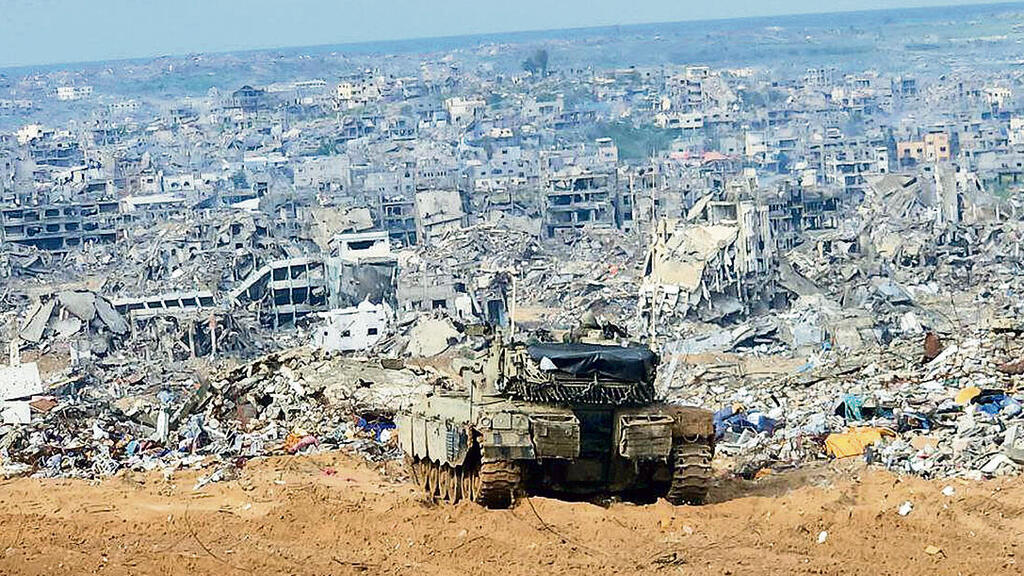
The second issue concerns the rehabilitation of Gaza. If Hamas does not disarm, the United States may, for its own reasons, prefer to delay a renewal of fighting and to create incentives for Gaza’s residents by beginning reconstruction. Israel may also prefer such an approach if there is escalation in other arenas or for domestic reasons. In such a scenario, the Israeli condition must be unequivocal: reconstruction processes will take place only in areas under IDF control. Only there will construction materials be brought in. Only there will rubble be cleared. Only there will temporary housing units be installed. Only there will damaged infrastructure be replaced. In areas under Hamas control, “old Gaza,” not even the first hint of reconstruction will begin as long as the condition requiring the removal of all weapons from the area has not been fulfilled.
Of course, there is no guarantee this position will influence Hamas, for whom survival is far more important than the living conditions of Gaza’s residents. But it is certain that if reconstruction takes place in areas under Hamas control, the achievements of the war in Gaza will evaporate as if they never existed.
The remaining war objectives
The third issue is the most plausible of all: preparing for a return to fighting. I believe the IDF has for some time been formulating operational plans to achieve the war’s unfulfilled objectives: the destruction of the military and governing capabilities of the terrorist organizations to ensure that Gaza no longer poses a threat to Israeli citizens. The operational lessons accumulated since October 2023 are numerous. The objective difficulties are well known, as are the political constraints. After the hostages are no longer in Gaza, it will be possible to forge a broad consensus regarding the southern front, similar to that which exists on Iran, Hezbollah and the Houthis. Creating national agreement in an election year is a complex challenge, but both the government and the opposition are obligated to make the effort to achieve it.
In conclusion: Trump is personally committed to implementing the plan, including the disarmament of Hamas and the demilitarization of the Strip. He is the architect, heads the Board of Peace and is mobilizing dozens of international leaders and figures to ensure the plan’s success. It is not without flaws, and Israel, which enjoys direct access to its architects and leaders, will seek to improve it along the way. If Trump’s vision is realized, as it was with the hostages, the gain is entirely ours. And if Hamas undermines Trump, the decision of when and how to act rests entirely in our hands.