

January 26 marks Australia Day. The date commemorates the arrival of the “First Fleet” at Port Jackson in 1788, an event that led to the establishment of modern Australia. Over the years, it has become a national day reflecting Australian identity, history, and shared civic life.
Having served for several years as a Shaliach (emissary) in Australia, I had the opportunity to experience the day up close. It represents a celebration of what modern Australia aspires to be. The Prime Minister and the Governor-General deliver speeches and award honors to outstanding citizens, young and old; citizenship ceremonies are held; and community events and cultural celebrations take place across the continent aimed at fostering community and a sense of belonging.
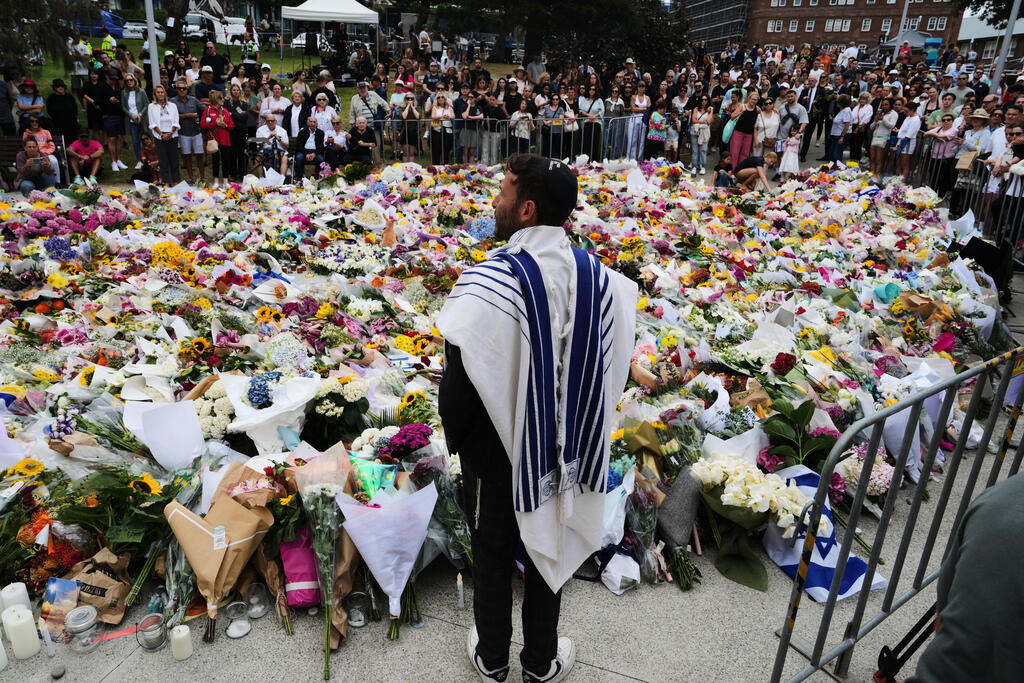
(Photo: AP Photo/Mark Baker)
Yet only a few weeks ago, Australia was shaken by an event that stood in stark contrast to everything celebrated on this day. A brutal terrorist attack, the cold-blooded murder of innocent people whose only wish was to celebrate the lighting of the first Hanukkah candle.
The attack undoubtedly shocked and rattled the Jewish world everywhere. Still, it is hard to say that many Australian-Jews were truly surprised. Antisemitism in Australia today is unprecedented for a country where Jews had lived in peace for so long. For some time now, members of the Jewish community have been reporting violent incidents and warning of a growing sense of insecurity. Many have long argued that such an attack was only a matter of time, warnings that were met largely with governmental indifference.
This brings us to the events of the following day: International Holocaust Remembrance Day. In Israel, we of course commemorate Holocaust Remembrance Day later in the year, but the world chose January 27 to mark the occasion - the date on which Auschwitz-Birkenau, the ultimate symbol of evil and the most systematic annihilation of a people in history, was liberated. The day is observed globally through ceremonies and official speeches at the United Nations and in parliaments, speeches that seek to honor the memory of the Holocaust, yet in practice have had limited impact on a collective memory that continues to erode over time.
The original purpose of the day - to underscore the global community’s commitment to Holocaust remembrance and to the enduring promise of “Never Again”- seems today more vital than ever. It is a promise that must be actively upheld.
It is hard to overlook how frequent these events have become. So frequently that we forget that we move on to the next tragedy. Much like the world’s growing willingness to forget the horrors of the Holocaust, as denial becomes increasingly widespread, the world has largely moved on from Bondi as well. Governments are often uncomfortable acknowledging that such atrocities can happen within their own borders.
These realities are not reflected only in statistics or headlines; we encounter them directly in conversations with young Jews who come to Israel through Masa Israel Journey from around the world. Whether from New York or Paris, Johannesburg or Sydney, the stories are strikingly similar. Young members of our people are growing accustomed to life in communities that require heightened security and consciously avoid standing out for fear of repercussions. At the same time, there is some solace in the fact that such moments often strengthen Jewish identity, a sense of belonging, and a shared destiny.
The proximity of these days recalls the Jewish community in Sydney, still reeling from its wounds, as well as Jewish communities worldwide, large and small, that may have already endured similar events or fear that such violence could strike them next. The very fact that we continue to live with the constant fear of such barbaric attacks only underscores the urgent need for a meaningful observance of International Holocaust Remembrance Day, one that goes beyond slogans and truly educates about the devastating consequences of antisemitism, incitement, denial, and, above all, indifference.
And yet, even in this fragile moment, there is hope - and an opportunity.
Hope comes from the Australian government, that is now advancing some of the most stringent legislation in the country’s history to combat weapons, incitement, and antisemitism. The Prime Minister has emphasized that just as antisemitism and racism run counter to Australian values, they must also stand in opposition to Australian law.
 Meir Holtz
Hope is also reflected in local initiatives, such as the New South Wales government’s effort to channel collective grief into positive, shared action through the initiative “One Mitzvah for Bondi", encouraging acts of kindness, solidarity, and mutual support in response to the attack.
That hope is embodied as well in young, idealistic Jews with strong identities who continue despite everything - who continue to come to Israel, continue to celebrate their Judaism, and refuse to bow their heads to hatred.
This hope will continue to shine a powerful light, one that reaches Australia as well. Today, as Australia marks its national day and its aspiration for social cohesion and community, we wish it the strength to raise its head in the face of hatred and to reaffirm its commitment to freedom for all its citizens, most certainly for Australia’s beautiful Jewish community.
Meir Holtz is the CEO Masa Israel Journey