

On the eve of the strike on Iran, U.S. officials envisioned a four- to five-day operation that would return a weakened Tehran to the negotiating table. According to one source, an American official conveyed an even more immediate proposal. Through a mediator, apparently Italy, he suggested reaching a ceasefire agreement today or tomorrow. Iran rejected the idea outright.
Supreme Leader Ali Khamenei was killed. Also killed at the outset of the operation were Iran’s defense minister, the chief of staff and the commander of the Revolutionary Guard. It is an extraordinary intelligence and operational achievement. In Israeli Air Force history, it will likely be remembered alongside the killing of senior officials in the previous operation in June and the destruction of the Egyptian Air Force in the first hours of the Six-Day War.
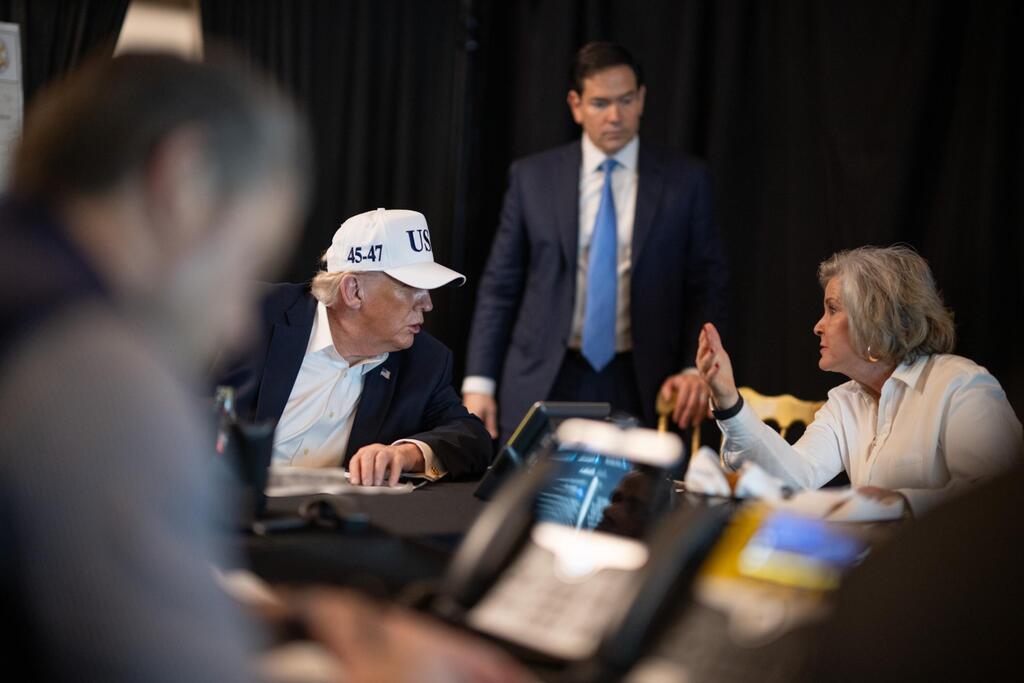
Trump in the situation room at Mar-a-Lago
(Photo: The White House)
And yet the ayatollahs’ regime has not collapsed. It is currently being run by a council of senior officials. The summary of Operation Rising Lion showed that the Iranian regime knows how to survive the loss of its top figures. The survival of the regime matters more than the survival of its people.
The question of what will happen when the regime formally announces that its supreme leader has been eliminated remains open. Nothing may happen; it is possible that Shiite proxies in Lebanon, Iraq and Yemen will be forced to join the fight with full force, even at great cost; it is also possible that opponents of the regime inside Iran will flood the streets.
For all the amazement over the first day’s military achievements, it is worth remembering that until it is over, it is not over. A single oil tanker sunk in the Persian Gulf, a U.S. aircraft carrier hit by a Houthi commando boat, dozens of American soldiers killed at a regional base, a spike in oil prices, any of these could complicate matters for Trump with voters at home.
Trump can end this operation in three ways that can be marketed as success. One, a severe military blow that weakens the regime internally and externally. Two, a surrender agreement on the nuclear issue. Three, the fall of the regime. The first is realistic, the second less so. The third is Trump’s great hope and his major gamble, but he understands that this objective will not be achieved immediately.
A country seeking to impose regime change on another must send its soldiers to seize the other side’s strongholds. That is the meaning of "boots on the ground". Trump does not intend to dispatch troops into the streets of Tehran. His version of boots on the ground is the millions of Iranians who are fed up with the Islamic Republic. On Saturday, he urged them to stay home. Later, he may call on them to go out.
From an American perspective, this is a war of choice. Iran did not pose a direct threat to the United States. Even its nuclear project does not necessarily constitute grounds for war. Trump has come to terms with North Korea’s nuclear weapons, let alone those of India and Pakistan. The Iranian regime slaughters its own citizens, funds terrorism and amasses a dangerous arsenal, but these are not matters that weigh heavily on Trump.
The attack on Iran is highly unpopular in the U.S., both among Trump's critics and his staunch supporters. Until recent days, it was not even on the public agenda. The decision to strike Iran is his way of declaring, I am MAGA, I restored America’s greatness.
In the first Gulf War, President George H.W. Bush could have pursued Saddam Hussein to Baghdad. He chose to settle for expelling Iraqi forces from Kuwait. In the second Gulf War, President George W. Bush decided to pursue Saddam Hussein to total victory and became entangled in a costly and unnecessary war. Trump is convinced he is smarter than both.
Prime Minister Benjamin Netanyahu says the current operation marks an unprecedented peak in the U.S.-Israel alliance. That is true in terms of military cooperation. It is not true in a broader sense, because the alliance is not between Israel and America as a whole but between Israel and the sitting president.
Israel is portrayed as the country that pushed America into a war that was not its own, and it even boasts of that role. That is precisely the narrative American antisemites on both the right and left have long sought. Israel may be benefiting from an emboldened Trump, but it risks alienating America in the process.
For the United States, this is a war of choice. For Israel, it is a war of necessity. Iran poses a tangible threat to Israel through its missiles, support for terrorism and nuclear ambitions. It may not be an existential danger, but it is unquestionably a serious one.
Expectations should be lowered. Israel’s past attempts to change regimes elsewhere have ended in painful failures. The achievable objective in this round is to destroy missile production facilities, launch systems and all infrastructure tied to the nuclear program. The more, the better.
It would be unwise to repeat the triumphant declarations made at the end of Operation Rising Lion in June. We did not destroy Iran’s military power then, and we will not destroy it now. They know how to rebuild quickly. But every blow to Iran’s military capability buys time, a precious resource if used wisely. With some luck, Iran’s leadership may conclude that crime does not pay and stop squandering the country’s wealth on war and terrorism.
As of the first day of the war, the IDF managed to absorb the barrages of missiles and drones. The defensive success stemmed from significant improvements in air defense, but also from Iran’s weakness. Its dispersal across eight fronts reduced its ability to launch large simultaneous barrages at Israel. Civilians were disturbed by frequent sirens, but the damage was limited.
An Israeli businessman who employs people in Israel and in Gulf states told me he sensed the difference. His employees in Israel were not alarmed. They have been through this before and emerged from it. His employees in the Gulf reacted with hysteria.
War or no war, another Israeli told me, Wolt delivery couriers continued as usual. Perhaps more than usual. Young riders with blue backpacks took over the streets, turning the war with Iran into something almost routine, with lunch delivered to their safe room doorstep.
First published: 08:52, 03.01.26