

In 1920, if you wanted to know the time, you needed a person. Every city had a “time teller.” Usually it was a clerk at the train station or the bank, whose job was to check the central clock and answer anyone who asked. It was a profession like any other and a real source of income, while people used it to feed their families and build a life.
Today, the idea sounds absurd. Why would anyone pay someone else simply to tell them the time? But then, it made sense. Clocks were expensive, synchronization was difficult and most people simply did not know the exact time. Until that changed.

I keep coming back to those time tellers lately, and the comparison is not a comforting one. Their profession did not disappear because a machine did their work better, but because it turned out there had never really been a need for a person to do it. Once the problem was solved, the job itself was revealed as unnecessary. And I wonder what it felt like to be one of them when they realized that.
I fear we are about to discover that many of the professions we consider “essential” are, in fact, modern time tellers. That includes people I love. Friends. Family members. It is not that AI will replace them. It is that they knew things we did not. Now we can know them ourselves. That is liberating and frightening in equal measure.
Pay 4,000 shekels for a lawyer, or ask ChatGPT in 30 seconds
Take the average lawyer. Most clients ask standard questions, such as how to cancel a rental contract, what rights I have if I am fired, whether an agreement is fair.
These are not complex legal problems; they are questions with existing answers. In the coming years, the lawyer may become the "time teller" of the law. Once I can get the same answer from ChatGPT in 30 seconds, the real question is not whether the lawyer is better than AI, but rather why I needed the lawyer in the first place.
This realization is brutal because it does not apply to everyone equally. It applies precisely to the “professional” layer: the upper-middle-class world of white-collar experts. Accountants who handle standard tax returns, investment advisers who sell generic portfolios, architects who plan routine additions, mortgage consultants and insurance agents; they are all in the same boat.
These are people who studied for years. People with offices, assistants and mortgages. People who believed they had built a safe profession for themselves.
And there is another realization, perhaps the most unsettling one: many of these experts already use AI themselves. They simply do not tell you. The lawyer asks ChatGPT before answering your email. The accountant runs the numbers through Copilot. The doctor uses AI to help with a diagnosis. In other words, we are already living in a reality in which we pay thousands of shekels for answers we could receive from AI ourselves.

Paying thousads for nothing?
(Gemini and ChatGPT)
Imagine paying a lawyer 4,000 shekels and walking out with the feeling that the advice was nothing special. What could you compare it to? Until recently, nothing.
Today, you open your phone, describe the same case to AI and discover that you received the same answer. No hourly billing, with clearer explanations. It is a strange moment, because you do not know whether to feel cheated or simply very smart and technologically advanced.
The real trouble begins when people who grew up with AI walk into your office. They will not be dazzled by a polished presentation or a well-worded document. At 25, they will ask a much harsher question: why should I pay you for this at all?
The first to be affected will be the middle layer of white-collar workers whose jobs are about transferring standard information from the book to the client: the accountant preparing routine tax returns, the lawyer drafting a rental contract, the insurance agent matching a policy according to a table.
They will be among the first to feel the pressure, because what they sell is easy to compare, the alternative is already here and the information is only a good prompt away. Once one client realizes AI saved them 3,000 shekels, they will tell others. Slowly, the old version of these professions will begin to lose its grip. And I don't know whether to be happy about that or simply sad.
I wish I could write that human expertise will always be valuable. It would be reassuring. But it would not be honest. Some jobs simply do not require much judgment or a deep reading of the situation, and in those fields AI will take over much of the work.
Expertise will survive only where three things are true: errors carry a real cost, reality is complicated and human beings must be taken into account.
That is where the real question begins: What is an expert worth when a decent answer is available to everyone in seconds? In the past, knowledge itself gave experts much of their power. They knew the law, the studies, the figures and the professional playbook. Today, that edge has not vanished, but it has weakened enough to unsettle the old order.
When anyone can get a reasonable answer on screen, the real advantage is no longer having the information. It is knowing when that answer fails the test of real life.
That is exactly where real experts justify their fee.
A good doctor is not someone who knows how to read symptoms. A good doctor is someone who looks at you and knows that something does not add up, even if they cannot yet explain why. A good lawyer knows when to fight, when to compromise and how a specific judge they know will read the case. A good manager understands who on the team is exhausted, who is hiding a problem and which decision will look right in Excel but tear the organization apart from within.
The machine can give an answer. The expert must understand what will happen if we act on it, and bear responsibility if it goes wrong.
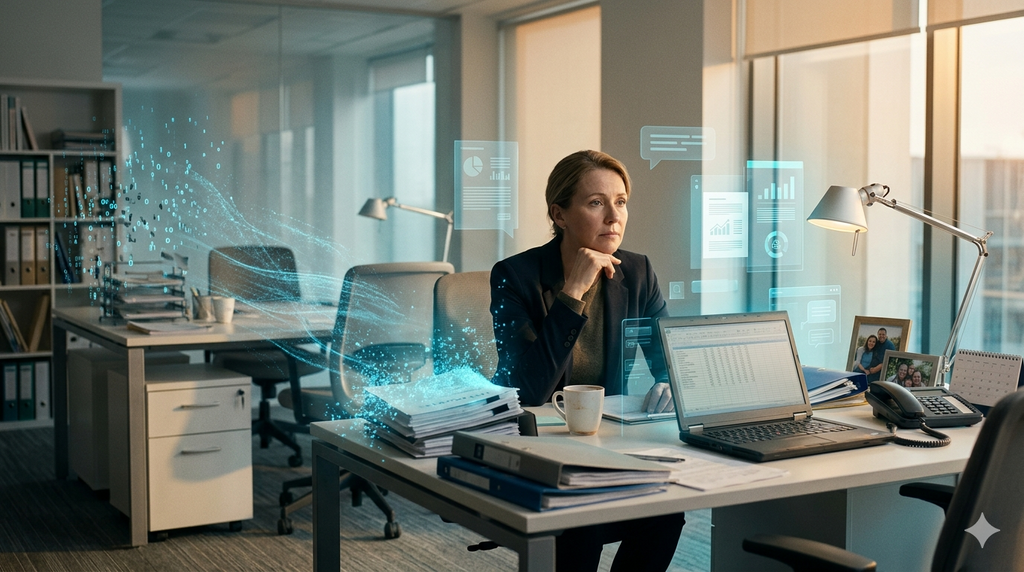
The expert has to see beyond the answer
(Gemini and ChatGPT)
For us, the clients, this is a shift in power. We need to stop paying for hours of searching and data collection. A time teller tells you what time it is. The expert of tomorrow helps you decide what to do with the time you have left. An accountant who merely submits numbers according to the law is unnecessary. An accountant who takes the numbers AI has already processed and builds a tax plan suited to your specific situation is worth the fee.
 Keren Shahar
There is one more thought I cannot shake. The time teller’s story did not end the moment someone put a watch in their pocket. It ended when people stopped noticing the profession had ever existed. There was no farewell ceremony. It simply faded away, and a generation later, almost no one remembered it had been a real job.
A quick test that could change your career
Think about your own profession. Not the title on your business card, but what you actually do hour by hour. Be brutally honest. How much of your day is real judgment: making decisions when there is no single right answer, taking responsibility when mistakes carry a price? And how much of it is really transfer: taking information from one place, dressing it in professional language and handing it to a client who might have found it alone? It is not an easy question to answer honestly. I ask it of myself again and again.
If most of your day falls into that second category, clients will slowly realize they need you less than they thought. They will get a good-enough result on their own, almost instantly and almost for free. I am sorry to put it so bluntly, but I think it is better to hear it now, while there is still time to adjust.
And if most of your day is spent on the first kind of work, do not get too comfortable. AI already knows how to analyze and make recommendations in fields that only recently seemed uniquely human. It may not replace you tomorrow, but it will give a serious advantage to those who learn how to use it.
Professionals who learn to work with AI will do your job faster, cheaper and sometimes better. Either you turn yourself into an expert who uses AI, or someone else in your field will do it for you. And then you will be the time teller no one needs anymore. I truly hope that will not be you.
Keren Shahar is a consultant and lecturer on applied artificial intelligence in organizations