


According to experts, Iran’s leadership is divided and torn between statesmen and fanatics, between realists and Islamists. The latter, many of them commanders in the Revolutionary Guards and security police who have found themselves in senior leadership positions, are blocking any agreement or compromise with the United States.
They increasingly display traits of zealous fanaticism reminiscent of the historic Nazi regime: detachment from reality, belief in miracles, indifference to the real economic and social condition of their country’s people and army, and the mass killing of regime opponents. They are willing to sacrifice Iran’s future and accept its destruction, just as Nazi leaders were willing, in March, April and early May 1945, to sacrifice Germany and accept its destruction. They persisted until Allied soldiers forcefully knocked on the doors of their headquarters.
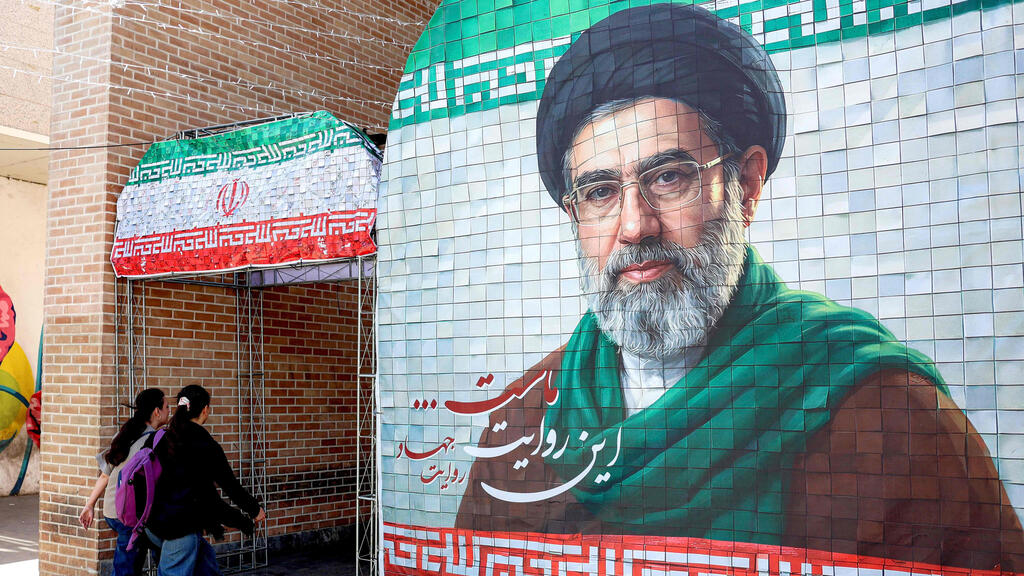
Iran’s Supreme Leader Mojtaba Khamenei on a street in Tehran
(Photo: AFP)
In the final 24 hours of April 1945, historian Volker Ullrich writes in his book Eight Days in May, hours before Hitler’s suicide in the fortified bunker in Berlin, American planes scattered propaganda leaflets over Munich calling on residents to take to the streets, overthrow Nazi rule and prevent bloodshed whose outcome was already known.
In response, a small local liberal anti-Nazi underground group launched a rebellion and even managed to seize control of one radio station. But its pleas for the men and women of Munich to join the uprising went unanswered. No one rebelled.
“The residents of Munich and the surrounding area preferred to wait,” Ullrich writes, “and the Nazi order was restored within a short time.” The rebels, those who failed to escape, were captured and brutally murdered by the SS.
Nazi rule ended only when columns of the U.S. Army entered the city center without encountering any resistance. After they arrived, masses of white flags were hung from Munich’s balconies and windows. Suddenly, there were no Nazis left in the most Nazi city in Germany.
Fanaticism and terror ruled Nazi Germany not only before Hitler killed himself on April 30, 1945, but also after, when he ordered the German people not to surrender and the army to fight to the last soldier. In his will, Hitler appointed Adm. Karl Dönitz, the navy commander and a Nazi loyalist to his core, as head of the German state, which was already almost entirely occupied.
Dönitz formed a functioning and belligerent wartime government cabinet. “Even after Hitler’s death,” Ullrich recounts, “the fierce battles between the German Wehrmacht and the Allied armies continued with great intensity.” The lost war did not stop on its own. A large majority of Germans, Ullrich noted with sorrow, saw unconditional surrender “not as liberation but as defeat, a national tragedy.”
The Germans did not overthrow Nazism by themselves, even though an overwhelming majority had lost faith in Hitler and did not mourn his death. They lost faith — and stayed silent. They lost faith — and did not rebel.
On May 10, 1945, in a special radio broadcast from his exile in California, the great German writer Thomas Mann hurled the bitter truth at his people: “If only the Germans had freed themselves from Nazi rule in time, if they had rebelled even at the last moment, they could now celebrate their liberation, their return to humanity,” he said.
But the Germans did not bring down Nazism themselves, despite the fact that a vast majority had lost their faith in Hitler and did not grieve his death. They lost faith and remained silent. They lost faith and did not rebel.
“The Nazi Third Reich,” Ullrich concluded, “functioned until the very last second.” All that time, in towns and cities across Germany, life appeared to go on as usual. Despite shortages and danger, cafes, businesses and movie theaters remained open, and the streets were full of people.
And back to the Middle East: In recent weeks, President Trump has offered the Iranian regime reasonable agreements to end the war. The rejectionists among the regime’s leaders have scornfully dismissed his proposals, despite the blows the Iranians have suffered and will continue to suffer in the war against the United States and Israel.
If Trump nevertheless decides to wait patiently for them to wake up from their fanaticism and zealotry, he may discover that his patience was in vain. That is the hard lesson demanded by European history from 81 years ago.