

A little more than 11 years ago, Angela Merkel, then Germany’s all-powerful chancellor, wanted her Obama moment. Instead of the “Yes, we can” slogan used by the president who led the Western world alongside her, Merkel chose a similar phrase: “Wir schaffen das” — “We can do this” — she said of the challenge of absorbing more than a million refugees, most of them young men fleeing wars in Muslim countries.
For the German public, this culture of welcome marked a high point in Germany’s effort at historical redemption. The record had flipped. From the nation responsible for the greatest manifestation of evil in history, Germany had become a standard-bearer for human rights.
(Photo: Matthias Schrader/AP)
Except it turned out Germany could not do it, and the challenge became a crisis. Whichever way you look at Germany today, the writing on the wall is enormous: “Caution: deadlock. Closed for repairs.” There is a housing crisis, a collapsing economy, an enormous energy crisis, a security crisis to the east that includes relentless hybrid attacks by Russian intelligence, a crisis with America, Volkswagen — the “people’s car” — laying off tens of thousands of workers and closing factories, a trade crisis with China, Trump and his whims, Germany’s sense of being orphaned by Mother America, a NATO crisis and trains — another source of German national pride — that never arrive on time. And that is only a partial list. Even the German national soccer team has become just another team.
It is neither possible nor fair to blame the refugees for all these crises. They are blamed mainly for matters involving Germans’ sense of personal security, particularly among Jews. Germany and every European country need immigrants. The continent faces a birthrate crisis and its countries need workers.
There were two problems with the refugees who arrived in 2015. The first was that the war in Ukraine in 2022 brought hundreds of thousands more refugees to Germany, giving residents an opportunity to compare Muslim-Arab immigration that often lived alongside German culture with European-Christian immigration that sought to enter mainstream life as quickly as possible.
The second, and more fundamental, problem was how the decision to accept the refugees was made and carried out. In the eyes of many Germans, the political, cultural, academic and legal elites of Berlin, Hamburg, Munich and Frankfurt imposed a new reality on them. Nobody asked them.
That crisis brought Alternative for Germany, or AfD, back to life. The party was originally born against the backdrop of the economic crisis. The refugee challenge went on to shape its agenda: a fascist party with fascist ideas, hostile to immigrants, pro-Russian, in favor of breaking away from the European Union, with antisemitic overtones and an effort to diminish the place of Holocaust remembrance in German history.
The party’s popularity has created an absurd domino effect.
Because AfD is regarded as a threat to the German Constitution, accused of undermining the foundations of democracy and monitored by Germany’s domestic intelligence service, every other party is doing everything possible to keep it out of the political game.
That means the Social Democrats, the Greens and the conservatives — parties that have almost nothing in common — form governments around a single objective: excluding AfD.
Germans looking for answers to all their troubles and problems are left with governments unable to agree on the issues most critical to German society. Many voters have grown tired of the traditional parties and are turning to AfD’s promises.
In the last federal election, AfD doubled its strength, became the second-largest party and the leading opposition force. It now leads the polls with 28% support, eight percentage points ahead of the conservatives in second place.
Where Germany was in 2016 and where it is today
Yesterday’s results in the state of Saxony-Anhalt represent another escalation. Nearly 44% of eligible voters in the state cast their ballots for AfD. Some 250,000 first-time voters chose AfD. The party has a future.
At its current numbers, AfD could join forces with Sahra Wagenknecht’s party, another pro-Russian movement with fascist overtones, and form a government.
The elites in Berlin, Hamburg, Munich and Frankfurt have been demanding for some time that AfD be banned. But that is a typically German treatment: lift the rug and sweep the dirt under the sofa. Germany needs a thorough Passover cleaning.
It wants to eliminate the symbol. But AfD’s content and substance remain. Unfortunately for the elites, they cannot revoke the voting rights of 30% of the country’s citizens.
Nor can one claim that 44% of Saxony-Anhalt’s residents are Nazis, far-right extremists or antisemites. There is such a hard core, but it is negligible compared with the majority of AfD voters who are simply fed up, feel neglected and believe nobody listens to them. They are willing to accept AfD’s empty promises because at least the party appears to care about what they have to say.
It is worth remembering where Germany stood in 2016 and where it stands today. That gap explains AfD’s popularity. Back then, Germany had conquered Europe without a single tank. It was still intoxicated by its fourth World Cup championship, powered by enormous economic strength and brimming with self-confidence. It led the camp fighting for human rights and against the climate crisis. This was the new Germany, the one that even persuaded thousands of Israelis to forgive it and move there.
Germany today is economically battered and politically paralyzed. From a country devoted to pacifism, it has become one of the world’s leaders in the arms race and is openly declaring its ambition, once again, to build the strongest military in Europe.
The leftist-Islamist alliance has made its public space dangerous for Jews and even Germany’s attachment to Israel and concern for its continued existence are now in question.
 Zeev Avrahami
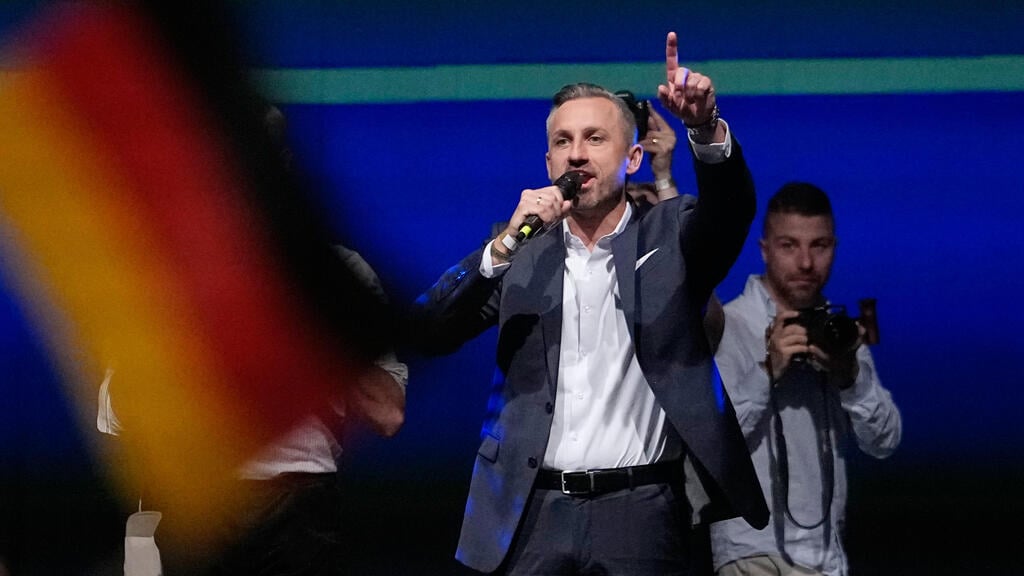
 AfD offers, well, an alternative. It offers an immensely charismatic figure in Ulrich Siegmund, a TikTok star who gives everyone he speaks with the feeling that he cares about them.
There should be no mistake: AfD is a dangerous party — dangerous to democracy, the law, public order, Jews, the judiciary and democratic institutions. An AfD government would give the party access to classified information and, combined with its sympathetic line toward the Kremlin, that would create an especially toxic cocktail. Given Germany’s history, it is almost unbelievable that a party like this could achieve success on such a scale.
But AfD is succeeding mainly because the other side currently offers no alternative at all. AfD has not moved an inch over the past decade. Its principles are the same principles, its words are the same words and its platform is the same platform. It has not moved. Germany and most of its citizens have — in two opposite directions.