


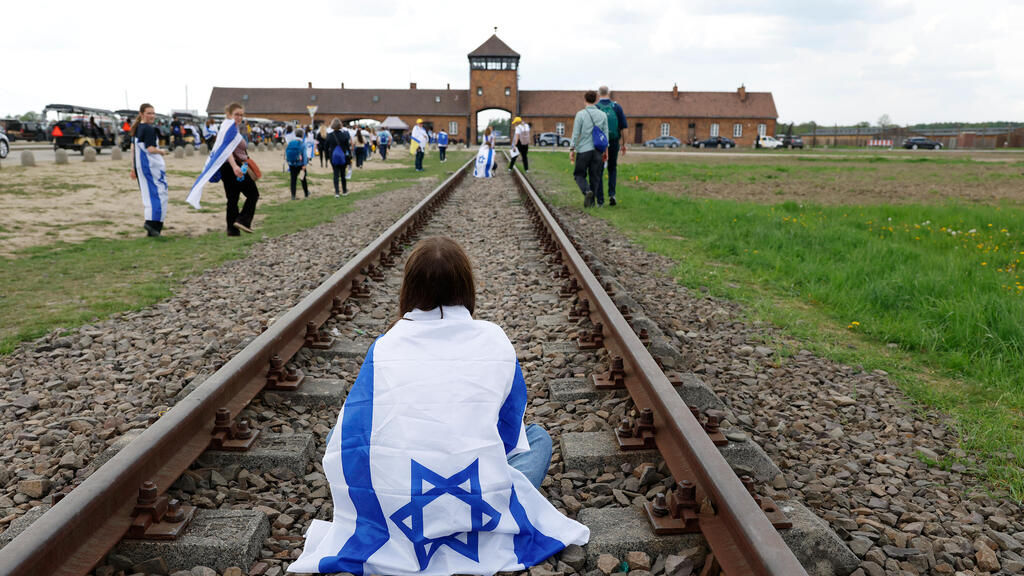
For 20 years, since January 27, 2006, the world has marked International Holocaust Remembrance Day. Yet it seems that little has been learned. The United Nations chose the date marking the liberation of Auschwitz-Birkenau in 1945 to remember what can happen when human beings, in this case Jews, are treated as “the other”: inferior, threatening, dangerous. Events are held mainly in countries with Jewish communities, but also in Asia and even in Arab states.
At the same time, antisemitism is raging at levels not seen in many years. One can debate whether anti-Zionism, which holds that the Jewish people alone are not entitled to self-determination in their own homeland, is antisemitism or merely a political worldview that happens to exclude Jews. One can also argue over when criticism of Israel is legitimate and when it becomes a contemporary expression of antisemitism. But there is no debate that a terror attack on a synagogue, or on people celebrating Hanukkah by the sea, is pure antisemitism.
Some will argue that this is a marginal phenomenon. Is it? At a white supremacist rally in the United States in 2017, which included praise for Hitler and accusations that Jews are destroying the world, a counterprotester was murdered. In response, President Donald Trump said there were “very fine people on both sides.” You may say this was a slip by a new president. Yet recently, a prominent conservative podcast hosted a Holocaust denier who admires Hitler and promotes white supremacy. Republicans argued among themselves over whether such views should be given a platform, but Trump backed the host, saying listeners should hear and decide for themselves. Decide what, exactly?
Although the president frequently speaks out against antisemitism and points to his converted daughter and her family as proof that he harbors no hatred of Jews, one could cite many troubling statements by him and by influential conservatives in the United States. The situation in Europe is no less concerning. In recent years, far-right parties with racist and antisemitic tendencies have gained power while expressing support for Israel. Hungary stands out among them. With local collaboration, 435,000 Jews were deported and murdered there in just seven weeks toward the end of the war, including many of my own relatives. That history has not prevented Prime Minister Viktor Orban from attacking liberal philanthropist George Soros, a Holocaust survivor, using language that echoes classic antisemitic propaganda about the manipulative international Jew who controls the world.
One could argue that given Israel’s current situation, it must maintain alliances wherever possible, which may explain why, ahead of Hungary’s recent elections, Israel’s prime minister appeared in a video endorsing Orban. Alongside him were leaders of Europe’s so-called new right, including parties that Israel officially boycotts because of their antisemitic positions.
Moreover, last year, representatives of these new right parties were invited to a conference on antisemitism organized by Diaspora Affairs and Combating Antisemitism Minister Amichai Chikli. Prominent Jewish leaders and organizations opposed the guest list and stayed away. Chikli explained the move as savvy diplomacy, citing antisemitism on the left, as if it does not exist on the right, these parties’ support for Israel and their fight against radical Islam.
הנפת דגל ישראל
(Photo: Shutterstock)
A cynical use of Israel
But many of these so-called friends of Israel are not fighting antisemitism at all. They are cynically using Israel and Jews in their struggle against Muslims in their own countries, and not only on the extremist fringes. When the Jewish state gives a platform to racists, it normalizes them and harms Jewish communities in the diaspora. The discourse spreading across Europe and the United States about “the other” echoes what Jews have endured for generations. Shamefully, we must admit that this discourse also exists and is deepening within Israel itself.
On election day in 2015, with polls showing him in trouble, Benjamin Netanyahu urged supporters to vote by falsely claiming that Arabs were flocking to the polls. I imagined a leader anywhere warning that “the Jews are flocking to the polls.” A year later, MK Bezalel Smotrich and his wife explained why she should not give birth alongside an Arab woman. I grew up in South Africa, where everything was segregated, benches, beaches, hospital wards. I later served as Israel’s ambassador there after apartheid ended, and I shuddered.
There is no shortage of sweeping statements and calls for harm from public officials, including politicians and rabbis paid by taxpayers, Jews and Arabs alike, and of course chants of “death to Arabs,” to all Arabs. The peak of this trend has unfolded in recent weeks, as politicians and parties compete over who can be more determined and blunt in refusing to include Arabs in any coalition formed after the elections.
After all, Arabs, as we of all people should understand, are cast as the other: inferior and above all threatening.
- Tova Herzl is a former Israeli ambassador to South Africa and the Baltic countries, and served as liaison between the U.S. Congress and the Israeli Embassy in Washington