


Consider a scenario that is not far-fetched: a Hamas terrorist cell from Ramallah receives a shipment of explosive FPV (first-person-view) drones through the porous border with Jordan, launches them and drops them on strategic sites in Jerusalem.
Now multiply that scenario — from Tulkarem toward Bat Hefer, from Jenin toward farming communities in the region, and of course from Gaza toward Israeli communities near the border. These drones can be ordered online and easily fitted with explosives. Anyone who believes this is imaginary would be wise to wake up quickly.
Gallery
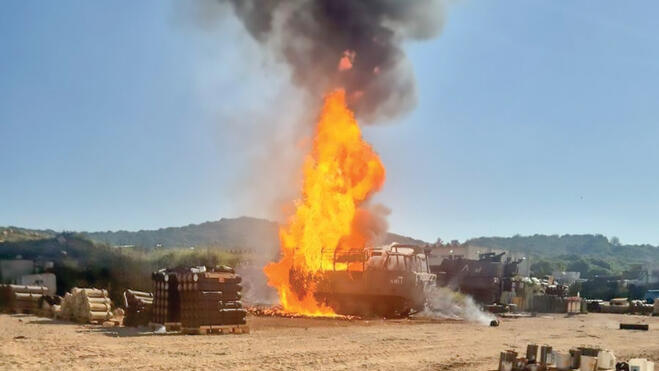
Moments after an explosive FPV drone struck an armored personnel carrier in an artillery battery on Thursday
At present, there is no Iron Dome equivalent for drones — not from Rafael Advanced Defense Systems nor from any other entity worldwide — that provides protection comparable to that against rockets. As a result, alongside preparations for a renewed confrontation with Iran, Israeli defense officials are working to find a response to a growing threat that could reshape the battlefield.
A country surrounded by hostile actors must now contend with a new reality: barriers and deployed forces can be bypassed, and at relatively low cost, swarms of drones can be launched deep into its territory.
Explosive FPV drones guided via fiber-optic cables have recently emerged as one of the most prominent threats to Israeli forces in southern Lebanon, requiring rapid adjustments in operational and defensive tactics. These drones are controlled through a thin fiber-optic cable that transmits commands and video without using radio waves, making them immune to electronic warfare jamming.
Their primary advantage is “electronic silence,” with no radio signature, significantly complicating early detection and interception. They can also operate at ranges of up to about 15 kilometers (9 miles) and carry explosive payloads, making them a precise, accessible and relatively inexpensive strike capability.
In recent weeks, several incidents have been recorded in which Israeli forces were hit by such drones, including direct strikes on combat troops and evacuation teams. One such attack killed Golani Brigade soldier Liem Ben Hamo on Thursday. These incidents underscore a shift on the battlefield — from indirect fire threats to precise drone-based attacks.
The Israeli military describes the threat as “complex and elusive” and is examining a range of possible responses, including optical detection systems, light radar and field alert mechanisms, alongside the development of advanced technological solutions.
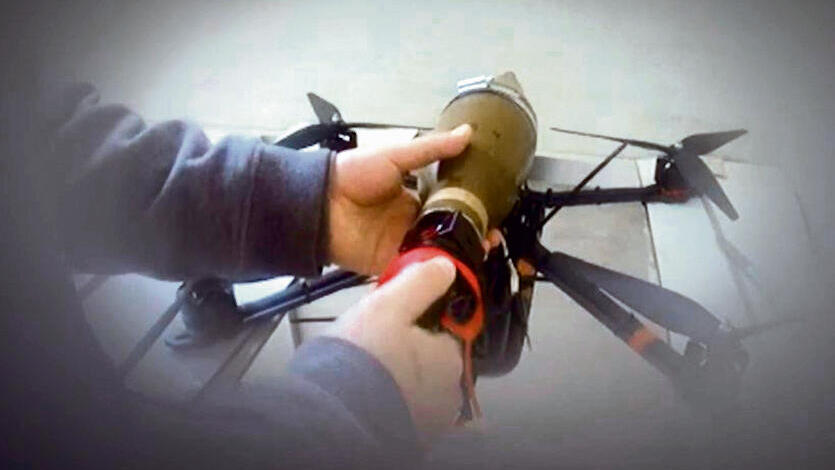
Hezbollah's drones
The emergence of fiber-optic drones, inspired by battlefields such as Ukraine, is changing the rules of engagement on the northern front and highlights a broader shift: relatively simple, low-cost tools can now challenge advanced military systems.
This threat, notably, should not have come as a surprise. It was observed in the war in Ukraine, and its appearance here was widely anticipated. The only surprise is that it did not emerge earlier, during Operation Northern Arrows in 2024.
In a meeting with the commander of the Galilee Division, Brig. Gen. Yuval Gaz, in early 2025, the primary threat presented — after Hezbollah’s Radwan force was pushed away from the border — was drones. Yet a solution has not been found.
The more serious issue is a longstanding gap within the defense establishment, as this problem has not received sufficient attention over the years. Responsibility for that gap lies, in part, with outgoing Air Force commander Maj. Gen. Tomer Bar, who is set to step down at the end of the week. He will be replaced Tuesday by Maj. Gen. Omer Tishler, who received his rank only a day earlier.
The Air Force has demonstrated an ability to operate deep inside Iran and Lebanon, carrying out complex campaigns and significantly damaging Hezbollah’s leadership and capabilities. However, its response to the drone threat has been less effective, despite notable improvement over the past two and a half years.
In contrast, the failure to address the threat of drones operating within enemy territory is considered severe. Here, primary responsibility rests with the Ground Forces, where efforts to develop solutions are only now being significantly accelerated.
Amid rising tensions along the northern border, senior Israeli military officials say restrictions on Israeli operations should be lifted and that forceful action should be taken against Hezbollah targets north of the Litani River. They argue that the supply chain of explosive FPV drones should also be targeted, alongside other Hezbollah assets, to create a “price tag” that will deter future launches.
Within the military’s senior leadership, there is growing recognition that the response cannot rely solely on defense or point interception. Current assessments indicate that existing measures do not provide a complete solution, particularly given the difficulty of detecting and intercepting such threats in real time.
“The current situation plays into Hezbollah’s hands — the rules must be changed,” officials said.
While the Air Force has demonstrated impressive capabilities in long-range operations in Iran and Lebanon, its handling of the drone threat has been less effective. In contrast, the failure to address drones operating within enemy territory is seen as a serious shortcoming, with primary responsibility lying with the Ground Forces.
First published: 11:58, 05.01.26