

Some social struggles gain momentum through persistent activism and broad public support, eventually reshaping expectations. Women’s representation in positions of power is increasingly one of them, emerging as a prominent demand ahead of Israel’s coming election.
Last week, Together chairman, former prime minister Naftali Bennett, introduced four new women joining his party: Bruria Naim, Esti Kobo, attorney Orly Harel and Olesia Kantor. The new candidates bring the number of women who have joined Yair Lapid and Bennett to 17.
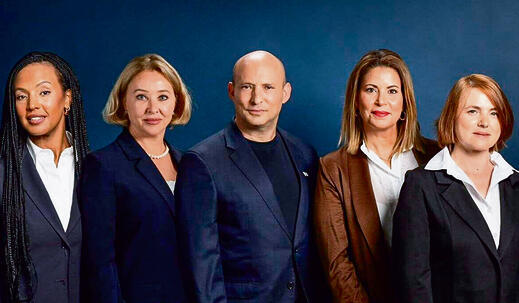
First among equals: Bennett with the party’s new female recruits
Yashar chairman, former IDF Chief of Staff Gadi Eisenkot, also announced the addition of social activist Yaffa Tebeje and Drom HaSharon Regional Council head Oshrat Gani Gonen. At present, eight of the list’s 13 members are women, more than 60%. Eisenkot has also committed to a zipper system, alternating women and men on the party slate.
The Democrats’ Knesset list is already structured in the same way, with MK Naama Lazimi winning first place in the party primaries.
Among the coalition parties, the situation is considerably worse. Two of them, Shas and United Torah Judaism, do not include women on their lists at all, while Likud currently has only one woman in its top 10, Minister Miri Regev.
The Likud primaries, due to take place next week, could change that picture, but for now the party has no formal policy of gender equality. In the Religious Zionist Party, too, there is only one woman in a realistic position on the slate, Minister Orit Strock, who finished first.
Women’s representation in Israel’s centers of decision-making is also at a low point in the government and in equally important forums, including the Security Cabinet and the senior leadership of government ministries.
Four years ago, frustration over that reality led social activist Yael Yechieli to establish the 5050 initiative. Yechieli understood that gender equality in Israel was steadily losing ground and, through intensive work and a broad coalition of partners, succeeded in embedding the concept of 5050 in the public conversation: the idea that full equality in positions of power should become the standard.
This is the classic approach of liberal feminism, which seeks to advance gender equality through political and legal reforms designed to create equal opportunity. Formal equality is a necessary first step toward change, and it is encouraging to see persistent activism on this issue actually produce results.
But equal representation primarily guarantees just that: equal representation. It has an important role in shaping society, and there is no question that a wider range of perspectives around the decision-making table benefits society as a whole.
But elected officials have different agendas and priorities, and putting women in positions of power does not automatically mean that women’s interests will be protected. Unfortunately, there are plenty of examples.
Party lists are expected to close in about a month, and only then will we discover whether the talented women brought into these parties have actually been placed in realistic positions.
With so many parties competing and Israel’s relatively high electoral threshold, further mergers are expected, potentially pushing women further down the lists once again. Female representation is essential. But it is nowhere near enough.
At present, many of the women recruited and guaranteed places in the parties may be accomplished professionals, but they have little political experience. Almost no Israeli party has senior women in its core leadership with established political records and their own agendas.
Every party is led by men who form alliances with men, negotiate with men and shape their candidate lists together with men. They are the confidants and the people driving the political conversation.
Women are not at the heart of party decision-making but on its periphery, photographed as a group around the party leader.
The announcement of four women joining Bennett’s party at the same time operates on precisely that frequency: a form of political “casting” designed to conform to identity politics and tick the box marked women, just as parties might seek to fill other identity slots such as Russian speakers or Ethiopian Israelis. The closed club where the decisions are made has yet to be broken open.
The only two female candidates who have spent years building themselves from the ground up and developing solid independent political bases come from opposite ends of the political spectrum: Naama Lazimi and Orit Strock.
Both built their standing gradually through grassroots work and the development of a clear political agenda. Their place in the leadership does not depend on gender-based placement or a favor granted by a party chairman. It rests on the political and ideological weight they themselves bring to the table.
Over the years, Israel has had other female politicians who built themselves in much the same way and developed political identities with genuine influence in this unforgiving arena.
Former Prime Minister Golda Meir is the obvious example, but many others followed: Shulamit Aloni and Geula Cohen, Limor Livnat and Tzipi Livni, Shelly Yachimovich and Ayelet Shaked.
The current Knesset includes excellent female lawmakers, but they are not in leadership positions within their parties. Alternatively, there are female MKs with strong political bases but weak performances.
Creating a layer of female leadership capable of wielding genuine power and influence over time requires several things to happen simultaneously. First and foremost, women must be willing to enter this difficult arena, articulate a political worldview and build a constituency around it.
The discussion about women’s representation also tends to overlook the unequal price of entering Israeli politics, which is aggressive, saturated with online abuse, deeply intrusive into private life and demands almost total availability.
While men entering politics often receive family and community support, women still face a double standard: they are judged both on their performance at home and on whether they display the “right” degree of femininity in public.
The threshold a woman must clear to build herself politically from the ground up is therefore much higher. Without structural support networks and party mechanisms that enable women to grow politically, many highly capable women will simply choose to exert influence from outside the system.
Another necessary step requires party leaders to understand that casting women is not enough. The move from representation to partnership is essential if genuine change is to occur.
Without real partnership at the core of decision-making, and without allowing female candidates to develop clearly defined political identities of their own, Israel will not build a meaningful generation of female leaders.
Some excellent candidates could grow into such positions. But by definition, that requires male party leaders to make themselves somewhat smaller and stop blocking the women alongside them from flourishing, even if those women might one day challenge them for the party leadership.
But responsibility does not rest only with party leaders or female candidates. It also belongs to the public. Female representation is not an act of generosity granted by the political system, but also a basic condition for that system’s legitimacy.
Building grassroots support, creating communities around female candidates and backing women who present coherent, well-developed political worldviews is how each of us can help change the picture.