

The cleanest outcome, of course, would have been for the anti-Netanyahu bloc to win, say, 70 seats. Or 65. Or even just 61, the minimum needed for a majority in Israel’s 120-seat parliament. But that did not happen. It did not even come close. Which means the leaders of the bloc, who are expected today to get the first opportunity to try to form Israel’s next government, now face two choices: bring the ultra-Orthodox parties into the coalition and rely on outside support from the Arab parties, or return to the opposition benches. They can wrap themselves in the warm, comforting blanket of “we did not abandon our principles” and watch the other side make the decisions. Continue making the decisions.
There are moments in politics when leaders have to decide what to do with their promises, declarations and carefully drawn red lines. Three things can be said about this moment. First, to be clear, this is not the hour for purists, nor is it the time for self-righteousness. There is great comfort in occupying the moral high ground, but as the Israeli poet Yehuda Amichai wrote: “From the place where we are right, flowers will never grow in the spring. The place where we are right is hard and trampled. But doubts and loves make the world fertile.” Amichai may not have had this particular political predicament in mind, but his words fit it remarkably well.
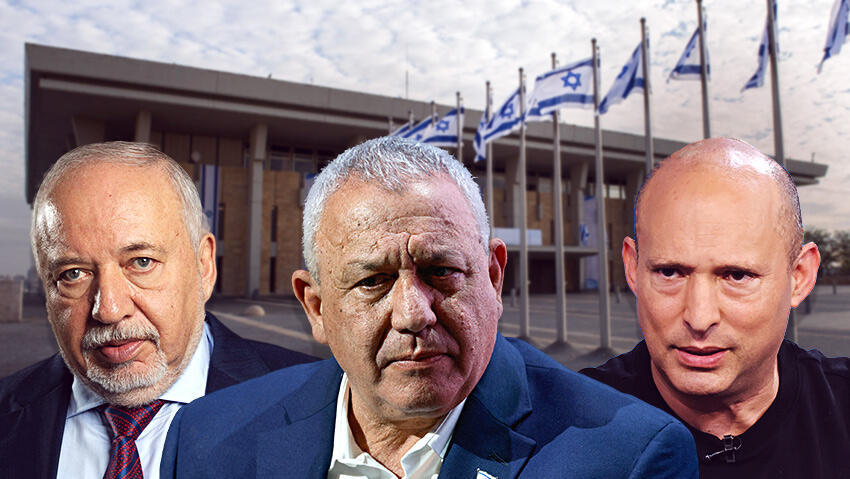
Naftali Bennett, Gadi Eisenkot and Avigdor Liberman
(Photo: REUTERS/Amir Cohen, Yariv Katz, Oz Moalem)
The second point is about politics itself, the art of the possible. A coalition with the ultra-Orthodox parties would require confronting difficult and complicated questions. The answer begins with recognizing that anyone who wants to bring about truly significant change must also know when to compromise at the margins. Israel’s not-so-distant history shows that this has been done before. In 1984, a national unity government was formed under Shimon Peres and Yitzhak Shamir. That partnership produced a series of major achievements, most notably bringing annual inflation down from an almost unimaginable 445% to 17.5%, and deciding to withdraw Israeli forces from deep inside Lebanon and establish the security zone in the south.
In 1992, Yitzhak Rabin formed a government that included both Shas, an ultra-Orthodox party, and the left-wing Meretz party, while relying on outside support from Arab lawmakers. That government brought sweeping changes to Israeli society, education, transportation and health care. It signed the peace treaty with Jordan and generated enormous hopes. The point is this: Israel now has an opportunity, and no one knows whether or when it will return, to rescue the civil service, strengthen the health system, improve education, address social distress, rebuild the north and south after years of war and restore public trust in state institutions. In other words, to do precisely what the dozens of ministers, deputy ministers, political appointees and networks of insiders failed to do over the past four years.
The third point concerns those negotiations with the ultra-Orthodox parties. They must be conducted simultaneously on the basis of clear principles and a genuine willingness to compromise. A fair sharing of national responsibilities cannot be treated as an optional extra that can quietly be buried in a footnote. Military or civilian national service, participation in the workforce, the teaching of core subjects such as mathematics and English in ultra-Orthodox schools, fiscal responsibility and protection of Israel’s democratic character must all be part of the negotiations. They must also be part of the compromise, one that creates a gradual path forward, sets measurable goals and establishes clear timetables.
“We are a fighting opposition,” Likud lawmaker Miri Regev said in May 2022, when she urged her colleagues not to support legislation that would have provided substantial tuition assistance to Israelis serving in the military. “So we don’t have any qualms.” The parties seeking to replace Netanyahu should have qualms. They should certainly have the kind that help them distinguish between right and wrong, between what is justified and what is not. But at this moment, when they have a chance to form a government of change, discomfort over making certain compromises in order to build that government is a luxury they cannot afford.