


The United States is sending a third aircraft carrier to the Middle East, a move that signals preparations for a prolonged military campaign against Iran and a clear message from President Donald Trump that Washington will not settle for anything less than Tehran’s surrender.
According to reports on Saturday, the USS George H.W. Bush has begun sailing toward the region with its carrier strike group, which includes three guided-missile destroyers. The group is expected to reach the eastern Mediterranean within 10 to 12 days.
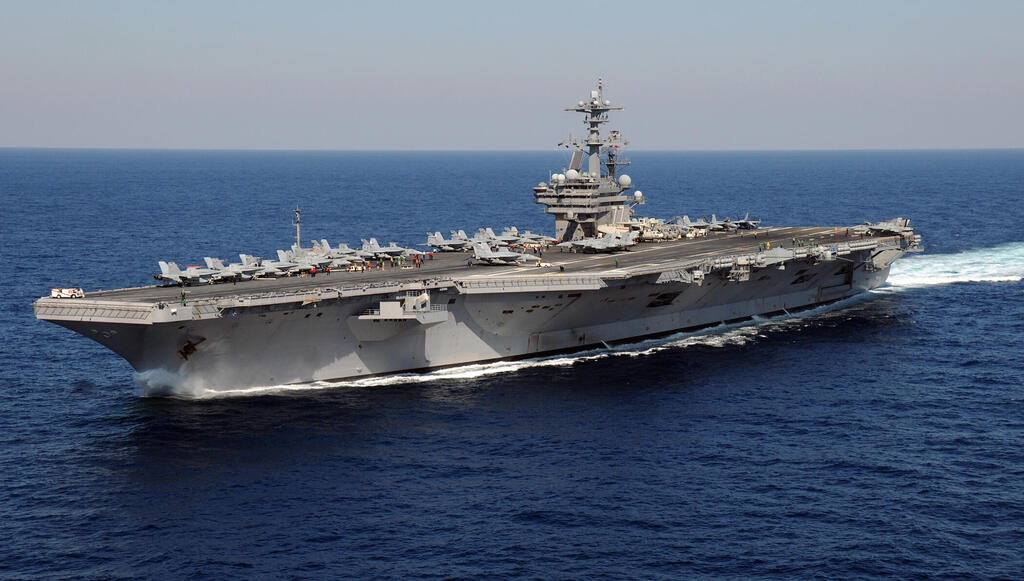
The USS George H.W. Bush
(Photo: MC3 (SW) Nicholas Hall/Wikipedia)
The deployment will make Bush the third U.S. aircraft carrier operating in the region, joining the USS Abraham Lincoln and the USS Gerald R. Ford, which are already participating in operations related to the war with Iran.
The move underscores Washington’s expectation that the conflict could last weeks or even longer.
Preparing for a prolonged campaign
According to security assessments, operating three carrier strike groups allows the United States to sustain prolonged military operations without exhausting its forces.
Such a deployment would enable continued pressure on Iranian military capabilities and government infrastructure, potentially weakening the regime while maintaining operational flexibility.
The strategy could allow sustained strikes while rotating ships and crews to prevent excessive operational strain.
Protecting oil routes through the Strait of Hormuz
Another key objective is stabilizing oil shipments through the Strait of Hormuz, a critical global energy chokepoint.
Since the start of the war, tanker traffic through the strait has reportedly dropped by about 95 percent compared with prewar levels.
Footage from the US aircraft carrier Abraham Lincoln
(Video: CENTCOM)


After U.S. forces destroyed much of Iran’s navy earlier in the conflict, the primary remaining threats are believed to be shore-to-sea missiles and fast attack boats.
U.S. officials say American forces plan to escort oil tankers through the strait and absorb the sharp rise in insurance costs that shipping companies are facing during the conflict.
The goal is to prevent a surge in global oil prices that could destabilize international markets.
Warning to Yemen’s Houthis
The immediate military signal is also aimed at the Iran-backed Houthi movement in Yemen.
The USS Gerald R. Ford and its strike group have already been deployed through the Suez Canal into the Red Sea, positioning them opposite Houthi forces.
The message from U.S. Central Command and the Trump administration, analysts say, is a clear warning to the Houthis not to escalate attacks on regional shipping or U.S. interests.
Rotation of carrier forces
Once the Bush arrives, U.S. commanders will decide whether it will remain in the eastern Mediterranean to strike targets in western Iran or pass through the Suez Canal into the Red Sea to relieve the Ford, which has been deployed at sea for nearly a year.
Such a rotation would allow the other carriers to reduce operational tempo and replenish supplies while maintaining a continuous American naval presence in the region.
The United States operates 11 aircraft carriers, meaning that within less than two weeks, more than a quarter of them could be involved in the conflict with Iran.
Two of the ships — the Bush and Lincoln — are older vessels from the Nimitz class, while the Ford represents the U.S. Navy’s newest carrier design.
Trump’s message: surrender
The deployment of a third carrier is also seen as a political and strategic signal from Trump.
According to analysts, the message mirrors the “unconditional surrender” doctrine announced by U.S. President Franklin D. Roosevelt and British Prime Minister Winston Churchill during World War II.
Trump has repeatedly stated that the United States will accept nothing less than Iran’s complete surrender in the current conflict, and the growing military buildup in the region appears designed to reinforce that message.