

Our preoccupation with the potential threat from Iran makes us blind to the actual danger posed by North Korea. The alliance between Russia, China and North Korea has created a direct arms pipeline to our region, demanding a fundamental shift in Israel's security doctrine.
For two decades, Israel’s strategic focus on Iran's nuclear ambitions, while necessary, was based on a misdiagnosis. We feared the future Iranian nuclear program was the primary sword, when the more immediate danger was always its existing terror network. The bomb was meant to be the shield, providing a nuclear defense for its proxies. This deterrent is now upended. A new geopolitical reality has emerged that provides the shield without an Iranian bomb, requiring a fundamental reassessment of our national security priorities.
Gallery

Northn Korean leader Kim Jong Un
(Photo: Alexander Kazakov, Sputnik, Kremlin Pool Photo via AP)
North Korea is not just an arsenal; it is now a laboratory. By supplying Russia with millions of artillery shells and advanced ballistic missiles for use in Ukraine, Pyongyang is gaining priceless, real-world experience on how well its systems perform against Western-supplied air defense and electronic warfare capabilities. It is no longer a theoretical threat. It is a proving ground where North Korean weapons are refined on the modern battlefield, where battle-hardened versions then become available for purchase by actors like Iran and Hezbollah. Neglecting North Korea is not a viable option because doing so means ignoring the production lines that are actively perfecting the weapons that will be aimed at Israel in the next conflict.
The development is the formation of a Chinese-led cooperative bloc—an “Axis of Immunity” united by a shared interest in challenging the U.S.-led global order. Their alignment is transforming North Korea from an isolated nation into a highly effective arsenal. Russia offers a hard military shield and advanced technology in exchange for munitions, while China provides the economic agreements that insulate the regime from international sanctions. This role was explicitly outlined by the U.S. Office of the Director of National Intelligence in its 2024 Annual Threat Assessment, which stated that "China remains a vital economic lifeline for the DPRK, and its tacit support allows Pyongyang to weather sanctions and continue its weapons development programs."
The critical race is between adversarial offense and Israeli defense. The "asymmetric acceleration" of our adversaries is no longer limited to their slow, state development of missiles. It now includes the potential "off-the-shelf" acquisition of sophisticated, proven weapons like the North Korean KN-23. This poses a direct challenge to Israel's defense establishment, leaving the Minister of Defense and the IDF Chief of Staff to determine the critical timing: whether Israel can field and scale its own next-generation defenses before its enemies can acquire and effectively deploy a critical mass of advanced projectiles from the Pyongyang logistics pipeline. The existence of this pipeline dramatically increases the consequences of this race, making any delay in our defensive preparations a potential vulnerability.
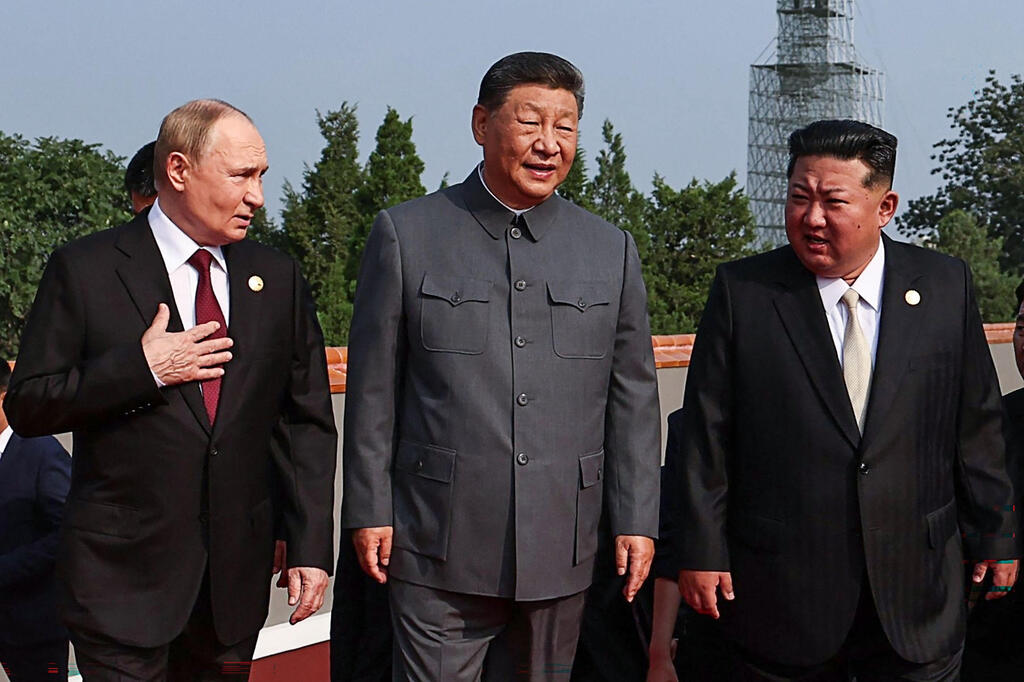
Russian President Vladimir Putin, Chinese President Xi Jinping and Northn Korean leader Kim Jong Un
(Photo: Alexander KAZAKOV / POOL / AFP)
Furthermore, this new axis has fractured the architecture of international containment. Israel’s long-standing strategy relied on a degree of consensus within the UN Security Council to limit proliferation. With Russia now using its veto to dismantle sanctions monitoring and to shield North Korea, that mechanism has lost its efficacy. The practical result was the March 2024 disbanding of the UN Panel of Experts that had monitored North Korea sanctions for 15 years. Following the veto, U.S. State Department Spokesperson Matthew Miller condemned the move, stating it "cripples the international community's ability to enforce UN Security Council resolutions" and shields Russia from accountability for its own violations.
This alignment also introduces a security vulnerability that is not amenable to traditional military solutions. A preventative strike, always a risky option, becomes infeasible against a state under the military defense of a nuclear power like Russia. This protection is no longer implicit; it is now a matter of public record. Speaking at a press conference in Pyongyang in June 2024, Russian President Vladimir Putin made the terms explicit: "I am referring to the breakthrough Comprehensive Strategic Partnership Agreement signed between us, which provides for mutual assistance in the event of aggression against one of the parties to this agreement." This agreement effectively neutralizes conventional military responses.
The current circumstances mandate a strategic realignment; an initiative should be directed by the Prime Minister’s Office. Israel's intelligence services must now elevate the Pyongyang-Tehran supply chain to a top-tier priority, on par with Iran's nuclear program itself. This trade is largely managed by North Korea's premier intelligence organization, the Reconnaissance General Bureau (RGB), which facilitates the country's conventional arms exports. Our diplomatic efforts should focus on building a broader coalition of vulnerable states—from Seoul and Tokyo to our partners in the Gulf. A common security pact should focus on using intelligence to discover and expose arms shipments and on developing joint defense strategies. The old policy of trying to contain the threat through sanctions and monitoring is no longer working. We must now actively work with our partners to intercept these weapons, because the danger of them reaching our enemies has become a much bigger threat than the risks involved in stopping them.
The traditional buffer of distance that once separated Israel from the Korean Peninsula no longer exists. The road from Pyongyang ends at our northern border. Israel's strategic doctrine must be realigned to address this reality.
- Jeshurun Hight is an academic intern at the Moshe Dayan Center and a graduate student in government at Reichman University; he studied diplomacy at the University of Oxford.