


One of the most explosive milestones of the election campaign is expected to come in about two weeks. Once candidate lists for the Knesset are finalized, proceedings will begin on requests to disqualify parties and/or individual candidates — first before the Central Elections Committee, then, once appeals are filed, before the Supreme Court.
In the past, disqualification requests focused both on parties and candidates representing the Arab sector and, on the opposite side of the political spectrum, on far-right parties and candidates. This time, however, attention is expected to center on the Arab parties, above all Ra’am, led by MK Mansour Abbas.
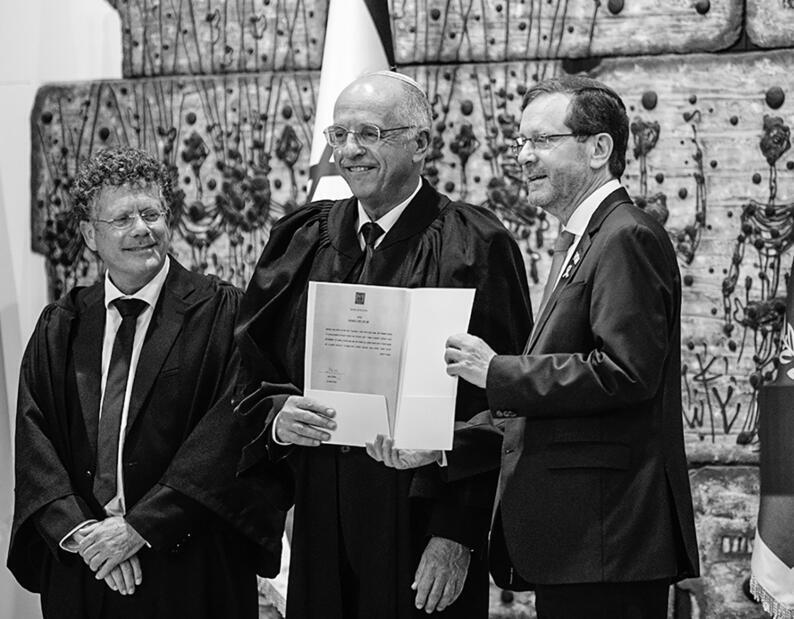
Sohlberg with Herzog and Amit; the High Court’s approach: Keep disqualifications to a minimum
(Photo: Alex Kolomoisky)
Polls project the Arab parties to win between 10 and 12 seats, potentially giving them a decisive role in the close race between the blocs. Whenever a center-left party leader is interviewed, they are asked the same question: “Would you form a government with Mansour Abbas or one supported by him?” The addition of retired police Maj. Gen. Yoav Segalovitz to Ra’am’s slate has brought the issue into even sharper focus.
Political assessments therefore suggest that right-wing parties will make determined attempts to disqualify some or all of the Arab parties from running for the Knesset. Even if those efforts fail, the attempts themselves could discourage Arab voters from going to the polls and reduce the influence of the Arab vote on the election results.
The right to vote and be elected is one of the fundamental rights in a democracy. Disqualifying parties and candidates infringes on that right and should therefore be permitted only when there are compelling grounds to do so.
“The main justification for disqualifying parties and candidates rests on the recognition that a democracy has the right — and even the duty — to defend itself against forces seeking to exploit democratic tools in order to undermine its foundations and harm its values,” said Dr. Amir Fuchs, a senior researcher at the Israel Democracy Institute.
“According to this concept, which developed out of lessons learned from the history of democratic regimes and is known as ‘defensive democracy,’ political actors who seek to abolish democracy should not be granted unlimited protection, even if they are acting through ostensibly democratic means.”
Section 7A(a) of Basic Law: The Knesset states that “a list of candidates shall not participate in elections to the Knesset, and a person shall not be a candidate in elections to the Knesset, should there be explicitly or implicitly in the goals or actions of the list, or the actions of the person, including his expressions, as applicable, one of the following: (1) negation of the existence of the State of Israel as a Jewish and democratic state; (2) incitement to racism; (3) support for an armed struggle by an enemy state, or of a terrorist organization, against the State of Israel.”
Targeting the chairman
A disqualification request is submitted to the Central Elections Committee along with arguments and evidence intended to prove that one of the grounds specified in law applies.
When the request concerns the disqualification of an entire party list, anyone may file it. In the case of a request to disqualify an individual candidate, the signatures of at least one-third of the committee’s members are required.
The party or candidate targeted by the request may submit a written response, and the attorney general also presents an opinion. The attorney general’s position generally carries significant weight, including before the High Court of Justice, but it is not legally binding.
Security agencies such as the Shin Bet are not directly involved in the disqualification process and do not brief the Elections Committee. Their position, however, is presented through the attorney general, who summarizes the professional view of the executive branch.
The committee debates the request and decides by majority vote.
The Central Elections Committee is headed by a Supreme Court justice — this time Deputy Supreme Court President Noam Sohlberg. The committee itself, however, is political in nature and is composed of representatives of the parliamentary factions according to their representation in the outgoing Knesset.
The committee chairman may participate in the vote, but over the years a tradition has developed under which chairmen refrain from doing so.
Because the coalition holds a majority on the committee, Likud is making unprecedented efforts to focus attention on Sohlberg and the committee’s professional staff. If the effort to silence the Arab vote is blocked, there will already be someone to blame.
“Disqualifying a party or candidate infringes on one of the most basic democratic rights, the right to vote and be elected, as well as fundamental rights to equality and political freedom of expression,” Fuchs said.
“It should therefore be done only in exceptional cases in which one of the grounds listed in the law is met, and on the basis of clear and unequivocal evidence. But the body making the disqualification decision is primarily a political body, whose decisions may be influenced by political considerations rather than substantive or legal ones, and it has no obligation to explain its reasoning. That is a very problematic situation.”
The constitutional and democratic crisis
While a decision to disqualify an entire party list can be appealed to the Supreme Court, disqualifying an individual candidate requires Supreme Court approval in any case.
“The court’s considerations are legal, and its consistent approach over the years has been to minimize disqualifications as much as possible,” Fuchs said. “In a series of rulings, the High Court has required solid, current and unequivocal evidence that the relevant ground exists.”
Cases in which the committee votes to disqualify are not uncommon, but cases in which the Supreme Court actually upholds the disqualification of a party or candidate are extremely rare.
Over the past 20 years, the committee has disqualified Balad in 2009, Ra’am-Ta’al in 2009, Haneen Zoabi in 2013 and 2015, Baruch Marzel in 2015, Ra’am-Balad in 2019, Ofer Cassif in 2019, Heba Yazbak in 2020, the Free Yigal Amir Party in 2020, Ibtisam Mara’ana in 2021 and Balad in 2022. In all of those cases, the High Court overturned the disqualification.
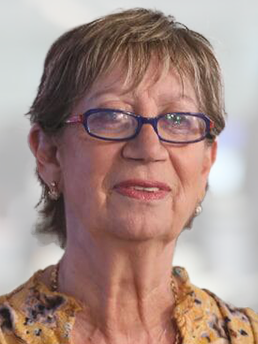 Tova Zimuky Photo: ynet
The only cases in which candidates were ultimately disqualified — not by the committee itself but following appeals to the High Court — involved Michael Ben-Ari in April 2019 and Baruch Marzel and Bentzi Gopstein in September 2019.
The court ruled in those cases that disqualification was unavoidable because of extensive and unequivocal evidence of incitement to racism against the Arab public.
The constitutional and democratic crisis, along with the deep distrust between Israel’s political and judicial institutions, could turn this process into an even more significant arena of confrontation.
“In the past as well, the court intervened quite frequently in decisions by the Elections Committee, which, it bears repeating, is a political body,” Fuchs said.
“In the current climate, we are likely to see sharper attacks on court rulings. Political actors may try to exploit this to undermine the legitimacy of the election results.
“But it is doubtful that rulings on disqualification, which have always been controversial, will cause the Israeli public to reject the results.”