

Over the past three years, Israel has worked systematically to dismantle the Iranian-led axis in Iran, Lebanon and Gaza. The central strategy has focused on striking the leadership of hostile regimes and terror organizations.
Ali Khamenei, Hassan Nasrallah and Ismail Haniyeh were removed from the decision-making chain, and successors viewed as less charismatic and less experienced took their place. In practice, however, those replacements are no more moderate than their predecessors. They remain committed to revenge and continue to advance the same extremist ideology.
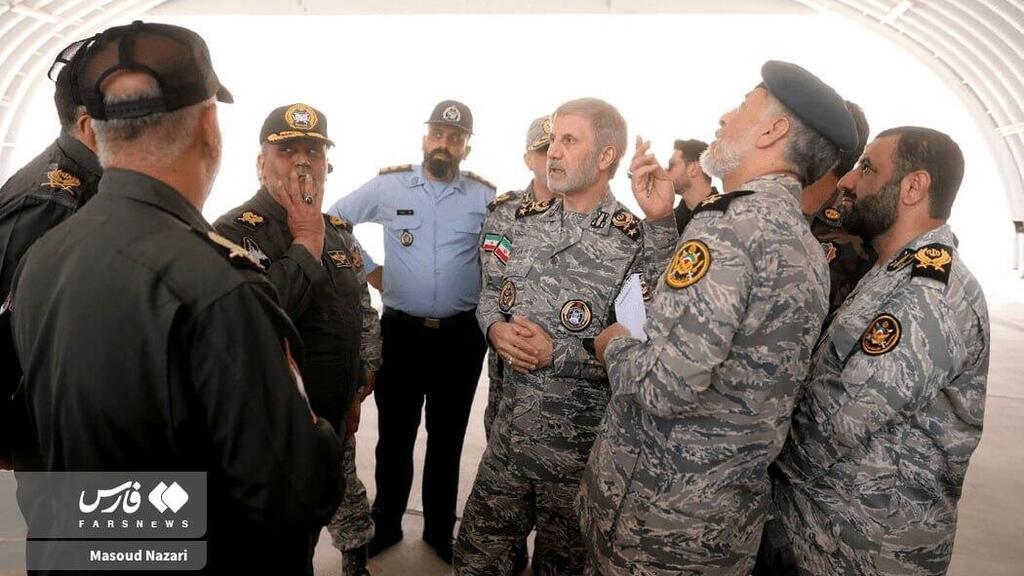
Amir Hatami, commander of Iran’s army, visits units in Isfahan
Alongside attacks on senior leaders, Israel worked to destroy the military and operational infrastructure of Hamas and Hezbollah. Those achievements were made possible by the courage of IDF soldiers and by significant intelligence and operational superiority.
But the experience in Gaza demonstrates that military success alone does not guarantee long-term strategic change.
No alternative governing mechanism was established in Gaza, and no rival Palestinian force was built that could challenge Hamas. As a result, the terror group managed to replenish much of its manpower and continued governing any area not held directly by the IDF.
Even in its weakened state, Hamas remains a significant governing force and could require Israel to maintain security operations for years.
Lebanon presents a different picture.
Israel chose to act through an arrangement with the Lebanese government, while the Lebanese Armed Forces began increasing their activity in the south. It is a complicated and gradual process that will require sustained American and Israeli support.
If it succeeds, it could undermine Hezbollah’s status and reduce its control over Lebanon without requiring an open-ended military confrontation.
Iran has also suffered significant blows. Strikes against the senior leadership of the Islamic Revolutionary Guard Corps and against military infrastructure exposed the possibility of deeper change.
At the same time, reports emerged of efforts to strengthen opposition groups, develop alternative leadership and even train and arm elements from Iran’s ethnic and political mosaic, particularly Kurdish groups.
There were also reports that Israeli intelligence considered promoting former president Mahmoud Ahmadinejad as a possible replacement for Khamenei. Ahmadinejad was viewed as more pragmatic on the nuclear issue despite remaining a conservative cleric and Holocaust denier.
But as time passed after the fighting ended, the regime managed to stabilize its control. The opportunity to turn those ideas into action gradually narrowed.
Regional tensions are now rising again, particularly around the Strait of Hormuz. Threats are being exchanged, forces are concentrating and limited attacks by both the United States and Iran are being carried out as part of the continuing struggle for deterrence and influence.
 Col. (res.) Doron Hadar
At the same time, U.S. President Donald Trump continues threatening to strike strategic regime infrastructure, including electricity, oil and gas facilities, based on the assumption that severe economic damage could destabilize Iran internally.
In my view, if the West truly seeks to end the Iranian regime, it should consider a different strategy from those attempted until now.
Instead of trying to topple the leadership from above, it should work gradually from below.
Such an approach could be based on dividing Iran into geographic regions. At each stage, the effort would focus on one area alone: weakening the regime’s capabilities there, creating conditions that allow residents to rise up and encouraging the establishment of an alternative local leadership.
Once such a leadership emerges, the international community should recognize it, provide civilian and security assistance and help it establish effective control.
Iran is an enormous country, both ethnically and geographically diverse. Any attempt to seize it or transform its regime through a single move is likely to fail.
By contrast, creating a sequence of areas where the regime loses its grip could set off a cumulative process that gradually erodes its power base.
The central lesson of recent years is that targeting leaders alone is insufficient. Extremist movements and regimes know how to produce replacements, even when those successors are less charismatic.
But when they gradually lose control over territory and population, their ability to recover is significantly reduced.
Col. (res.) Doron Hadar is a former commander of the IDF General Staff negotiating team