


Despite daily life slowly returning to routine in most of Israel, except for the Galilee, the four main fronts where the IDF is operating could still erupt. In Lebanon, active fighting is effectively underway, but because of restrictions imposed on Israel by U.S. President Donald Trump, the IDF cannot operate across the entire country or against all the targets it needs to strike.
In broad terms, the picture is this: In Iran, the United States and the Iranian regime are now waging an economic and psychological war of attrition, each trying to force the other side to accept its minimum demands in diplomatic negotiations that would lead to an end to the war.
Gallery
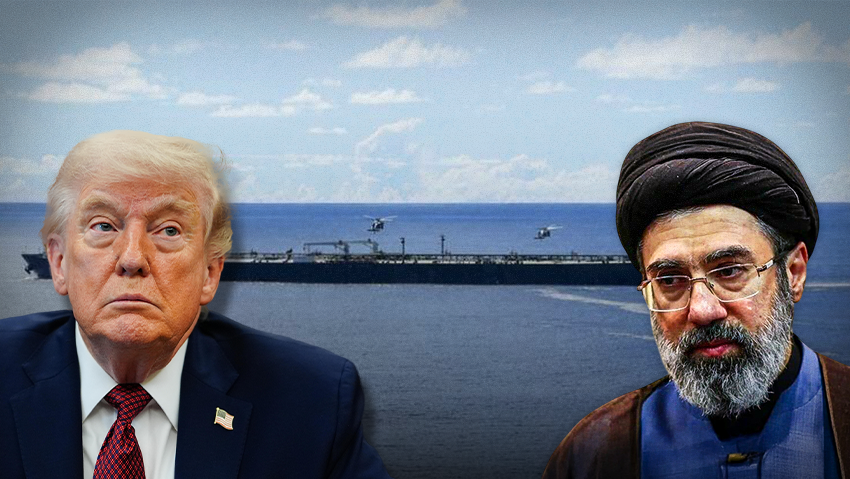
‘Who breaks first?’ Trump’s economic war of attrition against Iran
(Photo: Anna Moneymaker/ AFP, CENTCOM)
Israel, for now, is mainly watching from the sidelines and preparing in case the fire resumes. At the moment, it appears Trump intends to exhaust the damage he can cause Iran’s regime before turning, if at all, to renewed fire and strikes on Iran’s national infrastructure. This is a game for time that both the Iranians and the Americans intend to play over the next week or two.
Hezbollah tries to thwart the US-Saudi plan
In Lebanon, unless the recent sequence of rocket and drone launches and Prime Minister Benjamin Netanyahu’s order to “strike with force” lead to a change, Israel has decided to cooperate with the framework drafted by Trump and the Saudi crown prince. The goal is to weaken Hezbollah and deny it legitimacy to continue fighting through negotiations for peace and normalization between the Lebanese government, which represents most of Lebanon’s sects and most Lebanese public opinion, and the Israeli government.
This sophisticated diplomatic move will require concessions from Israel, mainly over territory it currently holds in southern Lebanon. But the White House and Riyadh believe an agreement with Iran, together with a peace agreement between the Israeli and Lebanese governments, would force Hezbollah to stop fighting and perhaps even place its heavy weapons under international supervision. That, they believe, would secure northern Israel for the long term.
Hezbollah is doing everything it can to thwart this Saudi-American move, with which Israel is cooperating. As a result, the ceasefire, which Trump supposedly extended by another three weeks, is proceeding exactly like the ceasefire declared at the end of 2024 between Lebanon and Israel. During that period, Israel continued systematically targeting Hezbollah’s efforts to recover and build up its strength.
But in the current situation, Hezbollah has decided to fight back in order to prove that it is standing on its feet and defending Lebanon, and therefore must keep its weapons.
Hamas gains legitimacy as renewed fighting draws closer
Gaza has become a secondary arena after Iran and Lebanon, and on the surface appears to be in a frozen state. Hamas refuses to disarm, which is why there has been no progress on all the other steps that were supposed to take place under Trump’s 21-point plan.
But Hamas is exploiting this situation to consolidate its rule and, apparently, to rebuild militarily. Municipal elections were held Saturday in Gaza for the Deir al-Balah municipality, which is controlled by Hamas, alongside elections in the West Bank held by the Palestinian Authority. These elections grant Hamas legitimacy, and the freeze on the ground is being used by the terror group to build legitimacy among international organizations and the Board of Peace.
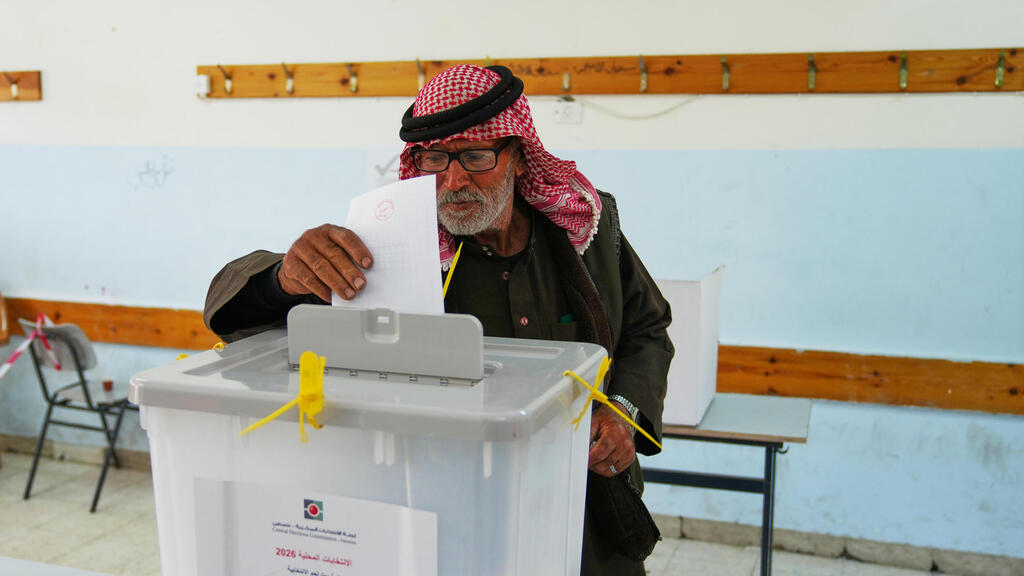
At a polling station in Deir al-Balah on Saturday
(Photo: AP Photo/Mahmoud Illean)
In Israel, officials say there will probably be no choice but to renew the fighting in order to drive Hamas out of the Gaza Strip and disarm it. But in the IDF, officials quietly say that if arrangements are not reached in Lebanon and Iran, the military will have a problem, mainly in combat manpower, carrying out what is needed in Gaza.
Chaos bordering on anarchy in the West Bank
In the West Bank, there is now a state of advanced chaos bordering on anarchy. Palestinian communities, already under economic distress, are under an increasingly tight closure imposed by Jewish rioters whose actions originate in farms on hilltops and illegal outposts between Palestinian communities. The situation there borders on anarchy, and Palestinian unrest is already visible. On Saturday, it was expressed in the entry of dozens of Palestinians into the abandoned Jenin refugee camp, despite an entry ban issued by the regional commander.
In the West Bank, Israel is struggling to enforce the law, mainly against Jewish rioters, similar to the police’s helplessness in enforcing the law in the Arab sector. The number of deaths of Palestinians at the hands of Jews is growing at a pace reminiscent of murders in the Arab sector.
The Iranian gamble
Back to Iran. It appears both sides have moved to an economic war of attrition because, from both the Iranian and American points of view, it is preferable to fighting.
As for Iran, the reason is fairly clear. Tehran’s current rulers have no effective leverage over the United States, and indirectly over Israel, except for blocking the Strait of Hormuz. The Iranians hope the damage to the global economy, and especially the energy price crisis they have created, will pressure Trump to stop the fighting.
US forces raided the M/T Majestic X in the Indian Ocean as it was carrying oil to Iran
(Video: CENTCOM)


The Arab Gulf states that produce oil are also applying pressure in that direction, and the Iranians are betting that, eventually, the American president, with gasoline prices also rising in his own country, will be forced to give in.
Trump, by contrast, is trying through a varied, systematic and comprehensive economic warfare campaign to functionally strangle the Iranian regime, and in doing so threaten the survival of the regime of the Revolutionary Guards and the ayatollahs.
Trump and his advisers chose economic warfare because they believe it can create the same threat to the Tehran regime’s survival that could be achieved by striking Iran’s national infrastructure, such as electricity, oil and gas production and bridges. Most importantly, economic warfare, of which the naval blockade is only one part, does not cause direct suffering to Iran’s civilian population.
The U.S. president does not want Iranian civilians, most of whom oppose the regime, to be hurt physically and economically by bombings of national infrastructure in major cities. He does not want Iranians to develop hatred toward the Americans and, as a result, rally around the regime. Trump, like Netanyahu and parts of the security establishment, still hopes to topple the regime through mass protests that would erupt after the war. As long as bombs are falling near them, the masses will not take to the streets.
Another reason the White House chose economic war is that the U.S. military and the IDF have more or less exhausted what they can do to the Iranian regime’s military and nuclear capabilities using air and naval fire. Now, the achievements must be preserved, and the regime must be prevented from rebuilding those capabilities for years.
An economic campaign centered on a naval blockade would indeed deprive the Iranian regime of the money, materials and contact with friendly countries such as China and Russia that would allow the Iranians to restore what was damaged. The naval blockade is not being imposed in the Caspian Sea, and Iran can receive some assistance from Russia, but not in significant quantities that would allow it to restore its nuclear and missile capabilities, as well as its air defenses, which were badly damaged.
A third reason is that a strike on Iran’s national infrastructure, including oil and gas production facilities, power stations and water desalination plants, would almost certainly trigger a severe Iranian response against oil and refining facilities in Arab Gulf states. That would worsen their economic situation and the damage to the international economy, even after the Strait of Hormuz is reopened, if and when that happens. That is why the United States prefers to use “soft” economic and psychological power, and is not rushing to resume fire.
The naval blockade and the Iranian bluff
The most important measure the United States is taking is the naval blockade. It is important to note that Washington is not limiting itself to a direct naval blockade on Iranian vessels in the Strait of Hormuz or on vessels trying to enter ports in southern Iran. The Americans are acting against the “shadow fleet” through which Iran transferred oil to China, India and other countries, bypassing U.S. sanctions on Tehran.
The Iranians, on the orders of Khamenei’s predecessor, developed an “alternative” economy that was operated mainly by the Revolutionary Guards. They smuggled oil from Iran to countries willing to buy it cheaply, and also purchased materials used to manufacture missiles and explosives, transferring them by ship from China and Russia to Iran.
The U.S. Navy is now working to thwart these smuggling operations, not only of oil but also of dual-use materials and other strategic materials, mainly through the Indian Ocean. The U.S. Navy has seized two such ships in recent days, and more action is expected.
The Iranians claim they are succeeding in crossing the Strait of Hormuz and smuggling oil, but these smuggling attempts are being thwarted by U.S. naval combat forces operating at a safe distance from Iran’s shores, far beyond the range of missiles and drones that could hit the aircraft carrier Lincoln and its accompanying destroyers, as well as the aircraft carrier Bush and its task force.
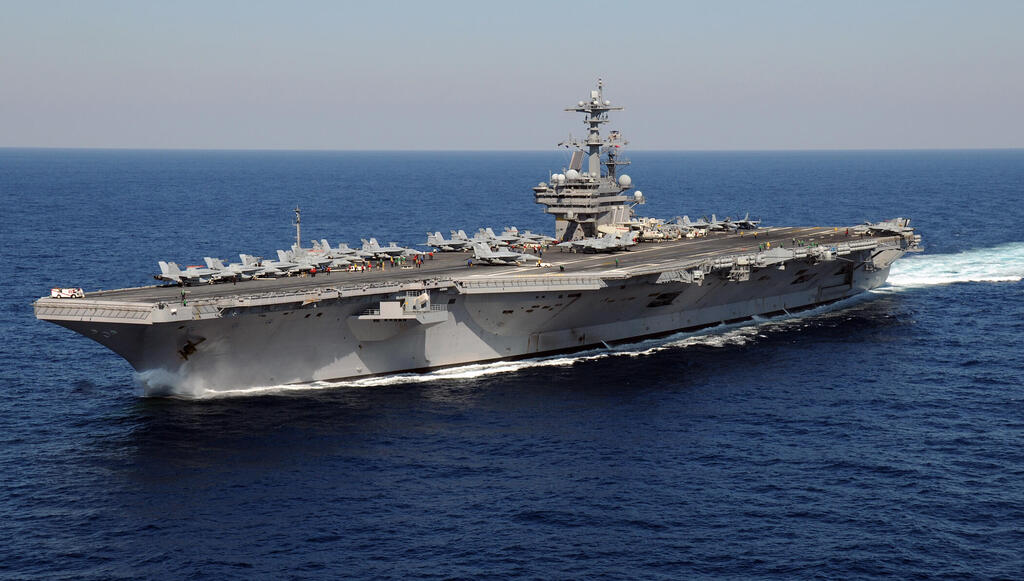
USS George H. W. Bush
(Photo: MC3 (SW) Nicholas Hall/Wikipedia)
If a tanker crosses Hormuz, the Americans wait for it and seize it once it is already in the Indian Ocean, on its way to China. So for psychological purposes, and mainly for domestic propaganda, the Iranians are bluffing. But by all indications, the naval blockade is what hurts them so much, and that is why they say they are unwilling to sit at the negotiating table as long as the blockade continues.
Alongside the naval blockade, the United States is now exerting economic pressure on Iran through every possible channel. One example is the freezing of cryptocurrency accounts the U.S. Treasury Department managed to identify and that are used by the Revolutionary Guards. CNN reported that in the past day, the U.S. Treasury succeeded in freezing, meaning denying Iran access to, $334 million by freezing digital currency accounts. This is a substantial sum that severely harms Iran’s economy, where cryptocurrencies have become an important financial tool.
According to estimates, international actors, Iran and people inside Iran have accumulated $7 billion to $8 billion in cryptocurrencies. The more interesting figure is that about half of that sum is held in digital wallets owned by the Revolutionary Guards. As every Israeli remembers, all the spies Iran managed to recruit in Israel received payment for their activities in cryptocurrencies, which they converted into cash.
It can be assumed that information about those digital currency accounts was passed to the Americans and helped them in the latest move, but that is not all. CNN reported that hackers, apparently operating on Israel’s behalf, stole $90 million a year ago from cryptocurrency accounts belonging to the Revolutionary Guards.
Another channel is sanctions on small refineries in China, with which the United States is blocking trade because they use smuggled Iranian oil. These details show that the United States did indeed prepare this economic campaign in advance. It remains to be seen whether it will succeed. The question is, who will break first economically? It is a game for time.
Time is working against Iran
Iran is playing for time, but time is working against it. The naval blockade could cause irreversible damage to Iran’s oil industry for years because the Iranians cannot export crude oil, and the storage tanks on Kharg Island and in the oil fields themselves are already full. Israel bombed most of Iran’s petrochemical industry, so they also lack refining capacity.
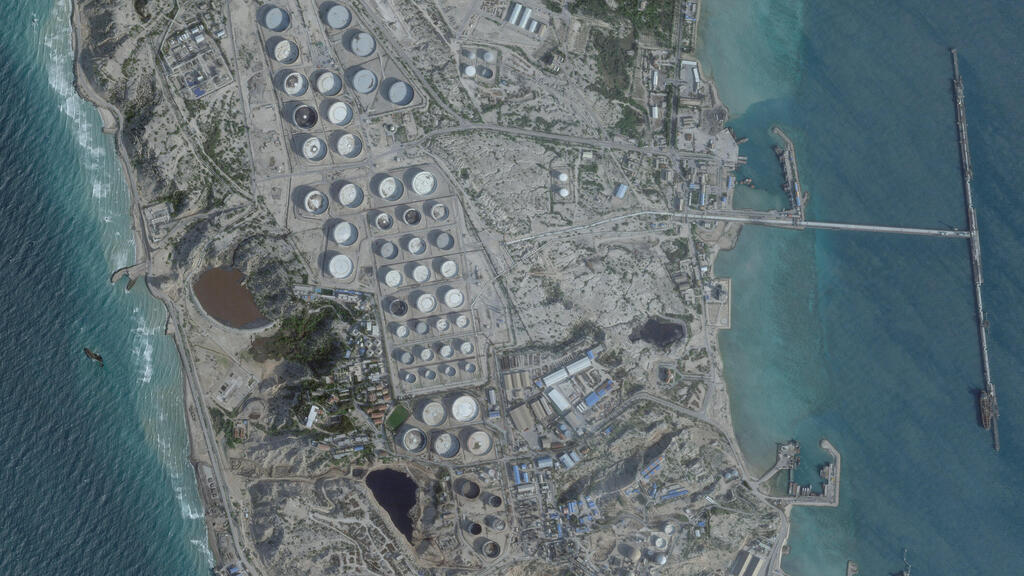
Kharg Island
(Photo: Planet Labs PBC 2026/ Reuters)
As a result, they are being forced to reduce oil extraction, and soon will have to stop it completely. That is because an inactive oil well that remains shut for several months loses the internal pressure needed for the pump to bring oil to the surface. The result is a shutdown of production in the oil field for a long time. To resume oil extraction, expensive and lengthy rehabilitation of the field’s production system would be required.
The Iranians, as noted, are counting on international pressure on Trump because of the energy crisis, and on opposition to the war inside the United States, reflected in Trump’s low approval ratings in the polls. This is not a good figure with midterm elections approaching, and Trump could lose the majority he holds on Capitol Hill. But Trump is signaling that he has time. By all indications, he hopes to repair the damage now caused to him in American public opinion through a “victory agreement” in which the Iranians surrender.
Meanwhile, the Pentagon is building up forces, while CENTCOM and the IDF are gathering intelligence and targets, and drawing up new options for striking the regime, options they did not previously have. The Iranians, by contrast, cannot do much beyond what they have already done and are doing. Therefore, the economic campaign against Iran will continue, and both sides are preparing for a resumption of kinetic fighting, while doing everything to avoid it.
In any case, Israel remains skeptical about the chances of subduing Iran through economic warfare. Israeli officials argue that only a devastating blow to national infrastructure will cause an extremist regime like the one in Tehran to agree to give up its nuclear capabilities and restrict its missile capabilities.