

A father sits with his three children in a typical Emirati living room. Suddenly, a siren sounds — the same chilling tone heard across Israel. The children tense in fear, but the father remains calm and reassuring, telling them there is nothing to worry about. One of the children runs outside, pulling out a phone to film a drone or Iranian missile. The father follows, explaining that doing so helps the enemy and warning against approaching interception debris. Firmly, he reminds them that a siren means staying indoors, not going outside.
He then recalls the days of the coronavirus pandemic, saying that Sheikh Mohammed bin Zayed had promised everything would be OK — and it was. Today, he says, it will be the same. At that moment, Mohammed bin Zayed (often referred to as MBZ) appears on screen, saying Emiratis are resilient and will get through this as well. The father turns back to his children and reassures them once again. A local version, in effect, of “together we will win.”
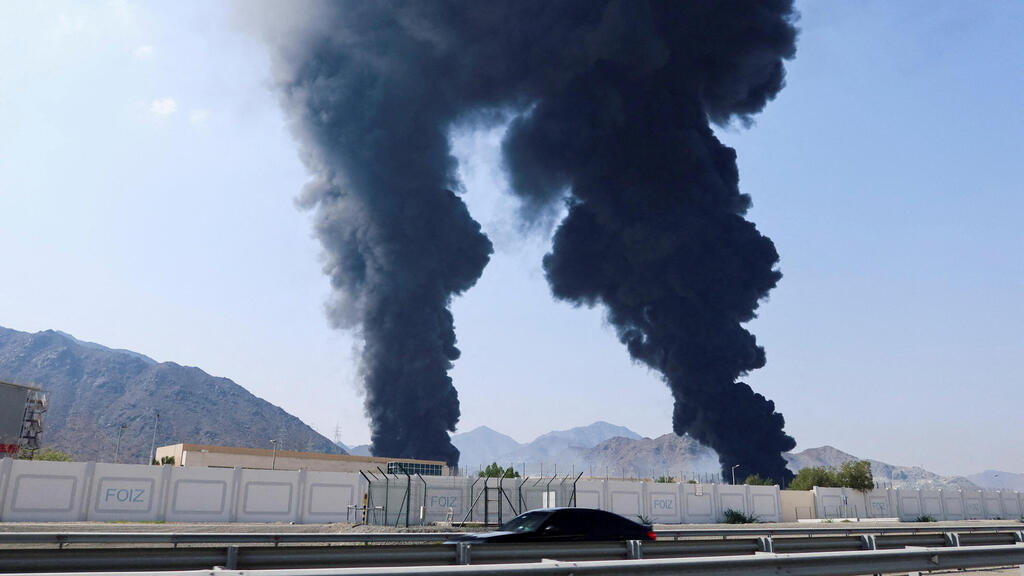
Fujairah in the United Arab Emirates
(Photo: REUTERS/Staff)
If this sounds like a public messaging video with familiar themes, that is no coincidence. A similar video was produced in the United Arab Emirates about two weeks ago and has already garnered nearly 2.5 million views on Instagram alone. It is not an isolated case. Since the start of the war, countries across the region — particularly the UAE — have been running intensive domestic resilience campaigns. The similarities to messaging in Israel are striking: calls for social cohesion, assurances that the situation is under control and clear instructions to the public.
At their core, the messages are similar because the concerns are universal. People seek safety, stability and well-being — and to avoid being harmed by an Iranian missile. But this shared narrative is not only a natural human phenomenon; it is also an opportunity for cooperation.
For years, a regional alliance has existed on the battlefield. The time has come to bring it into the realm of public messaging. A joint Israeli-Emirati campaign focused on civilian guidelines could illustrate this. The conditions are ripe: the circumstances are similar, the messages align and the concerns overlap. The potential benefits are clear. After more than a month of war, such a campaign could help reinforce public compliance with safety directives.
More importantly, the deeper message would matter just as much. An Israeli Home Front Command spokesperson wearing a kippah alongside an Emirati counterpart in traditional kandura would convey more than practical guidance. It would project interfaith tolerance and a sense of shared regional destiny in the face of a common threat — and help shape the vision many hope to see in the future.
The absence of such a campaign is not due to a lack of Israeli creativity. The system is rich in talent. Rather, Israel lacks a centralized national messaging authority tasked with assessing the broader landscape, identifying such opportunities and translating them into initiatives with diplomatic significance — linking the Home Front Command, the Foreign Ministry and the National Security Council into a cohesive strategic effort.
Such a joint campaign is just one example, but the broader point is clear. Extraordinary times create rare opportunities. The temptation to rely on familiar approaches is understandable, but without thinking outside the box, such opportunities will continue to pass by.
In his 1926 book “Sand and Foam,” Lebanese-American writer Khalil Gibran wrote that nothing unites people more than a common enemy or a shared hope. A century later, public safety messaging in Israel and the UAE could create a similar bond — and a joint campaign could serve as an effective tool not only for public communication, but for achieving far broader goals.