

The weaponized drone discovered at Leipzig/Halle Airport in Germany has reignited the debate over Europe’s ability to deal with the growing drone threat. But the more important economic story is not the drone itself. It is the identity of the organization that now needs to defend against it.
This was not a military force operating on a battlefield, but a civilian airport used for passenger and cargo transportation that also serves as part of NATO’s logistics network. It is exactly the kind of asset that increasingly blurs the line between commercial activity and national security.
Ports, airports, energy facilities, logistics centers and data centers typically sit outside traditional defense budgets. They are operated by companies, authorities and corporations that make investment decisions based on productivity, profitability and business continuity. Yet their shutdown can quickly turn a localized business disruption into an event with national consequences.
This shift is expanding the security market beyond its traditional customer base. The defense industry’s next customers will not only be militaries, defense ministries and intelligence agencies. They will also be infrastructure operators discovering that threats once considered primarily military have entered the heart of their commercial operations.
The Leipzig incident exposed a fundamental gap in Europe’s preparedness. Civilian airports may be able to invest in detection systems, but their options become far more limited once a threat has been identified. Shooting near runways can endanger aircraft, while jamming frequencies or navigation systems can interfere with aviation and communications.
The economic and technological challenge, therefore, is not simply to purchase another radar system. It is to build an integrated framework that connects detection, decision-making and a response that can be safely deployed in an active civilian environment.
From the defense industry’s perspective, the implication is clear: civilian customers are not looking for replicas of military systems. They need capabilities tailored to their specific sites, able to operate alongside existing systems, comply with regulatory requirements and evolve as the threat changes.
The opportunity is not in selling another standalone component, but in integrating different technologies into a system that can operate routinely, not only during wartime.

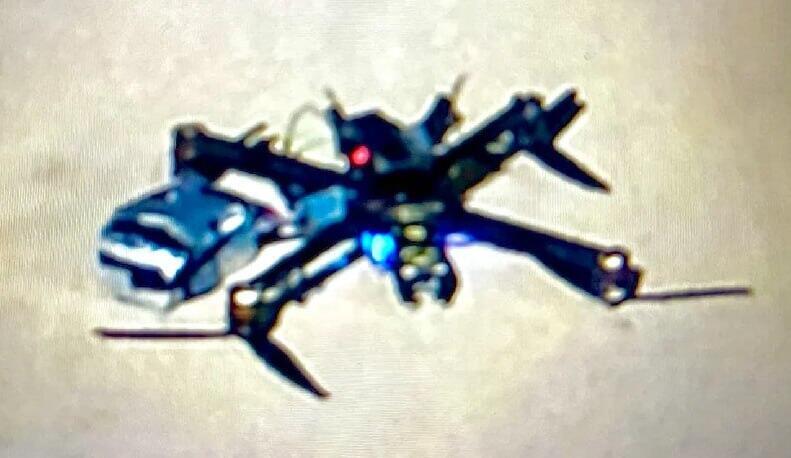
The drone lies near the runway. Another aircraft was struck 400 meters from the airport
Civilian customers also operate under a different set of constraints. They are subject to regulation, safety requirements, insurance obligations and service-continuity commitments. They cannot shut down a facility every time an alert is triggered, but neither can they simply ignore it.
They therefore need to know what has been detected, how serious the threat is, who is authorized to make a decision, and what response can be deployed without disrupting the very operation they are trying to protect.
This is where the shift from Protection to Resilience becomes important. It does not mean abandoning protection, but changing the metric by which protection is evaluated.
Instead of asking only how many sensors or mitigation systems have been installed, customers will increasingly ask how quickly a threat can be detected, how fast a decision can be made, how effectively the damage can be contained, and how rapidly essential services can continue or resume.
In the military world, a defense transaction is often associated with a major platform and a large procurement budget. In infrastructure protection, however, revenue may increasingly be generated through the integration of multiple capabilities and through long-term relationships with customers: installation, integration, training, maintenance, threat-library updates and continuous adaptation to changing conditions.
In this sense, the infrastructure-protection market may also reshape the structure of the defense industry itself. Companies offering standalone products will increasingly need to connect with complementary suppliers or become part of groups capable of delivering broader solutions.
 Eliel Schleider Photo: Ilan Besor
The competitive advantage will not lie solely in the performance of each individual component, but in the ability to make the radar, sensors, command-and-control system and response mechanisms work together as one integrated system.
For Israeli companies, this represents an opportunity that differs from the traditional surge in demand for weapons systems. Israel has extensive operational experience and advanced capabilities in detection, electronic warfare, command and control, and unmanned systems.
But succeeding with civilian customers will require companies to translate that experience into the language of operational continuity, safety, regulation and economic viability.
The sales process will also be different. Companies will not always face a centralized defense ministry that defines the requirement and manages procurement. Funding may instead come jointly from homeland-security agencies, transportation and energy ministries, and the infrastructure operators themselves.
Questions over responsibility and funding will require clearer frameworks, but they are unlikely to stop the market from developing.
The companies that succeed will not necessarily be those with the most impressive product in a demonstration. They will be the companies capable of integrating multiple capabilities into a live operational site, proving that the system does not interfere with its routine activity, and continuing to update it at the same pace at which the threat evolves.
The Leipzig incident is therefore more than another warning about drones. It signals the expansion of the defense industry into a new civilian market, where the asset being protected is commercial, the threat is security-related, and the solution must bridge the two worlds.
- The author is chief operating officer of Veloryx, a company operating in the homeland security sector.