

Since Benjamin Netanyahu returned to power in 2009, Israel has pursued covert operations, cyberattacks, diplomatic pressure and, ultimately, two wars aimed at eliminating Iran's nuclear threat. Yet despite extensive damage to Iranian nuclear infrastructure and the killing of senior political and military leaders, the central danger remains, in my assessment: Iran's stockpile of highly enriched uranium.
To understand how Israel reached this point, it is necessary to examine the development of Iran's nuclear program over the past 17 years and the four strategic mistakes that shaped Israel's response.
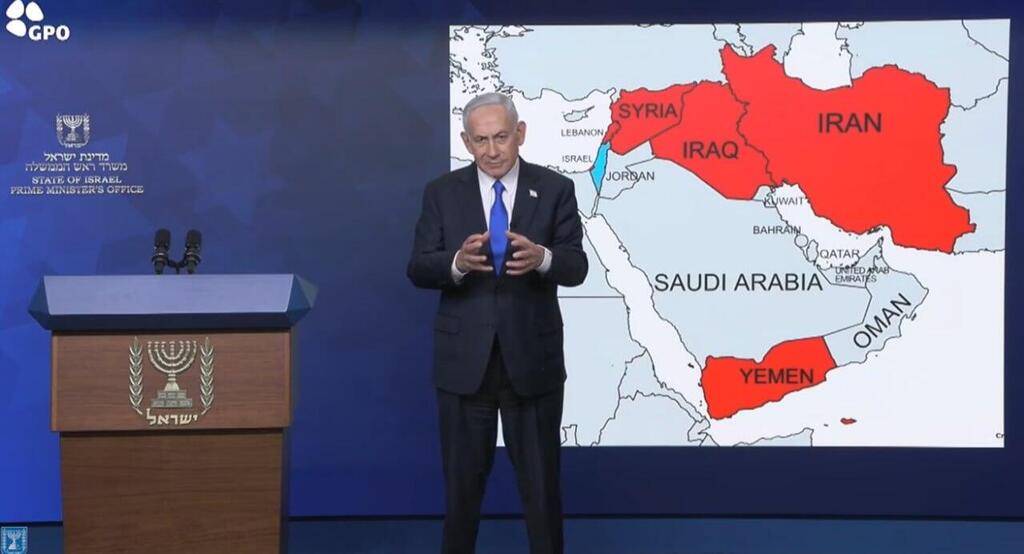
Prime Minister Benjamin Netanyahu
(Photo: GPO)
March 31, 2009: Netanyahu becomes prime minister
When Netanyahu was sworn in as prime minister, Iran operated approximately 4,000 basic centrifuges at a single enrichment facility. By August 2009, it had accumulated uranium enriched to approximately 5%, enough, if further enriched to weapons-grade levels of around 90%, for slightly more than half a nuclear bomb.
Israel prepared for a possible military strike and signaled its willingness to act, repeatedly declaring that "all options are on the table." However, according to reports published in subsequent years, opposition from senior Israeli defense officials ultimately led to a decision not to carry out the threatened attack.
2009–2013: Iran expands despite covert operations
According to foreign reports that were not denied, Israel assassinated several Iranian nuclear scientists and, together with the United States, conducted a cyberattack against the Natanz enrichment facility, destroying approximately 1,000 of its 8,700 centrifuges.
Nevertheless, Iran continued expanding its nuclear program. In 2012, it began enriching uranium at Fordow, a facility constructed deep inside a mountain.
Between August 2009 and August 2013, Iran increased its stockpile of enriched uranium ninefold. By then, it possessed uranium enriched to 5% that could, after further enrichment, provide material for more than five bombs, alongside uranium enriched to 20% equivalent to approximately one additional bomb. Its enrichment capacity had also tripled.
2013–2015: the nuclear agreement
Following intense diplomatic and economic pressure, Iran reached an interim agreement and subsequently a comprehensive nuclear deal with the five permanent members of the UN Security Council, the United States, Russia, China, Britain and France, together with Germany.
The Joint Comprehensive Plan of Action (JCPOA), signed in 2015, imposed extensive restrictions on Iran's nuclear program for up to 15 years.
Iran agreed to remove almost all its enriched uranium, retaining only slightly more than one-tenth of the quantity needed for a single bomb, enriched to no more than 3.67%. It also committed to reducing its enrichment capacity by approximately 80%, ending uranium enrichment at Fordow and modifying the Arak research reactor to prevent the production of weapons-grade plutonium.
These restrictions were accompanied by an extensive monitoring regime administered by the International Atomic Energy Agency (IAEA), including inspections of nuclear facilities, electronic monitoring of enrichment operations and centrifuge production, and continuous camera surveillance.
2015–2018: the US withdraws from the deal
Despite IAEA reports indicating that Iran was complying with the agreement's restrictions, Netanyahu pressed the United States to abandon the deal, arguing that its provisions were insufficient.
In May 2018, President Donald Trump announced the US withdrawal from the JCPOA and reimposed sanctions on Iran. Tehran subsequently began suspending its commitments in stages, while Russia and China strengthened economic ties with Iran and helped it circumvent American sanctions.
2020–2025: enrichment accelerates
According to foreign reports that were not denied, Israel assassinated Mohsen Fakhrizadeh, who headed a group of Iranian scientists responsible for preserving and advancing nuclear expertise, and conducted additional covert operations against nuclear production and enrichment facilities.
In response, Iran's parliament passed legislation requiring uranium enrichment to resume at 20% and imposing severe restrictions on IAEA oversight. Beginning in April 2021, Iran also started enriching uranium to 60%, a level representing approximately 99% of the enrichment work required to reach weapons-grade material when measured from natural uranium.
By June 2025, Iran possessed uranium enriched to 60%, a level it had not reached before the US withdrawal from the agreement. According to the estimates cited here, its highly enriched stockpile contained enough material, if further enriched, for approximately 11 nuclear weapons.
Iran also possessed approximately 21,000 centrifuges, with an estimated enrichment capacity 20 times greater than in 2018. At the same time, restrictions on IAEA inspections severely weakened what had been the most comprehensive and up-to-date source of information about the nuclear program.
June 2025–October 2026: two wars, but the threat survives
Israel, together with the United States, launched two military campaigns against Iran aimed at eliminating its nuclear threat and bringing down the Islamic Republic's leadership.
Large parts of Iran's political and military command structure were eliminated, and nuclear infrastructure sustained extensive damage. Yet the regime survived, appointing replacement leaders and commanders whom I regard as even more extreme than their predecessors, driven by military humiliation and a desire to avenge those killed.
Iran rejected Trump's demands for surrender and the dismantling of its nuclear program through an agreement. Instead, it concentrated on repairing the damage from the attacks and inflicting economic costs on Western countries through disruptions to maritime traffic in the Strait of Hormuz.
Most importantly, as far as is known, the enriched uranium stockpile was not destroyed in the strikes.
Four strategic mistakes
The first mistake: failing to strike in 2009
In 2009, Iran had only one operating enrichment facility, containing a relatively small number of outdated centrifuges and a limited quantity of enriched uranium.
A powerful military strike at that stage would, in my assessment, have stood a strong chance of halting or at least delaying Iran's enrichment activities for years. It might even have compelled Tehran to accept an agreement keeping it years away from nuclear weapons under strict international supervision, similar to the JCPOA but without an expiration date.
At the time, Iran also possessed relatively limited offensive weapons capable of reaching Israel.
Israel did not attack. By 2013, Iran had accumulated enriched uranium that could ultimately provide material for more than six bombs and had tripled its enrichment capacity.
The second mistake: undermining the nuclear agreement without preparing for its collapse
The 2015 JCPOA reduced Iran's enriched uranium stockpile by a factor of approximately 50 and its enrichment capacity by a factor of five.
That pushed Iran's estimated breakout time, the period required to produce enough weapons-grade uranium for a single bomb, to approximately one year if it violated the agreement.
The arrangement provided sufficient time to detect violations through exceptionally rigorous monitoring and, if necessary, launch a military strike capable of inflicting severe damage on Iran's enrichment capabilities.
Instead, Israel devoted its influence to undermining the agreement without preparing adequately for a military response should its collapse lead to renewed Iranian enrichment.
That is precisely what happened. Iran accelerated its nuclear activities, Israel did not launch a comprehensive military strike, and Russia and China helped Tehran circumvent American sanctions.
The third mistake: relying on limited covert operations
Rather than launching a comprehensive military attack in response to Iran's renewed enrichment activities, Israel reportedly conducted targeted strikes against production and enrichment facilities and assassinated a nuclear scientist.
Iran responded by expanding and upgrading its uranium enrichment program. The limited operations failed to prevent the continued accumulation of enriched material.
The fourth mistake: striking too late and targeting the wrong priorities
By the time Israel launched its military campaign in 2025, Iran had accumulated highly enriched uranium potentially sufficient for approximately 11 nuclear weapons.
At that stage, much of its enrichment infrastructure had become less critical to obtaining weapons-grade material because so much of the enrichment work had already been completed.
Yet Israel concentrated on eliminating political leaders and military commanders in an effort to bring down the regime, while attacking nuclear infrastructure that was, in large part, no longer essential to achieving the immediate objective of obtaining weapons-grade uranium. The remaining facilities, in my assessment, were comparatively easy to restore.
The highly enriched uranium, which had become the central element of the nuclear threat, was not the primary target of the military operation and, as far as is known, remained intact.
A different strategy is needed
Until the end of 2022, a powerful and decisive military operation against Iran's ability to produce fissile material, similar in strategic determination to Israel's attacks against nuclear reactors in Iraq in 1981 and Syria in 2007 under prime ministers Menachem Begin and Ehud Olmert, could have inflicted devastating damage on the nuclear weapons program.
From 2023 onward, however, the priority should have shifted toward destroying or neutralizing the enriched uranium itself. Neither approach was pursued when it was needed.
The situation recalls Winston Churchill's warning to Britain's House of Commons on May 2, 1935, about the failure to respond in time to Germany's rearmament. Churchill lamented that when a problem was still manageable, it had been neglected, leaving governments to apply remedies only after the situation had grown dangerously difficult to control.
Today, in my assessment, Iran could produce sufficient weapons-grade material for four nuclear bombs within four weeks using just 5% of the enrichment capacity installed at facilities that were attacked but not completely destroyed.
 Rafi Miron
A facility occupying approximately 1,000 square meters could be sufficient for such an operation, making it relatively easy to replicate and conceal. Iran also possesses additional centrifuges previously stored at other locations that could be used for enrichment.
Ynet has reported that Israeli intelligence believes Iran transferred thousands of centrifuges to what has been described as "Pickaxe Mountain," an underground site associated with its nuclear program.
The fundamental failure has been one of strategic priorities. Israel repeatedly attacked elements of Iran's nuclear program without eliminating the component that ultimately became the most immediate threat: its accumulated enriched uranium.
Israel now needs a different strategic approach and a fundamental reassessment of how to confront Iran's nuclear ambitions.
- The writer previously served as deputy head of Israel's National Security Council for technology and special affairs.