

More than 1,000 days have passed since the October 7 massacre. Yahya Sinwar’s malicious plan, known as “Al-Aqsa Flood,” sought to unite all fronts of the axis of evil with one purpose: destroying Israel and forcing the release of Palestinian prisoners held in Israeli jails.
Sinwar, who was later eliminated, and rightly so, hoped to create a single front stretching from Gaza to Lebanon, Iran and Israel’s Arab sector. He believed that a coordinated, simultaneous assault would overwhelm Israel and achieve the goals he had set.
That plan failed.
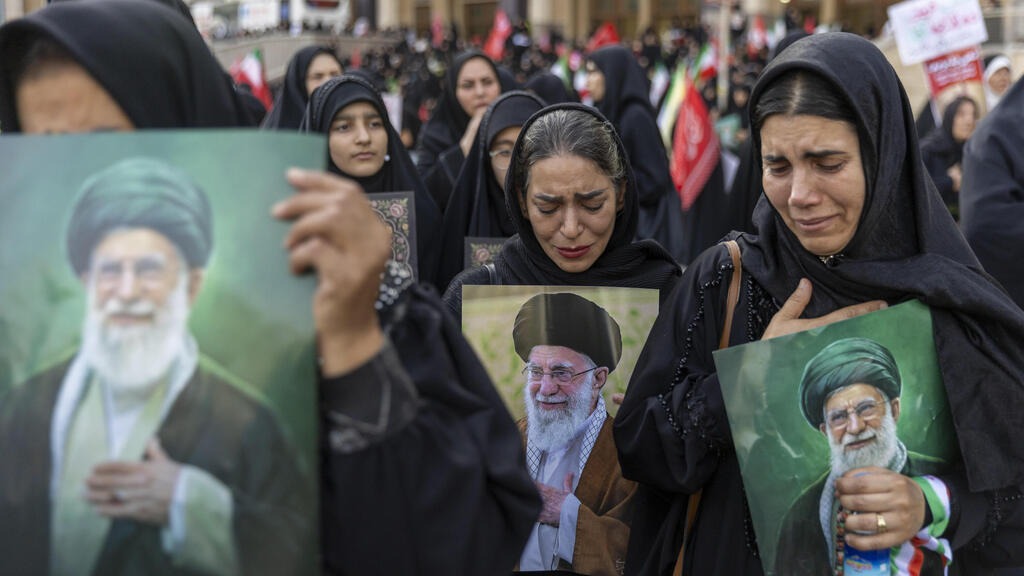
Funeral of Ali Khamenei in Tehran
(Photo: Majid Saeedi/Getty Images)
Hezbollah in Lebanon, under Hassan Nasrallah, who was also later eliminated, did not enter the war at full intensity in real time. It joined three days later and limited itself to indirect fire and anti-tank missile attacks. The Radwan Force did not activate the ground invasion plan it had prepared for years.
Arab Israelis, who clashed with authorities in mixed cities during Operation Guardian of the Walls, did not take to the streets this time. Iran, under Supreme Leader Ali Khamenei, who was later killed, also feared entering the campaign directly, apparently because of the aircraft carriers and submarines President Joe Biden sent to the region, as well as his “Don’t” speech warning that Iranian intervention would trigger a severe American response.
Three years later, after intense IDF fighting on all three fronts and the elimination of many senior leaders and decision-makers, Israel now faces new leaders who have stepped into their predecessors’ shoes, as well as organizations that survived: Hamas, Hezbollah and Iran’s Revolutionary Guard Corps.
These organizations view their survival itself as an achievement. Their legitimacy, in their eyes, to seek revenge has only grown. All three also gain recognition from the fact that they are parties to negotiations being conducted directly or indirectly with the main mediator, the United States.
In that sense, Sinwar’s plan achieved one of its central objectives: linking the fronts.
This is now happening through simultaneous negotiations with the three organizations, led by the United States and with the participation of Qatar, the main financier of the axis of evil. The talks are being conducted according to the principle of connected vessels, with clear links between the negotiation rooms.
The framework agreement, or 14-point understanding led by U.S. Vice President JD Vance with Iran, does not directly mention Hezbollah or Lebanon, but it does refer to a ceasefire on all fronts.
The framework agreement, or 14-point understanding led by U.S. Secretary of State Marco Rubio between Israel and Lebanon, does not mention Iran or its Hezbollah proxy. But it does include general language on disarming all armed forces in Lebanon. That cautious wording was not chosen by accident. Its purpose was to avoid undermining the nuclear talks in Switzerland.
The 20-point agreement with Hamas does not mention other fronts. At the same time, it also does not address the axis that funds Hamas, in this case Qatar and Iran.
In practice, the agreements avoid the connection between the fronts. Precisely because of that, they allow the current reality to remain in place, a reality that enables the axis of evil to continue its malicious plan while negotiations over the full agreements proceed intermittently and slowly.
On the ground, the situation works like connected vessels: an assassination in Gaza leads to escalation in Lebanon, escalation in Lebanon triggers an Iranian response, and tension in Iran leads to fire from Lebanon.
The fronts, in other words, are still connected. The axis of evil is still here and is working to restore the strength it has lost.
 Doron Hadar
 The combined mediation by the United States and Qatar is being exploited by the other side to improve its position at the negotiating table and to create leverage over the negotiating rooms.
The confrontation on all fronts began in Gaza, and it must end in Gaza.
Israel should first move quickly to establish the International Stability Force, begin taking control of the territory according to divided zones, and in the first stage cooperate with the Palestinian Authority by bringing its forces into Rafah and from there into the rest of the Gaza Strip.
Israel must connect moderate Sunni Muslim countries to the Gaza move, thereby reducing Iranian influence in the region. After the Gaza move, Israel should apply the same operational model in Lebanon. Through a domino effect, it can dismantle the Iranian ring that has been built around us over decades.
Israel must not be satisfied with its current hold on territory in Gaza and Lebanon. Hamas may try to create another round of fighting whose purpose would be to influence all the negotiation rooms being managed by the Americans.
Such a round could lead to an American demand for an IDF withdrawal from areas it has captured, including areas that do not appear on the maps of the 20-point plan and could prompt President Donald Trump to demand that Israel leave them.
Col. (res.) Doron Hadar previously served as commander of the IDF’s crisis management and negotiation unit