

The Muslim Brotherhood’s current troubles in the United States are not a sudden development. Rather, they reflect a slow and belated reaction to a strategy the movement has pursued over more than three decades: building educational and community infrastructures, nonprofit networks, campus organizations, international funding channels and local institutions designed to shape cultural, political and legal influence from within.
President Donald Trump recently signed an executive order directing his administration to determine whether certain branches of the Muslim Brotherhood should be designated foreign terrorist organizations. In an interview with Just The News, he said the United States will now work to outlaw the Muslim Brotherhood. A few weeks earlier, Secretary of State Marco Rubio said the State Department was already “working on the designation.”
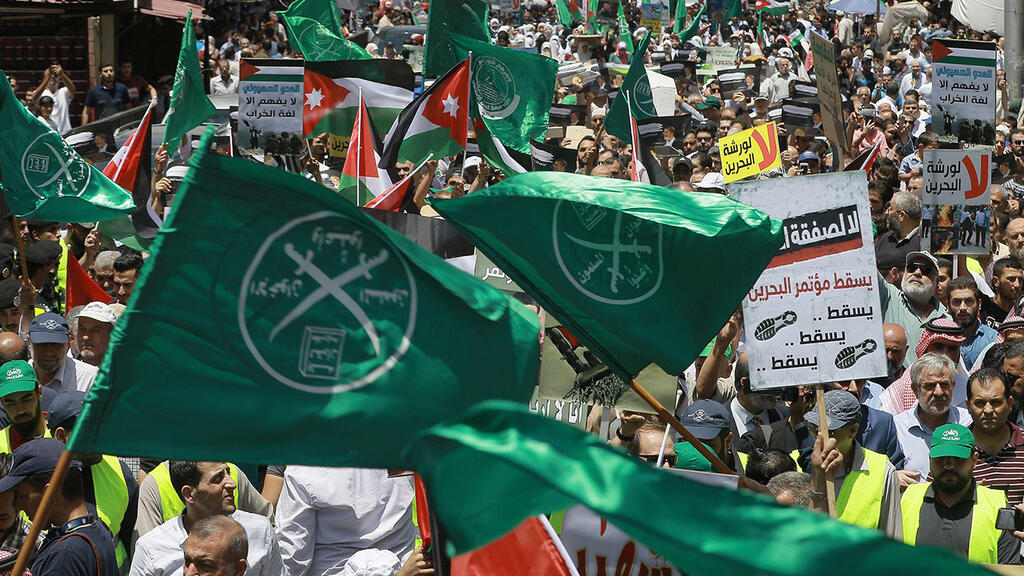
The announcement did not emerge from nowhere. It followed decades of activity in which a deep Islamist infrastructure was constructed inside the United States. Some of it emerged through federal investigations, some on university campuses and some through community-based projects.
To understand the inflection point of 2025, it is necessary to revisit the moment when the U.S. government first realized what it was confronting.
The conviction that shattered denial
The Holy Land Foundation (HLF), which presented itself as a Muslim charity in the United States, was in fact a fundraising arm that collected tax-deductible donations from Americans and transferred the money to Hamas through a sprawling network of money laundering operations controlled by the organization.
In May 2009, a federal court in Dallas handed down lengthy prison sentences to the group’s leaders. Shukri Abu Baker and Ghassan Elashi received 65 years each, and three others were sentenced to decades in prison.
The case revealed a dangerous model: U.S. citizens donated money legally and received tax benefits, but their donations were funneled directly to Hamas in Gaza and related networks. It was the first major operational proof that the Muslim Brotherhood viewed the United States not merely as a venue for local charitable activity, but as a vast source of funding for spreading Islamist influence at home and abroad.
The 1991 memo: a 100-year plan for gradual penetration—from preschools to Washington
Among the documents seized from HLF officials was a manifesto outlining the Brotherhood’s 100-year strategic plan for the “Islamization of America,” written in 1991. It portrayed the movement as a force building long-term influence from within the United States over the course of a century.
Protest slogans often referenced this idea in the language of “from the belly of the beast, the capital of U.S. empire,” signaling a strategy of infiltrating American society from inside.
The plan articulated a central goal: “settlement” — the creation of institutional infrastructure to make political Islam a permanent feature of American civil life.
The phases of penetration placed particular emphasis on youth:
Preschools: Creating independent educational institutions aligned with Brotherhood values.
Primary and secondary schools: Producing curricula and programs that distance students from American public education.
Universities: Controlling student associations, framing issues through “social justice,” forging identity-based coalitions and introducing narratives aligned with Brotherhood ideology.
Government: Encouraging candidates to enter all levels of public office, from city councils and school boards to mayors and members of Congress. Examples include figures supported by long-standing Qatari community programs and elected officials such as Rep. Rashida Tlaib and Rep. Ilhan Omar. Court testimony has previously alleged that Qatari institutions invested heavily in these networks.
The memo emphasized that the United States serves as a target for constructing civic, legal and cultural influence.
The international triangle: Turkey, Qatar and the Brotherhood in Gaza
To understand the American arena, one must also understand the external architecture feeding it. Turkey has become the Brotherhood’s strategic hub, offering political patronage, media infrastructure and organizational training. Qatar provides financing through charities, banks, digital platforms and media channels that support Brotherhood-aligned movements, including those with U.S. operations.
In Gaza, Hamas functions as the Palestinian branch of the Muslim Brotherhood and serves as an operational model. Hamas demonstrates how ideology, funding and international alliances can build a stable governing structure rooted in Brotherhood doctrine.
Together, Turkey, Qatar and Hamas form the triangle that underpins the Brotherhood’s American infrastructure.
The U.S. network—AMP, CAIR and SJP
In the United States, the Brotherhood operates through umbrella organizations rather than under its formal name:
AMP — American Muslims for Palestine:
Produces educational content, activist training, propaganda and grassroots organizing. It serves as the ideological incubator.
CAIR — Council on American-Islamic Relations:
A legal and media advocacy group that pressures institutions, threatens lawsuits and defends student groups engaged in anti-Western activism.
SJP — Students for Justice in Palestine:
A major campus-based activist network responsible for protests, professor harassment campaigns and anti-Israel messaging framed as “intersectional justice.” The movement links disparate minority groups under a shared narrative of struggle against “power,” often directed at Jews and Zionism.
Their strategic advantage is the ability to frame activism as advocacy for Palestinians while simultaneously inserting Islamist agendas into the institutions they influence.
The red–green alliance: how progressive LGBTQ groups ended up aiding Islamist agendas
Many Israelis ask how groups like Queers for Palestine can exist given Hamas’ stance toward homosexuality. The answer lies in the logic of shared enemies: intersectional ideology creates coalitions among groups that do not share values but unite against a perceived oppressor.
Thus, queer activists and human-rights groups have found themselves allied with movements rooted in theocratic worldviews that reject their own rights.
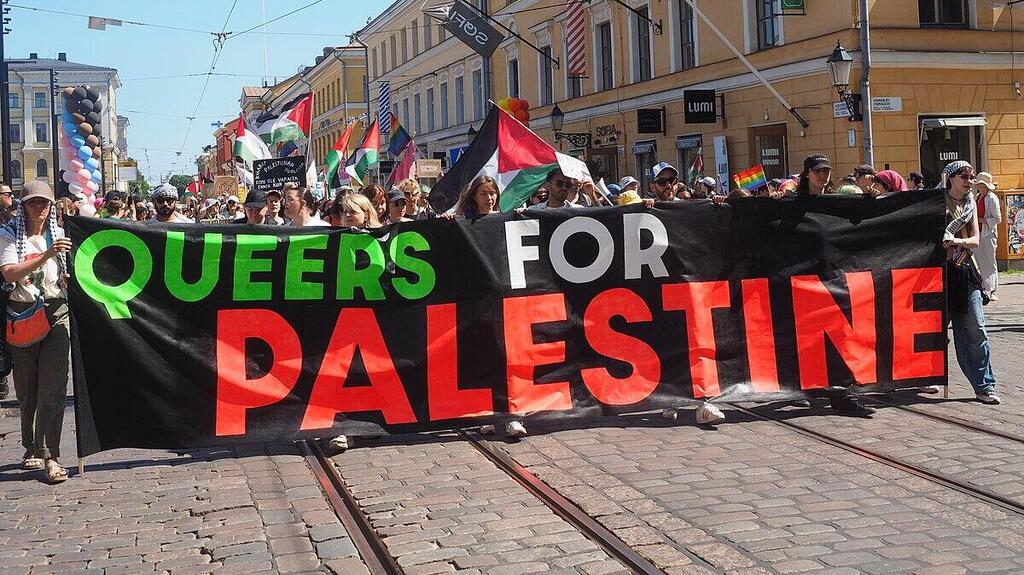
Queers for Palestine
A sharp example came from Hamtramck, Michigan. Progressive LGBTQ activists backed numerous Muslim-led “social justice” initiatives that helped secure a Muslim majority on the city council. After gaining power, the council passed a law banning pride flags in public spaces, claiming only U.S. flags were permissible. Attempts by LGBTQ activists to “raise awareness” afterward did not reverse the decision.
This is what a mature red–green alliance looks like.
Another Michigan example centers on Dearborn Mayor Abdullah Hammoud, who has emerged as a significant figure in American Arab-Muslim politics. During a city council meeting, Hammoud told resident Edward “Ted” Barahm he was “not welcome” in Dearborn after Barahm criticized street signs honoring Osama Siblani, the publisher of Arab American News. Barahm cited Siblani’s past endorsements of Hezbollah and Hamas, U.S.-designated terrorist organizations. Hammoud called him a “racist” and said he would “throw a parade” once Barahm left town. The exchange went viral, highlighting tensions between civic criticism and Islamist political influence.
Texas’ historic response to a proposed 'Sharia city'
Over the past year, Texans discovered plans for an autonomous Muslim city on a 400-acre tract of land. The project envisioned a self-governed enclave with religious courts, a school system, commercial centers and community institutions — effectively a local Sharia-based municipality inside an American constitutional jurisdiction.
The initiative caused public alarm. Texas fiercely protects the separation of religion and state, and the project was viewed as an attempt to create a religious-legal enclave. Last week, Gov. Greg Abbott signed a law designating the Muslim Brotherhood and CAIR as terrorist organizations in the state and barring them from purchasing land.
 Dr. Kobby BardaPhoto: Tal Givony
What is happening now in the United States is not an isolated phenomenon. It is a slow, delayed response to a Brotherhood system built over three decades — an ecosystem of schools, community institutions, campus networks, nonprofits, international funding and local projects designed to shape cultural, political and legal influence.
The year 2025 may be the moment when the United States not only recognizes the scope of this program but finally begins to dismantle it.
Dr. Kobby Barda is a researcher of American political history and geo-strategy at the Multidisciplinary School – HIT Holon.