

This week, Wikipedia marks 25 years since its founding. It once symbolized the internet’s great promise: free, collaborative knowledge accessible to all. But in 2026, that dream is steadily unraveling. Wikipedia is no longer just an information repository. It has become an ideological battleground in which organized interest groups succeed in distorting, deleting and rewriting history, sometimes in a systematic and deliberate way.
If you think Wikipedia is just another website that has become less relevant in the age of AI, you are missing one of the most dangerous arenas of influence of our time. It is among the most visited websites in the world, with between 3.5 and 4 billion visits a month, and a source that almost always appears at the top of Google search results. Beyond that, Wikipedia is one of the central knowledge sources on which artificial intelligence systems such as ChatGPT are trained. The implication is clear: a distortion or outright falsehood that takes root in a Wikipedia entry does not stay there. It is replicated and spread through AI engines and quickly becomes “knowledge” in the eyes of millions of users worldwide, who use it on social media, in academic work and as general reference. In this sense, Wikipedia is now one of the most influential mechanisms of knowledge poisoning in the digital age.
In an era in which young people form their worldview through social networks and AI engines, disinformation is no longer a theoretical problem. It is a real danger to states, communities and public figures. It is important to stress that this is not a legitimate dispute between differing opinions, but the erasure of documented history and the spread of false narratives under a veneer of “neutrality.”
The phenomenon did not begin recently, but in recent years it has intensified noticeably. English-language entries dealing with the State of Israel, Zionism, Jewish history and archaeology in the Land of Israel have undergone systematic rewriting. Behind the scenes, organized groups promote a specific narrative, delete established facts and block editors who try to introduce balance, sometimes through votes that lead to articles being locked.
This is not a theory. It is a documented reality. Only recently, Jimmy Wales, Wikipedia’s co-founder, addressed the English-language entry “Gaza genocide” and acknowledged that it was locked for editing due to severe bias and failure to meet the site’s standards. Editors who tried to balance the content found themselves removed or silenced. When it comes to the number of casualties in Gaza, Wikipedia states that the figure reaches about 680,000 people, a number that even Gaza’s Health Ministry, which is fully controlled by Hamas, does not claim.
There are many other troubling examples. Jerusalem, Israel’s capital, is not defined on English Wikipedia as a city in any country, but as a city in the “southwestern Levant.” Even after Wales’ personal intervention, the biased definition returned. Another example is that Israel is the only country with a dedicated entry comparing its institutions to the Nazis, including comparisons between Zionism and Nazi ideology.
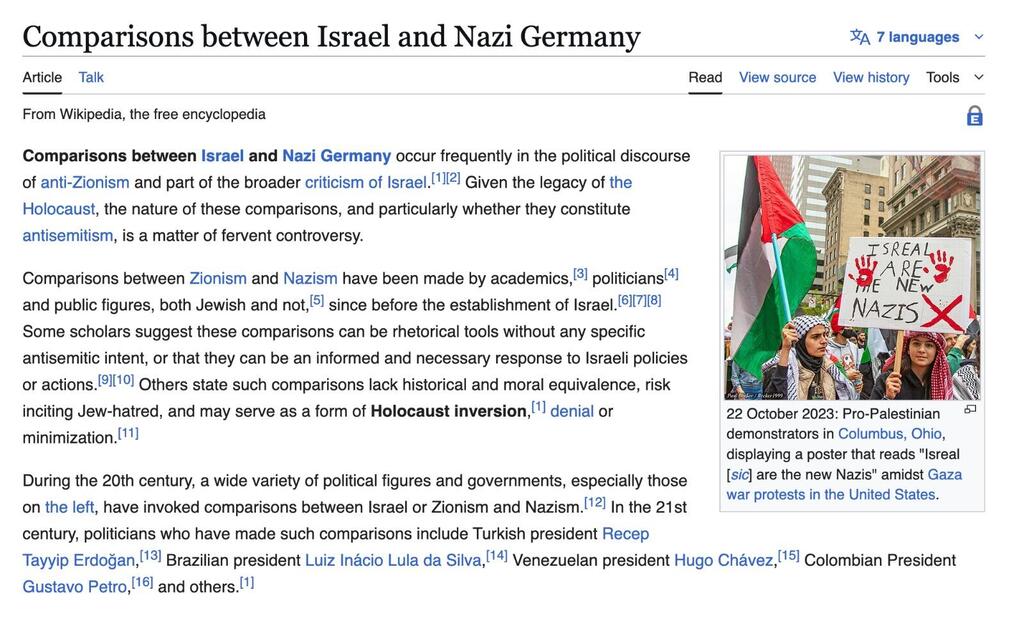
From Wikipedia: Comparisons between Israel and Nazi Germany
Beyond this, there is a systematic erasure of Jewish history. For example, entries that dealt with Hellenistic Judea under Greek rule were changed to “Hellenistic Palestine,” an anachronistic term, since the name Palestine was given to the region by the Romans in an effort to erase the name Judea, only about 200 years after the end of Greek rule. The historical connection to the Jewish people was erased, and the narrative reshaped.
Attempts to correct these distortions almost always meet the same outcome: the article is reverted to the biased version, and the editor is marked as problematic and sometimes stripped of the ability to continue editing. This creates a closed loop that makes correction difficult and perpetuates bias. Wikipedia has been captured by groups with an interest in spreading disinformation and half-truths. Whatever legitimate criticism one may have of Israel or its government, it is impossible to accept the spread of disinformation that poisons the global knowledge base, and public diplomacy is not the solution to this problem.
It is important to note that the problem is not unique to Israel. There are also gender biases and biases in other historical narratives, such as coverage of the Iraq war, which has undergone dramatic changes over the years in line with the prevailing political climate. But in Israel’s case, the combination of organization, political motivation and global influence makes the phenomenon particularly dangerous, with geopolitical, economic, cultural and academic implications for Israel and the Jewish people.
There are individuals such as Dr. Shlomit Aharoni-Lir, who researches the politics of knowledge and exposes many of these biases, alongside organizations such as Here4Good, where I lead the research field, that are pushing for policy changes and greater public awareness. There is now also a need for state actors and technology companies to help address the problem.
Ella Kenan is a co-founder of the organization Here4Good, where she leads content creation and research on the impact of foreign actors on public opinion through social networks and artificial intelligence models, and on exposing disinformation campaigns and networks.