

For several decades, Iran has invested resources and effort in promoting a political tool meant to help it achieve its declared goal of eliminating Israel: Holocaust denial. The logic is straightforward. If it can be proven that the Holocaust never happened, or at least if its story can be undermined, then there is no justification for the existence of Israel, which, by this argument, was established because of and in the wake of the Holocaust.
Holocaust denial in Iran began after the Khomeini revolution, mainly through statements by political leaders and state media. About 20 years ago, in 2005, Iran’s rulers, Supreme Leader Ayatollah Ali Khamenei and Mahmoud Ahmadinejad, who had just taken office as president, decided to deny the Holocaust openly and officially, and to recruit international support for that effort.
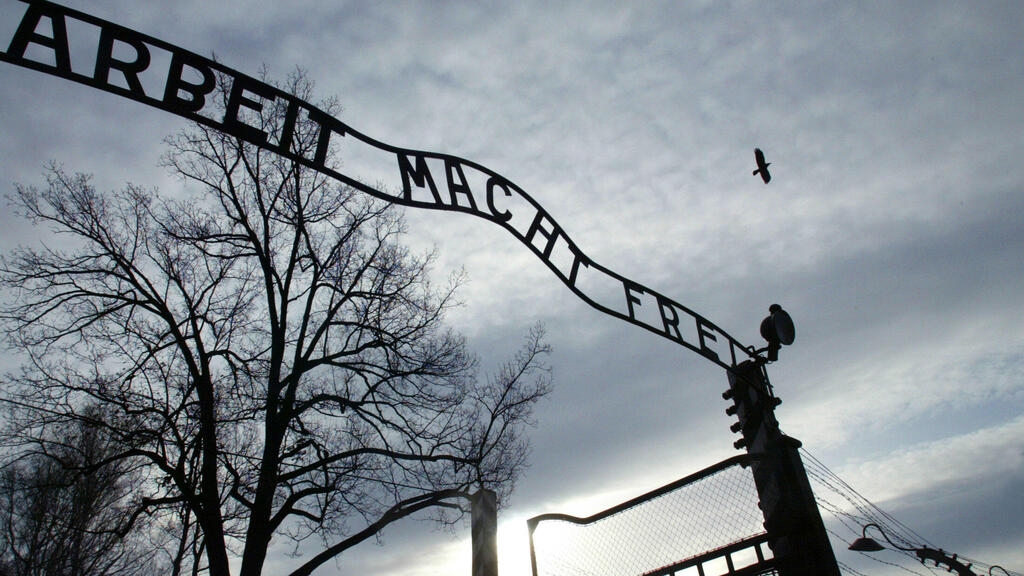
The sign at the entrance to the Auschwitz concentration and extermination camp
(Photo: Katarina Stoltz/Reuters)
In 2006, preparations began for a conference designed to make waves worldwide. It was given the title “International conference to review the global vision of the Holocaust,” presenting itself as a serious scholarly gathering.
Holocaust deniers who had fled Europe to Tehran assisted with the preparations and shared their experience. Many were facing pending court judgments at home, as legislation criminalizing Holocaust denial has existed since the 1990s and includes penalties of up to three years in prison. Dozens of Holocaust deniers from around the world indeed arrived for the conference, which opened in late 2006, deliberately scheduled on International Human Rights Day.
Among the guests of honor were David Duke, the former leader of the Ku Klux Klan, and French Holocaust denier Robert Faurisson, a tireless figure in the movement who once managed to secure a lengthy visit with Otto Frank, Anne Frank’s father, and later published a pamphlet claiming Anne Frank did not write the diary attributed to her. Members of the ultra-Orthodox group Jews United Against Zionism also attended, along with Rabbi Aharon Cohen of the Neturei Karta sect. They did not deny the Holocaust. On the contrary, they came to deliver an anti-Zionist message.
The conference drew sharp condemnation worldwide, especially from Western countries and international bodies such as UNESCO. Iranian students protested as well. In Israel, there were, unsurprisingly, loud objections to this display of organized, state-sponsored international Holocaust denial. As expected, the conference ended with resolutions to establish an institute for Holocaust research, prepare for a follow-up conference and launch a website to provide denial materials to anyone interested. The site went online in 2010.
Cartoons denying the Holocaust
The next stage came in January 2016, 10 years ago, when Iranian authorities announced preparations for an international cartoon contest denying and mocking the Holocaust, with winning entries to be displayed in an exhibition. It was the third such denial cartoon contest held in Iran, but this one drew broader international participation. It opened in May, deliberately timed to coincide with Israel’s Independence Day.
The organizers tried to frame the contest as an expression of free speech. If the French magazine Charlie Hebdo is allowed to mock the Prophet Muhammad, they argued, then they too should be free to mock whatever they choose. In practice, the exhibition presented a disturbing and inciting collection of antisemitic and anti-Zionist images, saturated with blood and brutality.
One of the most prominent participants, who placed second, was Carlos Latuff, a Brazilian-born cartoonist of Lebanese descent. His work has been known to admirers worldwide for decades and is familiar to any scholar of antisemitism and anti-Zionism. He depicts Jews as demonic murderers, portraying Nazis as childlike by comparison. In 2002, he drew Israelis as bus bombers killing passengers. During the COVID-19 pandemic, he portrayed the Israel Defense Forces as forcibly spreading the virus among neighboring populations. He was sued, found guilty of radical antisemitism and fined heavily, a ruling that only enhanced his standing within denial circles.
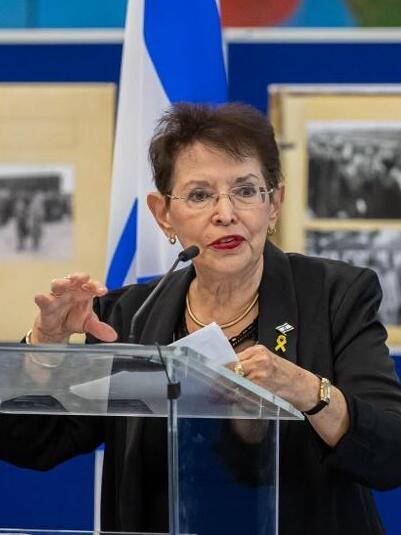 Prof. Dina Porat Photo: Ouriel Morgensztern
All of this reflects a policy Iran has pursued for the past two decades. But the State of Israel was established through Zionist vision and action, not, God forbid, from the ashes of the victims. Today, on International Holocaust Remembrance Day, established by the United Nations at the same time, in 2005, and on every other occasion, it is worth recalling the efforts that led to the founding of the state, and in doing so, contributing to the fight against Holocaust denial.