

The gap between prayer and action in the Middle East was not only philosophical. Until recently, it was also practical. For years, Iran and its proxies held an extreme idea of Israel’s destruction, but managed it with deep belief and in the form of prayer, not as an operational plan.
In Iran, prayer is not merely a statement; it is an organizing force. It hovers above reality, shaping it, giving it meaning and direction. It is what people rise for in the morning. But it is also controlled.
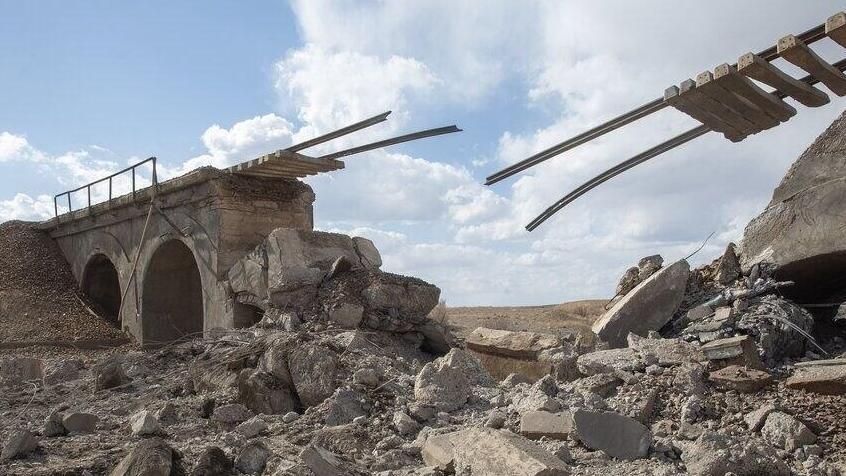
The railway bridge targeted in Iran
Behind the faith lies a deeper concept: redemption should be hastened, but not forced. This is the central difference between the Shiite worldview and that of ISIS. To draw closer. To provoke. To stretch the boundary, but not to cross it.
Unlike ISIS, which decided the ‘end of days’ had arrived — and that even suicide would be redeemed because God would ultimately save them — for the Iranians, faith and prayer were core elements of identity, but they did not dictate battlefield decisions.
From this also derives their strategy: an ambition to become a nuclear threshold state, one that remains perpetually on the brink but does not cross the line. This is not weakness. It is a method — to hold the idea in constant tension between possibility and realization.
This logic also drove the concept of exporting the revolution: harassing Israel through distant proxies while preserving the homeland. Yet it also reveals a deeper limitation: the Iranian system knows how to threaten, but not how to manage the realization of those threats. It is built for the moment before — for tension, for the threshold, for possibility — not for the reality that follows.
Paradoxically, even as it moves closer, it seeks to remain there. Its aim is to return again and again to that same moment: the point at which it threatens but still controls the outcome.
Thus a fragile but stable balance emerged: all sides wanted more than they were willing to do. This gap between aspiration and action served as the region’s safety mechanism.
It was not true stability, but repetition — a paradoxical safety valve of endless rounds that changed little. Much noise, little change. Many declarations, few decisions. Precisely because no one went all the way, the system held.
'Perhaps it is actually possible to destroy Israel'
In recent years, in various places, a new thought began to take hold: “Perhaps it is actually possible to destroy Israel.” Hassan Nasrallah began speaking of conquering the Galilee. Nuclear scientists returned to building a bomb, not just enriching material. Hamas envisioned reaching deep into Israel and physically linking up with allies in Nablus and Hebron (cities in the West Bank). In different rooms, a belief began to form: perhaps “we are the generation of victory; we will destroy Israel.” The next step was to plan.
Then came the moment in Gaza.
In a closed room, an operations planner presents a plan. Raed Saad was the one who designed the operation to overrun and destroy Israel’s Gaza Division. But in the end, he hesitates: it is possible, but not feasible. The cost would be devastating. The chain reaction would spiral out of control.
This was the final moment of the old world. But the decision that follows does not just alter a course of action — it shatters an entire method. Yahya Sinwar does not merely approve an operation; he collapses the Iranian model itself.
Patience is the force that sustained the Shiites for years
It is no coincidence this happened under a radical Sunni leader rather than a Shiite one. Patience has been the strongest force sustaining Shiite communities for years. They were oppressed, but patient. It is no coincidence that ISIS emerged among radical Sunnis, not Shiites. Shiites have patience.
Israel was caught off guard, but Nasrallah and Iran’s Supreme Leader Ali Khamenei were no less surprised. “We spoke about destruction, but we did not plan to begin — certainly not tomorrow morning.” Many asked why Nasrallah did not join. Why? Because he was fundamentally surprised, and because it contradicts the doctrine of patience. For Nasrallah, victory is tied to eternity; it does not have to happen on his watch.
On Oct. 7, at 6:29 a.m., it was not only the border that was breached. The Israeli conception collapsed, but so did the Iranian method. Because once the gap disappears, there is no longer control. There is no longer a game of thresholds.
There is only outcome. The implication is deeper: Israel is not required merely to change the rules of the game, but to change the game itself — from one of risk management, deterrence and balances to one of decisive outcomes. From a reality in which the enemy is allowed to “pray,” to one in which every prayer may become action.
 Shahar Segal Photo: Motti Kimchi
Once that boundary is broken on one side, it erodes on the other as well. On our side, too, temptation arises — to blur the line between plan and aspiration, to call something a strategy even when it is still a prayer.
There is a half-cynical saying about this: if you want something not to happen, present a plan. A plan on paper can be an excellent way to remain in the world of declarations, without paying the price of real action.
Therefore, the question of toppling the regime in Iran is not only a matter of will, but of honesty. Is it a structured plan, with stages, tools and measures of success? Or is it a direct continuation of this new logic, in which strong desire is enough to count as action?
The problem with prayer disguised as action is not only that it may fail — but that it releases one from responsibility.