


The turbulence that has gripped the Middle East since Oct. 7 has at times worked to Israel’s advantage. In recent weeks, however, it has produced a growing list of challenges. At the center of the latest crisis is the rapid Houthi advance along Yemen’s Red Sea coast and around the Bab al-Mandab Strait, where the Iran-aligned group has seized Mocha, Perim Island and other strategic positions from forces aligned with Yemen’s internationally recognized government.
What might once have looked like another development in Yemen’s long civil war now carries much wider consequences. Traffic through the Strait of Hormuz has already been severely disrupted by the continuing U.S.-Iran conflict, increasing the importance of the Red Sea as an alternative route for energy exports. Houthi gains around Bab al-Mandab therefore raise the prospect of pressure being applied simultaneously at two of the world’s most important maritime chokepoints.
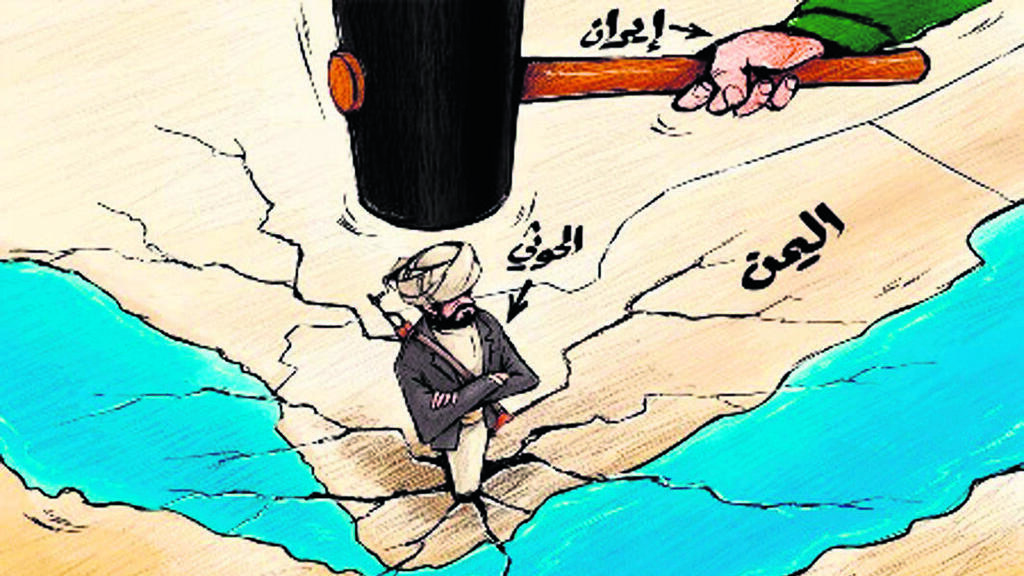
The Houthis are the nail at Bab al-Mandab; Iran is the hammer
(Illustration: From Kuwait’s Al-Jarida newspaper)
That danger is felt most acutely in Saudi Arabia. Riyadh has increasingly relied on its East-West pipeline and the Red Sea port of Yanbu to move oil away from the Gulf, making the route through Bab al-Mandab strategically important at precisely the moment the Houthis have expanded their presence there. Recent attacks have also disrupted Saudi energy infrastructure and added to volatility in global oil markets.
For Saudi Arabia, there is also an uncomfortable historical lesson. Its military intervention in Yemen beginning in 2015 inflicted heavy damage on the Houthis but failed to eliminate them. Large-scale fighting subsided after the 2022 truce, only for the movement to emerge years later with greater territorial reach and a more sophisticated missile and drone arsenal.
Saudi Arabia resumed major strikes in Yemen this year as fighting escalated again. The Houthis responded with attacks on Saudi territory and infrastructure, while their territorial gains this month have been described as their most significant in years.
The development also underscores a broader feature of the Houthi movement. Despite its close relationship with Tehran, it is not simply an Iranian proxy operating on command. Dr. Inbal Nissim-Lovton of Tel Aviv University’s Moshe Dayan Center argues that the Houthis combine close strategic coordination with Iran with an independent agenda rooted primarily in Yemeni politics. Their current campaign, she says, is also aimed at reversing the air and maritime restrictions Saudi Arabia imposed during the civil war.
Iran, meanwhile, benefits from the ambiguity. It can point to the Houthis’ battlefield gains as evidence that its regional network remains capable of exerting pressure despite the heavy blows it has suffered, while avoiding direct responsibility for every escalation around the Red Sea. The result is a form of strategic leverage: as pressure mounts on Iran’s own oil exports and shipping routes, its allies can threaten the infrastructure and maritime access of Washington’s regional partners.
Saudi frustration is compounded by the uncertain value of its alliances. Riyadh, Turkey and Pakistan signed the Mecca Joint Defence Agreement in August, under which an armed attack on one is to be treated as an attack on all three. Turkey has said it is prepared to help meet Saudi military needs, and the three countries are now planning urgent military talks, but the agreement has yet to translate into direct intervention against the Houthis.
The same dilemma confronts U.S. President Donald Trump. According to reports cited in this analysis, Washington has considered broader military action against the Houthis but remains wary of opening another front while its confrontation with Iran continues, oil prices remain elevated and other international crises compete for U.S. attention. For now, the White House appears to prefer deterrence and indirect understandings over another open-ended campaign.
Israel is not the central player in the current Saudi-Houthi confrontation, but the consequences reach it nonetheless. A stronger Houthi position around the Red Sea could again threaten Israeli-linked shipping and help Iran rebuild regional leverage. At the same time, the crisis may create opportunities for quiet security coordination between Israel and Arab states that share concerns about Iran and its allies.
But that possibility should not be confused with a ready-made regional alliance. The experience of the past three years has shown that shared fear of Iran can produce discreet cooperation without erasing political differences, particularly over the Palestinian issue. Saudi Arabia, the UAE, Jordan and other Arab governments may work with Israel on specific security threats while still imposing limits on how far that partnership can go.
The Bab al-Mandab crisis therefore cuts against the more optimistic versions of a “new Middle East” that emerged after Israel’s recent military successes. The region’s adversaries have not disappeared, alliances remain conditional and battlefield victories do not automatically become durable strategic gains.
The Houthi advance is a reminder of a recurring Middle Eastern reality: a relatively small actor, rooted in the mountains of northern Yemen, can acquire enough missiles, drones and geographic leverage to affect Saudi Arabia, Iran, Israel, the United States and global energy markets at the same time.
- Dr. Michael Milshtein is a senior researcher at Tel Aviv University’s Moshe Dayan Center