

In 1944, Jewish activists in the United States helped establish an organization called the American League for a Free Palestine. They wanted to end British rule and achieve Hebrew national independence. “Free Palestine” was their cause, too.
That history may surprise people who encounter the phrase today. It also raises a question: What happens when a slogan becomes detached from the history of the place it names?
Gallery
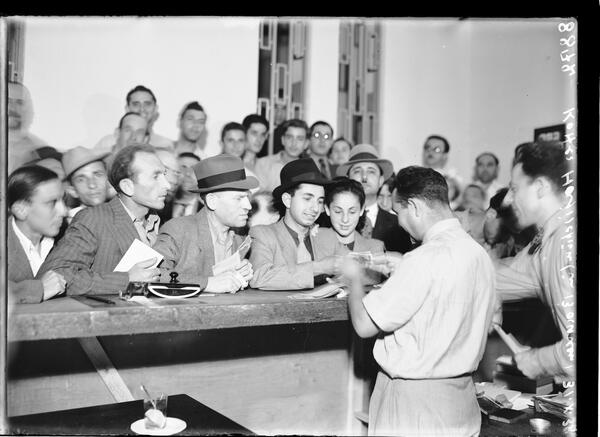
Residents donate money and jewelry at an Anglo-Palestine Bank branch in Tel Aviv for a fundraising drive organized by the Jewish National Council, 1938
(Photo: State Archives)
Before Israel declared independence in 1948, Palestine was not an independent Palestinian Arab state. Following the defeat of the Ottoman Empire in World War I, Britain administered the territory under a League of Nations mandate. Arabs and Jews lived there, and the citizenship framework introduced in 1925 allowed both to hold Palestinian citizenship.
Historians call this territory Mandatory Palestine. But “Palestine” and “Palestinian” did not have the exclusively Arab national meaning that many people now associate with them. Reading documents from that period through today’s political vocabulary can obscure as much as it reveals.
Consider the currency. Palestine pound banknotes and coins carried inscriptions in English, Arabic, and Hebrew. Beside the Hebrew name for Palestine appeared the letters alef and yud (א״י), an abbreviation for Eretz Israel, the Land of Israel.
Or consider football. The Palestine Football Association was established in 1928 and admitted to FIFA the following year. Arab, Jewish, and British clubs participated in football under the Mandate, but the national team that competed in the qualifying rounds for the 1934 and 1938 World Cups fielded Jewish players, with no Palestinian Arabs in its lineups. The association became the Israel Football Association after independence.
The Palestine Post, founded in Jerusalem in 1932, was a Zionist newspaper. It became The Jerusalem Post in 1950. The Palestine Orchestra, founded in 1936 by Jewish violinist Bronislaw Huberman, brought Jewish musicians threatened by Nazi persecution from Europe to Mandatory Palestine. After Israel’s independence, it became the Israel Philharmonic Orchestra.
These were Jewish institutions whose names included Palestine. Their existence is not a historical contradiction. It becomes one only if we assume that the word always meant what it means to us now.
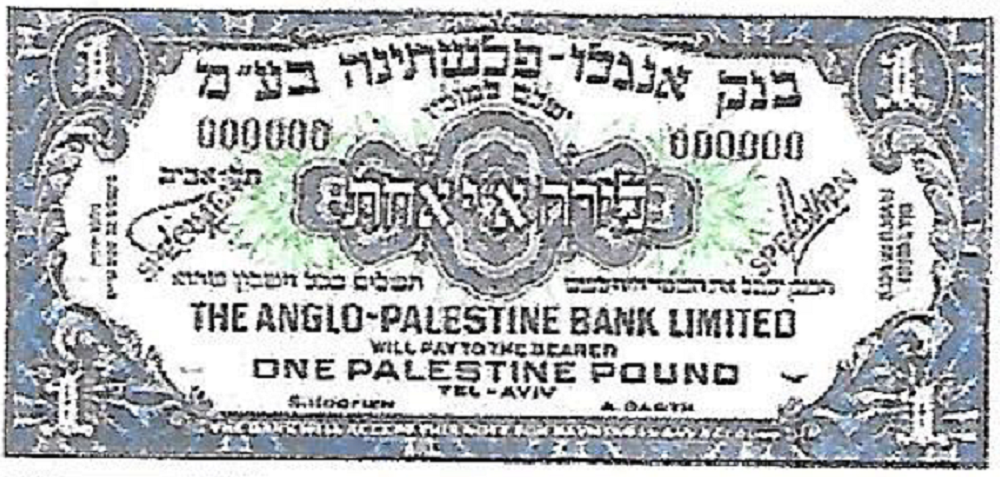
A Palestine pound banknote
The American League for a Free Palestine makes the point especially clearly. Associated with Hillel Kook, known in the United States as Peter Bergson, it mobilized support for the “Hebrew independence fight.” In October 1946, it launched a “Palestine Resistance Month” to enlist American backing for that struggle. The Palestine these activists wanted to free was under British rule.
None of this means that Palestinian Arabs did not exist or that their national identity appeared suddenly after 1948. Palestinian Arab nationalism was already developing under the Mandate. National identities have histories; acknowledging one people’s history does not require erasing another’s.
The distinction is between a territory’s name and the sovereignty that some now assume it signifies. A coin bearing the word “Palestine” demonstrates that the name was used. It does not demonstrate that a sovereign Palestinian Arab state existed before Israel.
Over time, “Palestinian” became associated internationally almost exclusively with the territory’s Arab population and its national movement. There is nothing illegitimate about that evolution. The problem begins when its current meaning is projected backward, turning Jewish Palestinian institutions into apparent evidence of a country that Israel supposedly replaced.
The historical record tells a more complicated story. Jews and Arabs lived under the same territorial designation while pursuing competing national aspirations. A Jewish newspaper could call itself the Palestine Post. Jewish athletes could represent Palestine. Jewish activists could demand a Free Palestine.
Acknowledging those facts does not settle today’s disputes over borders, occupation, security, or Palestinian statehood. It does establish that those disputes cannot be resolved by treating a historical name as proof of a vanished sovereign state.
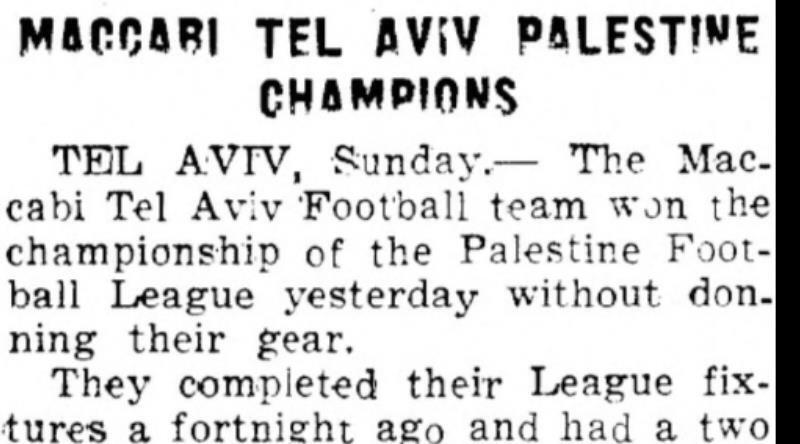
The Palestine Post
(Photo: State Archives)
This is more than a dispute over historical terminology. On October 4, the Green Party of England and Wales formally adopted an anti-Zionist policy calling for a single democratic state throughout “historic Palestine.” The party also reaffirmed its support for self-determination. That raises a question: What place does Jewish national self-determination have in that vision? The Jews who once demanded a Free Palestine were seeking national independence in that same territory. Their aspirations were part of its history, too.
The slogan’s history also reminds us that “free” requires a political explanation. Free from whose rule? Free to choose what future? And with what protections for the people whose freedom is being invoked?
Those questions are relevant to Palestinians themselves. Supporting Palestinian freedom should also mean supporting their right to reject Hamas and choose a different future.
In March 2025, Palestinians in Gaza demonstrated against the war, with participants also chanting against Hamas and demanding its departure. Their voices challenged the assumption that supporting Palestinian freedom necessarily means supporting the organization ruling them.
Palestinians should be able to choose their leaders, criticize them, and remove them without fear. Their right to self-determination includes freedom from authoritarian rule and armed coercion within their own society.
Nearly eight decades ago, Jewish activists demanded a Free Palestine. Today, many of us also want a free Palestinian Arab state, living peacefully alongside Israel. Taking that aspiration seriously means taking Palestinian freedom seriously, including freedom from Hamas.
Free Palestine. But free from whom, and free to do what? A slogan that claims to defend a people’s freedom should welcome those questions.
- Nira Broner Worcman is a Brazilian journalist, CEO of Art Presse Communications, and author of A Sisyphean Task: A Fight Against Disinformation About Israel and the Jewish People translated from a Brazilian hors commerce publication Enxugando Gelo.