

Direct negotiations between Israel and Lebanon, which began in Washington and led to a formal ceasefire — even if time-limited — are a historic development regardless of their future outcome. They are a clear product of the tectonic changes that have taken place in the region, and in Lebanon in particular, since Oct. 7, 2023.
The two countries previously signed a peace agreement in May 1983 that was never implemented. The central question now is whether conditions have matured for a stable peace agreement, and what conditions are necessary to ensure its durability if one is signed.
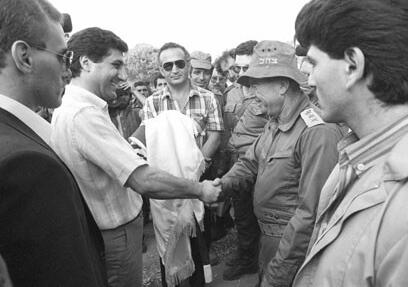
Rafael Eitan (Raful) and Bashir Gemayel in Lebanon
(Photo: Bamahane)
Lebanon, which experienced prosperity under the legacy of President Fouad Chehab and the framework of the 1943 National Pact — an unwritten agreement that regulated sectarian and familial power-sharing — collapsed into a brutal civil war in 1975. The war devastated Lebanese society, facilitated the rise of Shiite political power under Musa al-Sadr, led to the establishment of the Amal movement and later Hezbollah, enabled Syrian military intervention, and allowed the Palestine Liberation Organization to operate from Lebanese territory against Israel, drawing Israel into ongoing military involvement.
A brief moment of apparent hope emerged following Israel’s invasion of Lebanon and its alliance with Christian factions led by Bashir Gemayel, culminating in the May 1983 agreement signed with his brother, President Amin Gemayel. That agreement remained largely symbolic and was formally annulled about a year and a half later.
The war that began on Oct. 7 brought profound change to the northern front and to the long-standing conflict with Lebanon and Hezbollah, the country’s most powerful military and political force. Hezbollah, which suffered severe blows — including the killing of its longtime secretary-general Hassan Nasrallah, the destruction of key military infrastructure and the elimination of thousands of its fighters — was forced during successive ceasefire periods, and until the outbreak of what is referred to here as Roaring Lion war and the killing of Iran’s Supreme Leader Ali Khamenei, to accept renewed Israeli control of parts of Lebanese territory and sustained Israeli military operations carried out daily with little interference.
The 1989 Taif Agreement, which formally ended Lebanon’s civil war, stipulated that all militias be disarmed except for Hezbollah. The group demonstrated its strength in May 2008 after the Lebanese government, under pressure from the anti-Hezbollah March 14 coalition (a political alliance formed after the 2005 Cedar Revolution), adopted two key decisions: dismissing the head of security at Beirut’s airport for allegedly facilitating Hezbollah arms smuggling, and ordering the Lebanese army to dismantle Hezbollah’s independent telecommunications network used to manage arms transfers from Iran.
In response, Hezbollah and Amal activists took to the streets, creating chaos and forcing the government to reverse course. This ultimately led to the Doha Agreement, which granted Hezbollah its most significant political achievement — veto power within the Lebanese government through a “blocking third.”
That arrangement collapsed in 2024, when Hezbollah was forced to relinquish this veto power. Its longstanding slogan, “the army, the people, the resistance,” has since come under increasing criticism within Lebanese public opinion, including among Shiites, particularly in light of the war’s consequences. Criticism has intensified further as Israel expanded its buffer zone and continues to destroy infrastructure in southern villages, preventing the return of hundreds of thousands of displaced residents.
So what has changed, and what still must change? All actors in the arena have undergone transformation, whether by choice or necessity. The Christian factions of today are not those of 1982. Syria has withdrawn from Lebanon, and Israel would risk serious consequences if it were tempted to allow its return under Ahmad al-Sharaa. Lebanon’s Shiite community has paid — and continues to pay — a heavy price for Hezbollah’s conduct. Iran’s influence in Lebanon is declining sharply despite persistent efforts to maintain it. Israel, for its part, has adopted a far more aggressive posture toward Iran and its regional proxies.
Yet despite this apparent window of opportunity, no meaningful change can occur without addressing the Lebanese army — just as no Lebanese government is likely to agree to a continued IDF presence on its soil. The Lebanese army is widely regarded as a national institution with broad public support despite its poor performance. However, its operational weaknesses risk rendering any agreement ineffective.
The army has a history of failing to enforce international resolutions such as U.N. Security Council Resolution 1701, and of not implementing initiatives such as the September 2025 “Homeland Shield” plan to disarm Hezbollah in southern Lebanon. It suffers from significant financial, morale and operational challenges and relies heavily on U.S. support. Its soldiers, particularly Shiites, often face issues of divided loyalty, with some reportedly assisting Hezbollah. There have also been instances of operational cooperation between the army and Hezbollah, including joint actions against Sunni militant groups along the Syrian border in 2017.
Given the understanding that the Lebanese government seeks change but struggles to implement it, Israel should focus negotiations on the Lebanese army and the fundamental reforms it requires. Responsibility for restructuring the army should be transferred to the United States and Saudi Arabia — similar to the historical model of the Jordanian Arab Legion — while removing Hezbollah influence at all levels.
If such changes are implemented, alongside the broader regional shifts, a durable peace agreement may be achievable. Without a dramatic transformation in this sphere, however, any agreement is likely to remain ineffective, much like the unfulfilled accord of 1983.
Dr. Haim Golovenzits is a Middle East specialist and commentator.