

Several weeks ago, Maggie Haberman and Jonathan Swan’s book, Regime Change, was published in the United States. It is not about Israel’s own judicial overhaul, and only touches in several chapters on the regime change that did not take place in Iran. Instead, it describes what happened, and what is still happening, during Donald Trump’s second term in the White House.
The authors, two of The New York Times’ leading White House correspondents, spoke to dozens of people in positions of power, from Trump himself to domestic staff in the residence wing. What emerges is a political machine that is aggressive, ruthless and intensely focused on the will of one man, yet also remarkably leaky, down to full quotations from conversations Trump held with some of those closest to him.
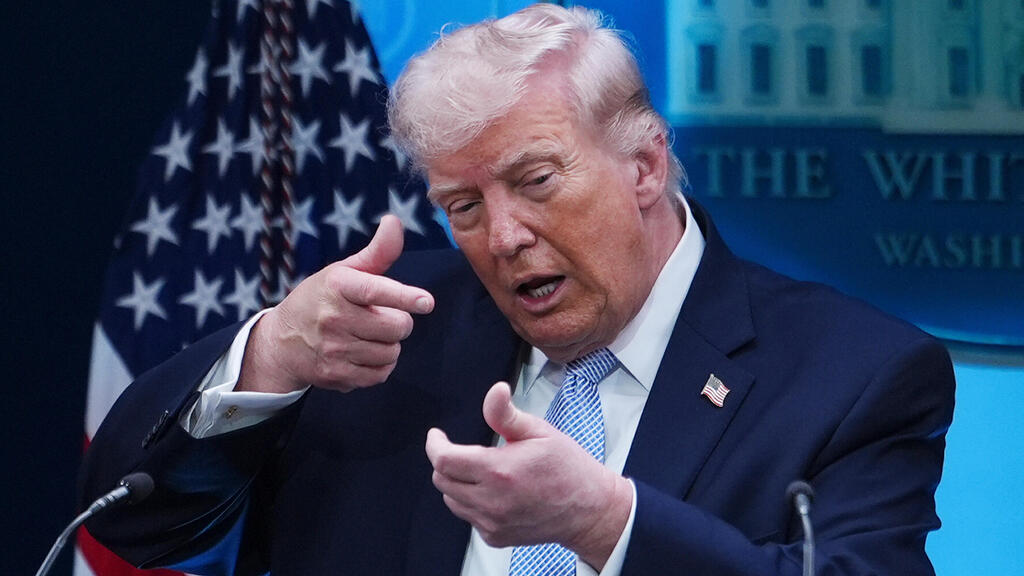
US President Donald Trump
(Photo: Julia Demaree Nikhinson/AP)
The bottom line is this: America has never had a president like this, not even Trump in his first term.
There is much to learn from the book. First, how the war with Iran began and ended from the perspectives of Trump, Vice President JD Vance, Secretary of State Marco Rubio, Chief of Staff Susie Wiles and other senior officials, each with a different version. Second, what each of them thinks of Netanyahu and of Israel. Third, how Trump behaves behind closed doors, what drives him, where his strengths lie and where his weaknesses are. Fourth, how fragile the U.S. Constitution can be when facing a president who recognizes no limits.
America will recover. It can afford to. But woe to countries whose politicians look at what is happening in America with admiration and rush to copy all its mistakes. The regime change in America is best left in America.
According to transcripts of discussions published in the book, Israel launched Operation Rising Lion in June of last year without receiving Trump’s explicit support. Netanyahu had promised to warn Trump in advance, and did so. Trump responded with contradictory statements. To opponents of the operation, he said he had warned Netanyahu: “Bibi, don’t do it.” To supporters, he said the opposite.
Rubio made sure to issue a statement on the first day of the operation denying any U.S. involvement. The concern in the White House was that Iran would strike an American base in the Gulf. The statement was intended to calm the Iranians.
Trump made up his mind only the next day, after Fox News, the television channel he watches, reported enthusiastically on the elimination of Iran’s senior regime figures and top nuclear scientists. “Trump is drawn to victory,” one aide explained. “Nothing else captures his heart.”
Gradually, Trump annexed the operation to himself. He ordered the bombing of the Fordow nuclear facility using bunker-busting bombs he had refused to provide Israel. After 12 days, he ordered Netanyahu to stop the operation.
After the pager operation in Lebanon in September 2024, Netanyahu brought Trump a gold-plated pager as a gift. Trump played with the device with a mixture of fascination and fear. “Don’t touch the button,” he shouted at a guest in the Oval Office who was holding the pager. “It will explode.” He watched a video showing people whose hands were severed in an instant. The effect impressed him. The blood repelled him.
The book says Trump has a basic affection for Israel. “He’s a boomer,” one of his aides explained to the authors, meaning he belongs to an age group for whom support for Israel is a natural part of their upbringing.
Those around him think differently. Netanyahu is seen by them as a burden. They disliked his influence over Trump and feared it would drag the president into a war that would inevitably end in economic and political catastrophe. After promises of a quick collapse of the Iranian regime failed to materialize, they were happy to place the blame on Netanyahu. That was what the party’s supporters wanted to hear.
 Nahum BarneaPhoto: Avigail Uzi
Trump is described in the book in two ways. One portrays him as a personality bordering on disorder: a man unable to control his mouth, unable to manage a schedule, living inside a bubble that prevents him from confronting reality, attentive only to his instincts, self-absorbed and self-assured, ignorant, erratic and unsuccessful in his dealings with the leaders of major powers.
The other portrays him as an authoritarian ruler who built a powerful political apparatus, vengeful and capricious, based on the herd culture of social media, dismissive of the Constitution, the law and the rules of the game, and who achieved unprecedented control over the administration, the party, both houses of Congress and the Supreme Court.
The world fears him. Members of Congress fear him. How do these two descriptions fit together? They fit when one thinks of similar rulers. While reading, the image that comes to mind is Charlie Chaplin’s character in The Great Dictator, dancing his unforgettable dance with the globe-shaped balloon.
In a conversation with the authors, Trump compared himself to Stalin, Mao, Hitler and Napoleon. He is greater than them, stronger than them. The lesson for the prime minister of a small country is clear: think twice before embarking on an adventure with an American president whose role models are these figures. Beyond the door lies bitterness.